

Introduction: The Chest Is a Load Platform, Not a Pocket Bank
The core question of a front-load hunting system is not how much it can hold. It is whether, at the exact moment your hands are occupied, your body is leaned forward and your eyes are up-range, your critical item is still in a predictable place. A chest pack that fails that test does not matter how much it stores - because at the moment a shot is possible, everything it carries becomes dead weight.
Most chest-rig discussion focuses on pouches: what attaches, where, and how much it holds. That conversation is necessary, but it is downstream. Upstream of every pouch decision is the chest pack body itself - the main box, its closure, the satellite compartments bolted to its perimeter, and the harness that pins the whole assembly against the sternum. This article breaks down that body architecture, using the GAF OUTDOOR 905-043 bino harness bag (olive, with camouflage colorways available) as the reference platform: a 0.39 kg (0.86 lbs) box-shaped front-load system built around a magnetic flip-top lid, a YKK zippered front pocket, a bottom and a side satellite pouch, an integrated rain cover, and an H-style mesh harness.
The claim to be tested is simple: the body architecture - not the accessory list - determines whether a front-load platform is trustworthy in the field.
Technical Part 1: Why the Chest Is a Different Load Case
The physics of front-loading
The chest is fundamentally different from the back and the hip, and every design choice in a front-load system follows from that difference.
Center of gravity is in front of the spine. A backpack puts its load behind or above the center of mass; a chest pack puts it directly in front of it. Every degree of torso rotation - turning to read a track, recovering from recoil, stepping over a log - swings the chest load on an arc the back load never travels. A load that is stable on the back becomes a pendulum on the chest.
The load moves with the torso, against the arms. The chest is the pivot of all upper-limb motion. A load sitting on the sternum intersects the arm-swing arc of drawing a bow, shouldering a rifle, or raising binoculars. A back or hip load never conflicts with those arcs.
Available area is a hard constraint. The usable chest rectangle is smaller than the back, and it is shared: protective or safety vest, harness gear, outerwear layering, and individual body type all encroach on it. A chest pack that expands beyond its own footprint will fight a jacket zip, a bow string, or the shoulder line of a rifle.
From these three facts comes the first design rule: a chest load must sit close to the body and must not expand outward. A soft, bulging load swings, brushes the weapon, and disrupts the draw. Every millimeter of outward expansion converts torso rotation into load oscillation.
Fewer-faster beats more-slower
The hard area constraint also sets the pocket philosophy. On a backpack, a dozen hidden pockets is a feature; on the chest, it is a tax, because every extra opening is another finger-decision at the moment of need. The right metric for a front-load body is not compartment count but retrieval speed at a known location. That is why the reference platform carries exactly one main compartment and two satellite pouches - and nothing else. The architecture prioritizes speed and predictability over capacity.
What 0.39 kg actually means
The 905-043 weighs 0.39 kg / 0.86 lbs. At the chest, self-weight is not neutral. Because the load sits ahead of the center of gravity, every gram adds leverage against the sternum, and a swinging load adds dynamic force on top of static force. The qualitative rule field guides use: fatigue amplification at the chest is materially greater than at the back or hip for the same mass, and it accumulates over a full day of moving. A 100 g saving at the chest is worth more than 100 g at the hip. A sub-400 g body is the threshold under which the platform stays out of the way until the shooter actively uses it - which is why the box is built from 500D nylon (pro-grade fabric) that balances stiffness against weight, and why the harness is a single H-style mesh panel rather than padded multi-strap hardware.
Interference management with backpack and belt systems
In practice the chest platform operates as one layer of a three-layer system: backpack (upper/back), chest pack (sternal front), belt (waist). The 905-043's H-style harness passes across the back like a backpack strap - deliberately, so that when worn over a pack, the H panel sits behind the straps and the pack body stays in front of the sternum, and the shoulder loads do not collide. The side waist-strap attachment point exists for a second, optional tie to a belt rig, pinning the chest pack against vertical bounce on long climbs. The selection rule: a system that cannot coexist with the customer's existing backpack-and-belt loadout will not be worn, no matter how good it is alone.
Technical Part 2: Box Body, Closure and the Modular Frontier
Box-shaped main compartment vs. soft pouch
The main compartment of the 905-043 is box-shaped, not a soft pouch. Box geometry buys three things:
Deformation control. A soft bag deforms as contents settle, so the lid opens onto a slanted, unpredictable interior. A box opens onto the same interior every time - the "predictable place" proposition from the Introduction, enforced by the box.
Retrieval geometry. The box's vertical walls and flat floor align the binoculars along the chest axis; pulling the optic out is a single-axis motion, while a soft bag requires lift, rotate, and clear against a slanted bottom.
Fit for the optic. Binoculars and rangefinders are rigid, prismatic bodies with flat faces. A box wraps them without point-loading; a soft bag lets them rock and transmits impact into the hinge and objective.
The box is also why the lid can be a magnetic flip-top at all: the lid has a flat, constant surface to close against.
The magnetic lid, engineered
The closure is a Magnetic Flip-Top (magnetic lid): one-hand instant access - no zippers, no fumbling. The engineering intent is to match the action the hunter is actually performing: eyes up-range, head forward, one hand free. A zipper needs two hands or a fumble at a pull tab while looking down; a magnetic lid opens with a thumb and a light pull, keeping the line of sight up the whole time.
The boundary conditions are honest:
Foreign-object intrusion. A magnetic lid has no positive latch; dust, mud, and grit get in if the pack is set down lid-up. The magnetic closure is a speed mechanism, not a security mechanism.
Rain. The magnetic gap is not a weatherproof seal. That is exactly why the platform carries an Integrated Rain Cover (below) - the rain cover is the weather system, the magnetic lid is the access system. They must be specified together.
Magnetic-part inspection. The magnets and their retaining hardware belong in a pre-season check: look for looseness, corrosion at the contact faces, and closure force. Cold temperatures and gloves reduce the tactile certainty of a closed lid - a qualitative reality field users report - so the check routine compensates.
Why the main box still keeps a YKK zippered front pocket
A common question: if speed is everything, why does the box's front face carry a YKK zippered pocket at all? Because a front-load body needs two layers: a quick-access layer and a secure layer. The magnetic lid opens the main compartment to the binoculars - the item reached for most often and least able to be dropped. The zippered front pocket holds what must not shake loose in a fast move: small optics accessories, a hand-warmer, a phone. The zippered pocket is the "secure" layer; the lid is the "fast" layer. Removing either layer degrades the system.
What the inner/outer dimension gap tells you
The 905-043 is listed with two dimension sets (H × L × W), and the gap between them is the most useful field spec on the sheet:
| Dimension set | Height | Length | Width |
|---|---|---|---|
| Outer | 7.5″ (19 cm) | 6.3″ (16 cm) | 3.1″ (8 cm) |
| Inner | 5.5″ (14 cm) | 6.3″ (16 cm) | 3.1″ (8 cm) |
Height drops from 19 cm to 14 cm - 5 cm consumed by the flip-top lid structure, the interior lining, and seam/foam allowance. Width is preserved at 16 cm. The practical read: always verify load items against the inner dimension, not the outer. A 14 cm binocular body fits with clearance; a 15 cm body will not, no matter how hard the lid is pressed. For B2B buyers, this dual-dimension spec is also a design discipline: when customizing a main-compartment size, both numbers must be agreed, because lid and lining thicknesses decide how much of the outer box is usable.
10×42 and smaller: the fit envelope
The reference platform is specified to Fit 10×42 or Smaller Bino - compatible with standard full-size binoculars up to a 42 mm objective. In practice that covers the mainstream hunting optic band: 8×42 and 10×40 fit with room; a 12×50 exceeds the objective diameter. The 10×42 ceiling is a deliberate choice: it keeps the box inside the chest-area constraint from Part 1 while still accepting full-size glass. When a B2B customer's market skews to larger optics, the main-compartment dimension is the first OEM/ODM parameter to change (see Part 3).
The modular satellite pouch system
"Modular" in the body means the compartment hierarchy radiates outward from the central box. In the 905-043:
Main box (center, fastest, most protected): binoculars - the primary optic.
Bottom attached pouch (lower radius): bear spray - the item that must be reachable without reaching across the body; a bottom position keeps it below the jacket hem, where a side reach would be blocked.
Side elastic pouch (lateral radius): rangefinder and other small rigid items; the elastic side panel gives a push-in, push-out lateral retrieval that does not interfere with the main lid.
The hierarchy logic: item frequency and criticality set the radius from center. Most-reached item at center (binoculars), critical-but-rare item at bottom (bear spray), small-occasional item at side (rangefinder). The draw-string loop at the lid edge of the main box completes the modular frontier - it is an attachment point, not a compartment, and it signals that the body is designed as a platform with defined attachment points, not a bag with zips.
Integrated rain cover: optics first
The Integrated Rain Cover deploys in seconds and keeps the glass dry. The design trade is explicit: protect the optic first. The cover is specified to shield the box (and its contents) from rain, not to make the whole harness a waterproof suit. The magnetic lid is an access mechanism and is not a weatherproof seal - the rain cover is the weather system. With both specified as a pair, the platform stays functional in wet conditions: the hunter deploys the cover, the magnetic lid still operates under it, and the optic stays dry.
500D nylon + Duraflex: the hardware positioning
The body is 500D nylon - a pro-grade fabric - and it is the stiffness-to-weight choice behind the box geometry: stiff enough to hold shape against a full-size binocular, light enough to keep the platform under 400 g. The YKK zipper is the secure-layer hardware; the Duraflex buckles are the harness-adjustment hardware - a reliable, standard buckle spec that keeps adjustment points simple and durable instead of adding exotic hardware that becomes a failure point.
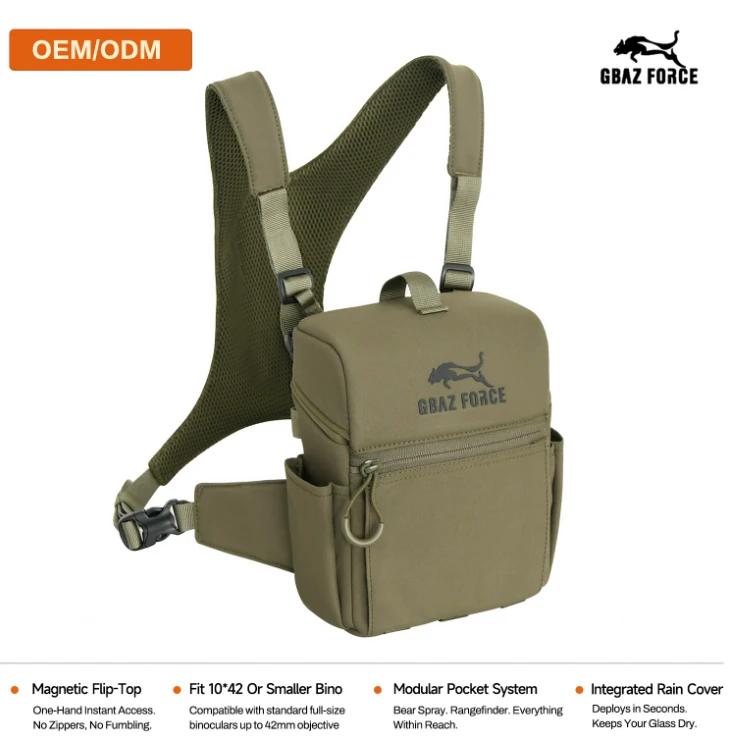
The body is the platform - magnetic lid up front, satellite pockets below and to the side
Technical Part 3: Field Scenarios & B2B Selection
Three scenarios, three main-box setups
The same body architecture reads differently across three common hunting modes:
1. Bow hunt - silent movement. The bow is the dominant action; the chest platform must not swing against the string or the shoulder. Here the box carries binoculars (to read the stalk line), the bottom pouch carries the critical small item, and the side pouch is kept light. The magnetic lid matters most here: the archer cannot stop to fumble a pull tab. The close-to-body box profile is what keeps the platform out of the draw arc.
2. Rifle hunt - movement / ambush. The rifle is shouldered for long stretches; the chest load must not push the shoulder line. The H-style harness behind the backpack straps (Part 1) is the key here: the box sits flat against the sternum and does not wedge between the shoulder and the rifle butt. The main box runs full (binoculars plus a spare optic in the zippered front pocket), and the side pouch carries the rangefinder for range calls on the stalk.
3. Observation-focused / scouting hunts. Binoculars are the primary instrument and are used continuously. The magnetic flip-top is the defining feature: repeated, one-hand, eyes-forward access all day. The integrated rain cover becomes a daily-use feature rather than an emergency, and the bottom and side pouches carry the rotating small load.
A note on magnetic parts in cold and with gloves: closure feel is reduced under thick gloves and in low temperature, and the tactile "click" is less certain than bare-handed. Field reality is that hunters learn to confirm closure with a light tug, and that a pre-season and mid-season check of the magnetic hardware is part of the routine. This is normal, expected behavior of a magnetic speed closure - not a defect - and it is precisely why the zippered secure layer exists in parallel.
Rain cover, cleaning and care
Rain cover: deploy and stow in seconds; check the seam and the box opening edge before a wet season so the cover sits flush on the box.
Mud and dust: the 500D nylon body wipes clean; the magnetic lid edge and the zippered front pocket are the two places grit accumulates - wipe the lid edge and clear the zipper before sealing it.
Binocular compartment: the interior lining is where condensation and grit land after a cold morning; dry the lining and air the compartment before sealing for the day.
Magnetic closure check: confirm closure force and hardware condition at the start and end of the season.
End-of-season storage: store with the lid open and the compartment ventilated; do not leave the magnetic lid pressed shut on the lining for extended storage.
B2B selection guide
Customer segments. The front-load body platform serves:
Hunting optics brands that want a co-branded, optic-dedicated carry system (the box as a branded optics platform).
Outdoor optics retailers that need a front-load SKU to pair with their binoculars range.
Hunting-goods chains that need a chest pack that fits a broader gear system (backpack + belt).
Bow and rifle clubs that buy for members and range programs.
OEM/ODM customization points (where the body architecture opens up):
Main-compartment size and inner/outer space - the 19 × 16 × 8 cm outer / 14 × 16 × 8 cm inner pair is a starting point; the first parameter to move for larger optics (see Part 2).
Closure method - magnetic lid, zipper, or hybrid (magnetic fast layer + zippered secure layer, as the reference platform uses).
Satellite-pouch combination and layout - which pouches (bottom, side, front), where, and in what arrangement.
Color and camouflage - olive as the reference; camouflage patterns available.
Harness form - H-style mesh (reference), single-shoulder, or belt-attachment interface.
Rain cover configuration - integrated or separate; coverage area.
Logo and branding - custom logo, size, and color are supported.
MOQ: from 300 pcs per color - low enough for a regional brand or a single retailer to test the platform before committing to a full color range.
Factory capability. GAF OUTDOOR operates on a Design Supported / Production Guaranteed basis: design drawings can be produced, new styles are released monthly, and logo, size, and color customization is standard. With 10+ years of experience and a record of serving 80+ brands, the front-load body platform is offered as a stable, spec-able product line rather than a one-off build.
Conclusion
The chest pack body is the front-load platform, and the platform is defined by four decisions made before any pouch is attached: a box-shaped main compartment for a predictable place, a magnetic flip-top for one-hand, eyes-forward access, a satellite hierarchy for critical items at a known radius, and an H-style harness that lets the system coexist with the rest of the loadout. The GAF OUTDOOR 905-043 bino harness bag is a clean reading of that architecture - 0.39 kg, 500D nylon, magnetic lid, YKK zippered front pocket, bottom and side satellite pouches, integrated rain cover, H-style mesh harness, 10×42 fit envelope. For B2B buyers the value of the platform is that each of those four decisions is customizable within a stable, production-guaranteed line, at an MOQ of 300 pcs per color.
FAQ
Q1: What binocular size does it fit?
The reference platform is specified to fit 10×42 or smaller - standard full-size binoculars up to a 42 mm objective. 8×42 and 10×40 fit with room; larger objectives (12×50, etc.) exceed the box. When customizing, the main-compartment inner dimension is the parameter to move, and load items should always be checked against the inner (14 × 16 × 8 cm) rather than the outer (19 × 16 × 8 cm) dimension.
Q2: Is the magnetic lid reliable in rain?
The magnetic lid is an access mechanism, not a weatherproof seal - rain is handled by the integrated rain cover, which deploys in seconds and shields the box and its contents. Specify the two together. Magnetic closure feel is reduced under gloves and in cold, so confirm closure with a light tug and include the magnetic hardware in the pre-season check.
Q3: Can it be worn over a backpack chest strap?
Yes - that is the intended layering. The H-style harness passes across the back like a backpack strap, so the box sits in front of the sternum, ahead of the shoulder loads, without colliding with the pack straps. The side waist-strap attachment point allows an optional second tie to a belt rig to reduce vertical bounce.
Q4: Can main-compartment size, color, and harness be customized?
Yes. GAF OUTDOOR supports OEM/ODM on: main-compartment size and inner/outer space, closure method (magnetic / zipper / hybrid), satellite-pouch combination and layout, color and camouflage, harness form (H-style / single-shoulder / belt interface), rain cover configuration, and logo. MOQ is 300 pcs per color, and design drawings can be produced before production.
Q5: What does the 0.39 kg self-weight mean for all-day wear?
At the chest, self-weight amplifies fatigue more than at the back or hip because the load sits ahead of the center of gravity and swings with the torso. 0.39 kg is a sub-400 g threshold that keeps the platform out of the way until actively used. The 500D nylon box and the single H-style mesh harness are the stiffness-to-weight choices that make this possible.
GAF OUTDOOR · Design Supported / Production Guaranteed · OEM / ODM ready: custom logo, size, color. MOQ 300 pcs per color.


