

Introduction
Length is the specification gun case buyers get wrong most often.
Order a case two or three inches too long and the rifle flops around inside, slamming against the far wall every time the strap shifts. Order it too short and the muzzle or the buttplate will not seat, and you are back at the returns window. The real trap, though, is subtler than either of those: the length a seller prints on the spec sheet, the length you measure across your own rifle, and the length of usable space inside the case are frequently three different numbers - and only one of them actually decides whether your gun will fit.
Most soft case listings lead with a single number. That single number is almost never the one you should be shopping by.
This article breaks down the engineering logic behind matching a case length to a rifle. We use the GAF OUTDOOR GC series of soft gun cases as our working sample, and we anchor the discussion on the GC-17, whose published exterior and interior dimensions let us show exactly where the "missing" length goes and how to design a selection process that avoids it.
The takeaway up front: buy to the interior length, not the exterior length, and always leave a deliberate margin. Everything below is the reasoning behind that rule.
Technical Part 1: Three Numbers, Not One
Exterior length, interior length, and overall gun length
Every gun case has at least two length numbers, and your rifle adds a third:
Exterior length - the outside dimension of the closed case, measured tip to tip. This is the number that appears on a box, on a retail tag, and in most quick spec tables. It describes the case, not the space your gun lives in.
Interior usable length - the distance from the inside muzzle wall to the inside butt wall. This is the only number that must clear your rifle's overall length.
Overall gun length - the axial length of your specific rifle as configured, measured from the muzzle to the buttplate.
On the GC-17 the relationship is spelled out directly: the exterior length is 48" (122cm) while the interior length is 47.2" (120cm). That 0.8" (about 2cm) gap is not a rounding error. It is the physical cost of the zipper channel, the seam and piping at each end, and the tapered muzzle section that closes down around the barrel. A seller who lists only the exterior number has handed you a figure that is, by design, larger than the space available. You must compare your rifle's overall length against the interior dimension, not the exterior one.
A word on consistency: within a single product family you may occasionally see the same model number quoted with slightly different figures across materials - for instance, a lineup sheet may print the GC-17 at 50.4" while its own spec table lists a 48" exterior and a 47.2" interior. Treat any single printed number as an approximation until you have the model's own exterior/interior pair. When you are sourcing, always ask for the interior dimensions by model and verify them against a physical sample. The interior number is the contract; the others are marketing.
Measuring overall gun length correctly
The baseline measurement runs along the gun's axis, from the muzzle face to the rearmost point of the buttplate. Lay the gun on a flat, straight surface and measure the longest axial path, not a diagonal.
From that baseline, add for everything that extends the working envelope:
A muzzle brake, choke tube, or suppressor adds its protruding length to the front.
An adjustable butt or a longer stock pad extends the rear.
A raised or extended cheek piece can push the top of the stock up and back, affecting both perceived length and required interior height.
A mounted optic or iron sight set does not add axial length, but it raises the profile and can dictate interior height and the width of the body section (covered in Part 2).
Write the configured overall length down before you shop. A rifle measured bare is a different gun than the same rifle with a suppressor and a scope on it.
How much margin to leave, and why
"Exactly fits" is a bad design. Margin is not waste; it is the space that lets the case do its job.
The right margin depends on how the gun actually enters and leaves the case. If a clean axial drop-in works, a modest margin is enough. If the muzzle tapers and the stock flares, the gun may need to be inserted on a slight diagonal to seat, and the margin has to absorb that geometry. Cold-weather use adds more: thick gloves make a tight draw harder, and a case that only closes when the gun is jammed in the right orientation will frustrate you in the field every single time.
Two more factors push the margin up. First, mud, sleet, and a wet barrel: a gun that is wiped but not bone-dry, or a case that has collected moisture, needs a little breathing room to dry out without forcing a swollen seam. Second, optics height: a taller scope demands more interior height, and that is often paired with a need for a little length slack so the lens or a scope cap can clear the closure.
The engineering reason "exact fit" fails is simple wear. The muzzle end and the buttplate end are the two points that strike the zipper track and the end piping every single time the gun is loaded and unloaded. A zero-margin case concentrates all of that impact on exactly the parts of the case that are thinnest and most likely to split. The zipper ends and the end piping are where soft cases die first, and a tight fit accelerates it. Leave the margin.
Technical Part 2: Case Construction, Profile, and Protection
The tapered profile
The GC-17 carries a muzzle-end taper: the case narrows around the barrel toward the front while the body section stays wide enough for the stock and the scope. The taper serves two purposes. It matches the downward-sloping silhouette of a scoped rifle, so the case does not carry a useless cube of empty air at the muzzle, and it reduces the overall volume and the side-to-side swing of the load on your shoulder.
The taper is not universal, though. A heavy tactical rifle, or a rifle run with a high scope mount and a long action, can exceed the body width of a tapered case even when the lengths match. Not every rifle wants a tapered profile - the right shape depends on the gun's widest cross-section and where it sits.
Fabric: 600D oxford polyester and a 0.54kg total weight
The GC-17 main fabric is 600D oxford polyester. That is a deliberate middle position in the soft case market. It is abrasion-resistant enough for daily field use - dragging over a truck bed, brushing against reed beds, stowing in a vehicle rack - while staying light. The GC-17's published total weight is 0.54kg. That number matters: a case this light does not punish your shoulder on the walk to the stand, and it keeps the carried load honest when you add a loaded gun, optics, and gear.
Heavier, tactical-grade cases use denser fabrics and more padding. They protect well but add mass. The 600D / 0.54kg build is the trade-off for hunters and club shooters who value carry weight and price over maximum impact protection. There is no "best" - there is only the right weight for the job.
Padding and the black interior lining
Inside, the GC-17 uses a black lining with a padded divider. The padding absorbs the everyday impacts that a hard shell would take - the drop, the bump, the lean against a fence. The black lining has three quiet functions: it gives high visual contrast, so you can see a dirty chamber, a smudge on a lens, or a drop of solvent at a glance; it avoids dye transfer onto a light stock or a bright optic; and it reads as neutral in product photos, which retailers appreciate.
Carrying logic: handle, adjustable shoulder strap, and side pocket
The GC-17 is built to be carried three ways. The top handle is for short transfers - from the rack to the truck. The adjustable shoulder strap is the primary field carry, and the adjustability is what lets the same case fit a shorter shooter and a taller one without a custom strap. Stacking a gun case against a daypack or a load carrier is common in the field, and a flat, stable case profile makes that cleaner.
The side flip pocket is for the small, always-needed items: a cleaning patch, a spare cap, a pair of gloves, a phone, or a magazine pouch. Putting the small stuff on the outside keeps it from rattling against the gun and keeps the main compartment dedicated to the firearm.
Why the zipper and piping fail first
The zipper track and the end piping are the highest-stress points in a soft case. The zipper takes the full opening force every cycle, and the piping takes the concussive impact of the muzzle and butt at every load and unload. Protect them: keep the track free of grit before it works into the teeth, do not force a jammed zipper (work it with light tension and a little wax), and avoid overloading the case so the ends are not forced past their geometry. A case whose zipper and ends are well cared for outlives one that is not, by a wide margin.
Waterfowl cases: GC-20 / GC-39 / GC-10
The GC family splits the waterfowl segment onto its own line - the WATERFOWL GUN CASE - with the GC-20 at 53.1", the GC-39 at 50.4", and the GC-10 at 52.4". The differences from the standard line are real, not cosmetic. Waterfowl cases run in camo or olive-green colorways that break up the silhouette in reed beds, and they are specified for a wetter environment. The reality of a waterfowl setup is that a gun leaves the case soaked: condensation, rain, and splash from the blind all arrive together. The color scheme, the fabric choice, and the case geometry are tuned for a gun that is routinely wet on arrival, which is a different use case than a dry varmint rifle coming off a truck bed. That is why a waterfowl buyer should not simply grab the nearest standard case - the segment earns its own length and color range.
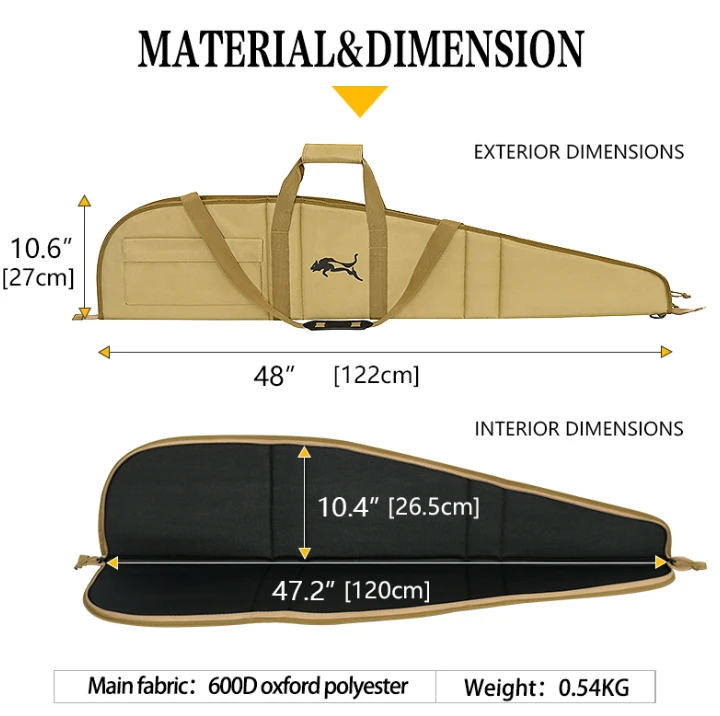
Exterior 48 in, interior 47.2 in - the gap between the two numbers is where buying mistakes happen
Technical Part 3: A Size Selection Workflow and B2B Selection
A five-step selection workflow
Here is the process to run for any rifle-to-case match:
Measure the configured overall gun length - muzzle face to buttplate, with suppressor, stock pad, and any extending feature included.
Add your margin - for the carry method and the climate you described, arrive at a required interior length.
Select the model whose interior length exceeds that value - within the series, pick the next size up, not the one that merely equals it.
Check the interior height - confirm the case's interior height clears the scope and the magazine; a length match with a height mismatch is still a no-fit.
Confirm the carrying method - decide hand-carry, shoulder, or stacked, and make sure the strap and handle configuration fits how the gun actually travels.
Run those five steps and the fit problem largely disappears, because you have separated the numbers that matter from the ones that do not.
How a series covers long and short guns with few models
The GC family spans an interior reference range from 44.5" to 53.1" across its models. That single band is enough to cover most short-action rifles at the low end, full-length hunting rifles and shotgun-class lengths in the middle, and the longest waterfowl setups at the top. A buyer does not need a different case design for every gun; a family of a handful of lengths, each with a clear interior dimension, covers the whole shelf. The point of a series is that you stock a small number of lengths and let the interior numbers do the matching.
The B2B value of one series across many lengths
For a distributor, a retailer, or a private-label brand, a single case family that spans many lengths is a stock-management asset. Fewer distinct designs mean fewer tooling changes, cleaner variant management on one platform, and a shelf that reads as a coherent line rather than a pile of unrelated SKUs. You can cover a wide customer base - short varmint rifles, full hunting rifles, waterfowl guns - from one platform while keeping each SKU's interior length honest and published. That is what makes a family like the GC series easier to plan, easier to display, and easier to restock than a catalog of one-off cases.
Why waterfowl and marsh segments need their own lengths and colors
The waterfowl buyer is a different customer, and the case has to say so. Camo and olive colorways, the wet-environment specification, and a length set that fits the longer waterfowl guns give that segment a dedicated range. Folding waterfowl into the standard line would under-serve both sides: the standard customer pays for a camo they never wanted, and the waterfowl customer does not get the lengths or the colors their setup needs. A separate length-and-color block is cleaner for the buyer and cleaner for the seller.
Maintenance and cleaning
After a muddy or salt-water day, the sequence matters. Shake and wipe the case outside first, then work the interior. Rinse or wipe the lining to remove grit and salt, and let the case dry open, not zipped, so moisture does not trap inside. Keep the zipper track clean and dry before you close it, and give a stiff zipper a little wax before it becomes a stuck one. Store the case unzipped or loosely closed in a dry place, and both the lining and the fabric will last far longer.
OEM / ODM selection guidance
For brands sourcing a gun case line, the decision is which segment to build and how to differentiate within it.
Typical buyers: firearm retailers building their own accessory range, hunting-supply channels looking for a coherent case family, private-label brands wanting a named line, and dog-hunting clubs or team buyers standardizing on one case.
The levers you can customize on a platform like the GC series:
Length specifications and the color range within the family
Camo and color schemes for a given segment
Outer pocket layout - number, position, and size of the side and rear pockets
Handle and shoulder-strap configuration
Interior lining material and divider/padding layout
Logo application method and placement
The GAF OUTDOOR factory stance is Design Supported / Production Guaranteed: the team can supply design drawings, brings new models to the line every month, supports custom logo, size, and color, and carries 10+ years of experience having served 80+ brands. For a buyer, that combination means you can take a published, tested case family and make it your own without carrying the risk of an unproven design.
Conclusion
A gun case length is not one number. It is the exterior length a seller prints, the interior length your gun must clear, and the configured overall length of your specific rifle. Match the interior number to the gun, leave a deliberate margin for carry, climate, and wear, and the fit problem stops existing.
For a B2B buyer, the same logic scales up: a single case family that spans a clear range of interior lengths - like the GC series from 44.5" to 53.1" - lets you cover long and short guns, standard and high-optic builds, and a dedicated waterfowl segment, all on one platform you can customize in size, color, and layout. Buy to the interior dimension, protect the zipper and the ends, and the case will outlast the rifle it carries.
FAQ
How do I know which length to buy?
Measure your rifle's configured overall length from muzzle to buttplate, add your margin, and buy the smallest case whose interior length exceeds that total. Never buy to the exterior number.
Does mounting an optic change the length I need?
Not the axial length, but it raises the profile. Check the case's interior height and the width of the body section; a tall scope can make a "length-matched" case a no-fit if the height or the width is wrong.
Can a waterfowl gun case and a standard gun case be used interchangeably?
They can physically fit the same gun if the interior dimensions match, but they are tuned for different environments. A waterfowl case runs wetter, in camo or olive colorways, and in the lengths waterfowl guns need. For the segment, use the waterfowl line; for a dry varmint or target rifle, use the standard line.
Why do the dimensions on different sheets sometimes differ for the same model?
A lineup sheet gives a reference figure; the model's own spec table gives the exterior/interior pair. Always work from the model's interior dimension, and confirm it on a sample before committing to a volume order.
What should I check before a volume OEM order?
Confirm the interior length and height by model, the color and camo options, the pocket layout, the strap and handle configuration, and the logo method. Ask for design drawings and a sample so the published numbers match the physical case.


