

Most "equipment packs" fail in the field for the same quiet reason: the fabric and the sealing architecture were never actually built for the conditions they end up in. Muddied shells, bilge water soaking through the back panel, a full day of rain, and repeated scuffs against hull metal and rock edges quietly work their way into the pack until it stops holding water out or holding its shape in. Capacity is rarely the problem. The failure is structural and material, and it shows up in returns, in complaints, and in a brand's reputation long before the stitch count ever gets checked.
In this article we take a specific, production-grade sample - the GAF OUTDOOR FI2307 waterproof equipment backpack, a 20L pack built around 1680D polyester that weighs 1.34kg - and break down what "hard use" actually demands from a pack's material, sealing, and carry system. The goal is not a product pitch. It is a selection framework that B2B buyers can apply when they are comparing gear packs for resale, private label, or professional use.
Technical Part 1: What "Hard Use" Actually Demands
Before touching the sample, it helps to define the three real stress sources a hard-use pack must survive. They are not abstract; they are the exact failure modes that generate field returns.
Abrasion. A pack dragged across a rocky shoreline, slid along the gunwale of a boat, or pressed against the edges of metal tools and camera gear takes continuous friction. Abrasion resistance is determined primarily by the yarn weight (the "D" or denier) and the weave density of the shell fabric. Thicker yarns and tighter weaves simply have more material to wear away before a hole appears. This is a direct, physical property - not a surface coating that can fail independently of the base fabric.
Water. Rain, splash, and standing bilge water test the sealing structure and, most critically, the zipper rating. A shell fabric can be coated or laminated and still pass water straight out through an unsealed zipper track. In a hard-use pack the zipper is the weakest link, so the zipper's protection level (the IPX rating) is often more decisive than the shell's.
Deformation. A pack that repeatedly carries hard, rigid items - tripods, rod cases, tool boxes - under compression and stacking must hold its shape. A soft, low-denier shell will collapse, fold, and develop permanent creases that then become abrasion and seam-stress points. A rigid, high-denier fabric resists that collapse and keeps the load distributed evenly across the body.
Now, the material choice. The FI2307 is built in 1680D polyester, and the number matters. Denier (D) is the unit of yarn thickness - higher denier means a thicker yarn. Compared with the 500D/600D fabrics that dominate the mid-range outdoor market, 1680D gives the shell a substantially thicker yarn and therefore a higher abrasion and tear-resistance floor. The cost is real: self-weight, and a stiffer, less supple hand feel. That is the trade, and it is an intentional one.
There is also a material-family point that buyers often miss. Polyester absorbs less water than nylon and stays more dimensionally stable when wet. A nylon pack that soaks up water gains weight, sags, and can change its shape while saturated; a polyester shell holds its geometry better and sheds that water load more cleanly. For a pack that will regularly meet standing water, that is a quiet but important advantage.
Put the two facts together and the 1.34kg self-weight of this 20L pack is a deliberate, legible decision: it trades self-weight for durability. For a B2B buyer, that is the key line item. A 1.34kg hard-use pack is priced and selected against the tolerance threshold of its target customer - a professional angler or a rescue technician will accept 1.34kg for a pack that survives the job; a casual day-hiker will not. The buyer's job is to match the denier, the weight, and the sealing spec to the customer's actual tolerance, not to a generic "outdoor" category.
Technical Part 2: Sealing Architecture and Carry Systems
The sample's most instructive feature is its sealing logic, which is worth reading as an engineering decision rather than a spec list.
The clamshell main compartment. The FI2307 opens on a zip-around, clamshell main compartment. The advantage is access: the whole opening unfolds flat, the gear lies out in a single plane, and you can see and reach everything without digging through a top-loading tube. For a pack organized by equipment rather than by clothing, that full flat access is a genuine operational benefit. The cost is equally clear: the clamshell has the longest seal perimeter on the pack, and therefore the hardest seal to make. A top-loader seals a small circle; a clamshell seals the entire outline of the shell. Every millimeter of that perimeter is a potential leak path, which is exactly why the main compartment is paired with the highest-protection zipper in the pack.
IPX7 main zipper, IPX4 secondary zipper. The front panel carries an IPX7 waterproof zipper on the main compartment and an IPX4 water-resistant zipper on the secondary opening. The two ratings are not interchangeable, and it is worth stating the boundary precisely. Under the common understanding of IEC 60529, IPX4 protects against water splashed from any direction without harmful effect, while IPX7 is the level that covers short-duration immersion. So the main compartment can take a full dunk, and the secondary pocket is built to take a spray of rain.
Equally important is what IPX7 is not: IPX7 does not equal long-term submersion, diving, or pressurized deep use. It is a rating for brief immersion, not for a pack to live underwater. A buyer marketing the pack should keep that boundary in the copy.
Why use two ratings at all instead of making everything IPX7? Because it is a rational allocation of cost and weight. The main compartment is where the critical, must-stay-dry equipment lives, so it carries the higher-protection, short-immersion-capable IPX7 zipper. The secondary compartment only needs to survive rain, so a lighter IPX4 zipper is sufficient. Spending IPX7 everywhere would add weight and cost to a pocket that never meets immersion. Two tiers, matched to two different risk levels, is the correct design.
The air valve. A clamshell waterproof compartment has a subtle problem: once zipped shut, the air pressure inside changes with temperature and altitude. As the pack warms in the sun or climbs in elevation, the trapped air expands and pushes against the seal; as it cools, it contracts and pulls. Left unmanaged, that sustained pressure differential works against the seal strip and makes the zipper harder to close cleanly. The air valve acts as a pressure-equalization valve - a standard engineering device that lets the internal pressure balance with the outside, so the seal is not fighting a constant differential and the compartment can be opened and closed without a pressure fight. The sample does not publish specific valve parameters, so it is described here by its general function, not by a number it does not carry.
The removable fishing rod holder. The front panel includes a removable fishing rod holder, and its value is modular. For the angler customer segment it is a first-class feature - a dedicated, fixed place for a rod keeps it off the gear and out of the way. For everyone else, removing it returns the pack to a general-purpose equipment pack with no dead hardware hanging on the front. That is the point of a removable module: one pack body serves two configurations, which is exactly the flexibility a B2B buyer wants when the same SKU has to cover both an angler line and a general gear line.
The carry system. A 20L class of load needs more than shoulder straps. The sample pairs a thick, breathable back panel (herringbone-quilted) with padded shoulder straps that carry a D ring and adjustment buckles, a chest strap, and a buckle waist belt. The logic is load distribution: the breathable, padded back panel keeps the load off the spine and lets air move in a hot, wet environment; the chest strap stabilizes the shoulders and stops the straps from sliding; the waist belt with buckle transfers a share of the load down to the hips, which is where the body is actually built to carry weight. For a 1.34kg pack that regularly carries a heavy load of hard gear, the waist belt is what makes the carry feel manageable at the end of a long haul.
D rings and the side system. The D ring on the front panel is an external attachment point for carabiners, straps, or additional gear - a low-cost, high-value expansion feature. On the sides, a side zip and a side mesh pocket serve two jobs: quick access without opening the main clamshell, and - for the mesh side pocket in particular - drainage. Water that enters a mesh pocket drains back out rather than pooling, which is why a mesh pocket is the right choice for a wet environment, while a sealed pocket is the right choice for the gear that must stay dry. The spacious inside keeps that zoning flexible enough to hold a full equipment load.
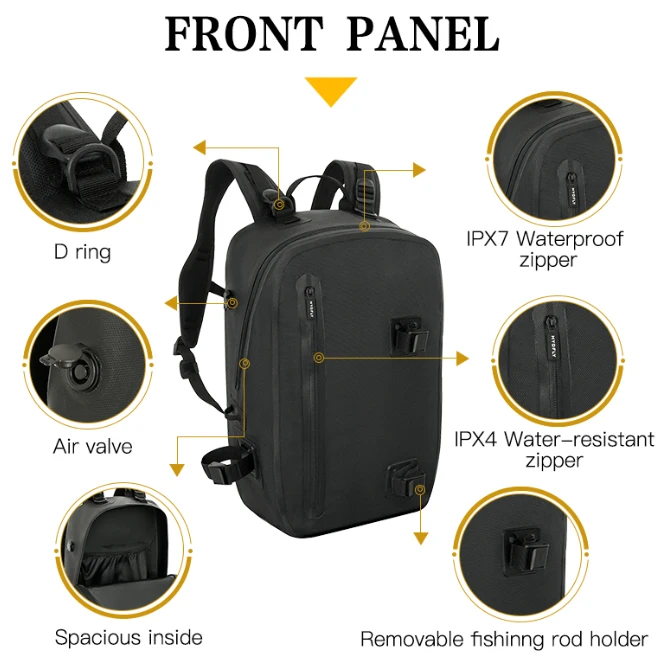
The sealing hierarchy on the front panel - IPX7 on the main clamshell, IPX4 on the secondary zip
Technical Part 3: Scenarios and B2B Selection
The right way to sell a hard-use pack is by scenario, because each scenario changes the loading and sealing strategy.
Boat fishing and kayak wading
The pack meets splashes, rain, and the occasional full dunk over the side. Here the IPX7 main compartment is the life-saver: electronics, tools, and spare clothing go behind the short-immersion zipper, and the air valve keeps the seal manageable after the pack has been in the water. The rod holder stays on. Load the heavy items low and close to the back.
Long-distance carrying in the rain
The test is a sustained, wet, moving load. The breathable herringbone back panel and the waist belt decide whether the carry is comfortable or a punishment. Everything that can get wet goes behind the IPX7 seal; the IPX4 secondary pocket takes the smaller, less critical items that only need rain protection.
Muddy mountain photography and gear transport
This is the abrasion and deformation scenario - rock, mud, and hard camera and tripod cases stacked under load. The 1680D shell's thickness and stiffness are doing the work here, keeping the pack from collapsing and the gear from banging around. Organize by equipment: each hard item gets its own zone, the center of gravity stays low and close to the body, and anything that will be wet is isolated from the dry electronics.
Vehicle and camp transfer
The pack shuttles between a vehicle, a base camp, and a worksite. The top handle, the D rings, and the full clamshell opening matter more here than the fine sealing - the pack is used as a rigid, shape-holding container that you can open completely, dump, and reload quickly.
A recurring principle across all four: a gear pack is packed by equipment, not by clothing. Clothing can be stuffed, compressed, and mixed. Equipment cannot. Hard items need their own zones, the center of gravity needs to be managed, and anything that will be wet has to be isolated from anything that must stay dry. A clamshell shell makes that equipment-first organization physically possible, because the whole load is visible and reachable in one flat plane.
Usage and maintenance. The sample's durability is real, but it is not maintenance-free. After saltwater exposure, rinse with fresh water - salt crystals are both an abrasive and a corrosion driver. Keep the zippers clean, and do not use the wrong lubricant on a sealed, IP-rated zipper track; heavy greasing traps grit, so keep zipper care light and manufacturer-appropriate. Check the seal strip regularly for debris and for the wear that opens the small gap through which water gets in. Choose a fabric cleaner that is safe for coated or laminated polyester rather than a solvent that can strip the coating. And for long-term storage, do not leave the pack fully zipped and compressed for weeks - store it with the seam and the seal relieved so the gasket and the fabric settle without a permanent stress.
B2B selection and OEM/ODM. The customer base for a 1680D, 20L, IPX7-sealed equipment pack is specific: fishing and marine-adjacent retailers, outdoor gear channels, brand licensees and private label brands, and rescue and inspection operations. The value of a B2B relationship here is that the pack is a platform, not a fixed product. The FI2307 shows which elements are configurable: fabric spec (1680D or a lighter-denier alternative for a lower-weight tier), colorways, the zipper rating combination (keep the IPX7/IPX4 split or move the whole pack to a single tier), whether to retain the air valve and the rod holder, the internal dividers and strap layout, and the logo process. GAF OUTDOOR backs this with 10+ years of experience, service to 80+ brands, the ability to turn out design drawings, and new models released every month, along with logo, size, and color customization. That combination - a proven, spec-verified pack plus a fast, design-capable production partner - is what makes the 20L hard-use pack a bankable line item rather than a single SKU.
Conclusion
A 20L equipment pack built in 1680D polyester is a specific, defensible engineering decision. The high-denier polyester buys abrasion and tear resistance plus wet-state dimensional stability; the IPX7 main zipper and IPX4 secondary zipper allocate sealing cost to the two real risk levels; the air valve, removable rod holder, D rings, and side zip complete a modular, equipment-first platform; and the 1.34kg self-weight is the honest price of that durability, to be priced against the tolerance of the target customer. For a B2B buyer, the FI2307 is less a product to resell than a proof of a design language that can be adapted - across denier, color, zipper tier, and modules - to a fishing line, a general gear line, or a professional operation. That adaptability, backed by a partner with 10+ years of experience and 80+ served brands, is the real reason this class of pack earns its place in a catalog.
Frequently Asked Questions
Can the IPX7 zipper compartment be soaked in water?
Yes, but only briefly. Under IEC 60529, IPX7 covers short-duration immersion - a dunk, or a submersion during a kayak rollover, is fine. It is not a rating for continuous submersion, diving, or pressurized deep use. Rinse the pack with fresh water afterward, especially after saltwater.
Is 1680D polyester going to be too heavy?
It is heavier than 500D/600D, and the 1.34kg self-weight reflects that. But the denier is buying real abrasion and tear resistance plus shape retention under hard loads. Whether it is "too heavy" depends entirely on the customer: a professional angler or a rescue user accepts it, while a casual user may prefer a lighter-denier tier. The B2B answer is to offer both and let the channel choose.
Can the fishing rod holder be removed?
Yes. The front-panel rod holder is removable, so the same pack body works as a dedicated angler pack or, with the holder off, as a general-purpose equipment pack. That modularity is one of the reasons it works across multiple customer segments.
Why does the pack use two different zipper ratings?
The main clamshell compartment carries IPX7 (short-immersion capable) because that is where the must-stay-dry equipment lives; the secondary opening carries IPX4 (splash and rain protection) because it only needs to survive rain. Matching the zipper rating to the real risk level is a deliberate, cost- and weight-sensible design choice.
Can GAF OUTDOOR customize the pack for our brand?
Yes. Customization covers fabric spec (1680D or lighter), colorways, the zipper rating combination, retention or removal of the air valve and rod holder, internal dividers and straps, and the logo process - with the partner's 10+ years of experience, 80+ served brands, design-drawing capability, and new models every month behind the program.


