

Introduction
A composite bow spends most of its working life moving. It sits in a pickup bed while you drive to a stand, leans against the tree line, rides in the cargo hold of a plane, and gets shouldered up a trail in the dark. In every one of those moments the bow is exposed - and the parts that fail first are rarely the ones people think of. The riser is the strongest, most forgiving part of the bow. The weak points in transit are the limb tips, the cams, and the string path: small, geometric, load-carrying features that happen to sit exactly where a truck tailgate, a root, or a pack strap can reach them.
This article breaks down the protection engineering behind a specific product category: the bow sleeve (the bow case bag). What does it protect? How does sleeve structure translate into real protection? And in which situations does a sleeve make more sense than a hard case? We walk through the failure modes of a moving bow, then examine sleeve architecture in detail - limb-first end caps, position restraint, quick-release hardware, and padded single-shoulder carry - before finishing with a B2B selection guide for brands and retailers.
Technical Part 1: The Failure Modes of a Bow in Transit
Impact: where the force lands
Impact in transit is different from impact on the range. A dropped bow or a hard-case slam is a single, high-magnitude event. Transit impact is low-magnitude, repetitive, and often unnoticed: the bow shifting against a truck-bed lip, a limb tip catching a tree root as you shoulder the bow, a cam striking the tailgate when the vehicle hits a bump. None of these will break the bow on the first occurrence. They accumulate. A scratched or cracked limb tip changes limb tune; a dented cam edge changes timing; and repeated micro-impacts loosen components that were torqued to spec in the shop. The common thread is that the force lands on a small, protruding feature rather than on a large, forgiving surface.
Abrasion and entanglement
String, cable, arrow rest, and sight are the most entanglement-prone parts of the bow. In transit they are free to move, and anything that can rotate, swing, or slide can catch: a loose sight arm, a cable loop, a rest that was not stowed. Friction from fabric, straps, and other gear also slowly wears the string and cable. A string that runs across a rough seam, or a cable that chafes against a metal edge, develops nicks that shorten service life. Entanglement is the most avoidable category of damage and also the most common - which is exactly why a sleeve that holds the bow in a fixed, restrained position matters.
Environmental exposure
Rain, snow, mud, dust, UV, and temperature cycling all act on the bow during movement, not only during a shot. Water and mud find their way into the string, the cam bearings, and any moving joint; salt and grit accelerate wear; UV degrades exposed plastics and finishes over months; and temperature cycling moves the limbs through thousands of tiny expansion and contraction cycles. A sleeve cannot seal the bow completely from the environment, but a closed, wrapped sleeve dramatically slows it down - keeping the bow in a consistent microclimate and keeping grit off the string path.
Why the tips fail before the riser
The bow acts as a lever. In any transit position, the riser is usually the supported central mass - the point that rests on the shoulder, in the bed, or against the strap. The limb tips sit at the far end of the longest moment arms. When the bow shifts or is struck, the displacement and the force are greatest at the far ends. Add the fact that the tips and the cam edges are small, thin areas, and the result is that a modest impact that would pass harmlessly through the riser gets concentrated onto a limb tip or a cam edge. This is the engineering reason the protection must be limb-first.
Why "quiet" matters in bowhunting
Bowhunting happens at close range and in the dark, where sound carries and attention is sharp. A piece of fabric rubbing against another piece, or a strap flapping, produces a rustle that - at the moment when silence is your only cover - can be read as an abnormal sound. In the field, noise is not just an inconvenience; it is a functional failure. A bow sleeve built from a low-friction brushed fabric is chosen specifically so that the bow moving inside the sleeve does not add that rustle. This is the whisper-silent, zero-rustle design intent: the sleeve should not become the loudest thing on your body.
Four requirements for a bow sleeve
These failure modes reduce to four design requirements that a well-built sleeve must meet:
Wrap the tips. End protection that cradles the limb tips and the cam edges.
Constrain displacement. Hold the bow in a fixed position so the tips do not travel and the string does not swing free.
Block the elements. Slow moisture, grit, and UV from reaching the string path and the moving joints.
Make no noise. Use a low-friction, quiet fabric so the sleeve does not betray your position.
Technical Part 2: Sleeve Architecture and Carrying Logic
Sleeve or hard case: a question of distance and handling
A full hard case is the maximum-protection option, but it carries real costs: weight, volume, and the fact that it must be carried as a rigid box. A sleeve is lighter, can be rolled or folded, and can be tucked into a backpack, a truck, or a car trunk when it is not in use. The right choice is a function of transport distance and handling:
Short, field-level movement (walking, shoulder-carrying, a short truck hop): a sleeve is enough, and often better, because it is fast to access and quiet to carry.
Long-haul, checked-baggage, or rough-logistics movement: a hard case is the correct tool, because it is built to be dropped, stacked, and handled by strangers.
A sleeve is not a lesser version of a case. It is a different instrument for a different job.
Limb-first protection
The defining engineering idea of this sleeve is that the protection leads with the limbs. Reinforced end caps cradle both limb tips, absorbing the trail impact at the tips rather than letting it travel into the limbs and the cams. Instead of a uniform shell that protects everything equally, the design concentrates strength exactly where Part 1 said the force lands. The end caps are the load-bearing protection elements; the sleeve body is the restraint and the barrier. The reference build pairs a camo body with olive-green end caps - the visual cue that the ends, not the middle, carry the protection.
Sizing: the 38-inch reference
The reference product is built at 38 inches, and that number is a fit reference, not a decorative one. The correct way to size a sleeve is against the bow's axle-to-axle length: the sleeve should be long enough to fully contain the bow from tip to tip, with the end caps seated over the limbs. A sleeve that is too long lets the bow slide inside - which defeats the position restraint and re-exposes the tips. A sleeve that is too short simply will not fit. For B2B programs, this is exactly why length and bow-type fit become a customization parameter rather than a fixed spec.
Position restraint
A sleeve is not just a bag; it is a restraint. By keeping the bow locked in one position, the sleeve limits the travel of the tips and keeps the string, cable, and sight from swinging free where they can catch on a strap or a buckle. The restraint is what converts a loose, moving bow into a stable, contained one - and it is the direct answer to the entanglement failure mode.
Quick release and the single-shoulder sling: the time trade-off
The quick-release buckle system is built around one idea: one clip, bow out, shot ready. The bow comes out in seconds, because in the field hesitation costs shots. The padded single-shoulder sling, with its quick-adjust buckle, keeps the bow secure on your body while your hands stay free for climbing, rigging a stand, or handling other gear.
There is an honest trade-off here, and it should be stated plainly. A system that opens in one clip is fast to access - which is also what makes it fast for anyone else to open if the sleeve is left unattended. For a hunter moving under their own control, the quick release is a feature. For a bow left in a vehicle or an unmonitored space, the decision about how "one-clip" fast the closure should be becomes a security choice as much as a convenience one. The right answer depends on the use context, and it is one a brand should make deliberately, not accidentally.
Brushed tricot: silence, feel, and care
The shell is brushed tricot - a soft, low-friction fabric chosen for two things: quiet and feel. It moves against itself and against the bow with minimal rustle, and the surface has a soft hand. In field use, water droplets bead on the surface and run off, which is useful in a drizzle; this should be described as what it is, a beading behavior, and not read as a formal waterproof rating. For care, the brushed surface should be treated gently: a dry brush or a light damp wipe for mud and dust, then air-dried rather than soaked or machine-washed. The soft hand is part of the reason the fabric was chosen, so the cleaning should preserve it.
Hardware: Duraflex buckles
The closure and adjustment hardware is specified as Duraflex buckles, positioned as the premium tier for this application: a strong, low-friction, weather-tolerant fastening that holds under load and still releases cleanly with one pull. In a B2B build, buckle brand and specification are a customization line item, because different brands carry different preferences and cost targets.
Wrap-and-roll: the carry footprint
Finally, the sleeve wraps and rolls down into a compact package. This is what makes it a "pack it out" item: when the bow is not in play, the sleeve rolls up small enough to tuck into a pack, a truck, or a trunk. Carry efficiency is the sleeve's core advantage over a hard case - it is protective when it is working and nearly invisible when it is not.
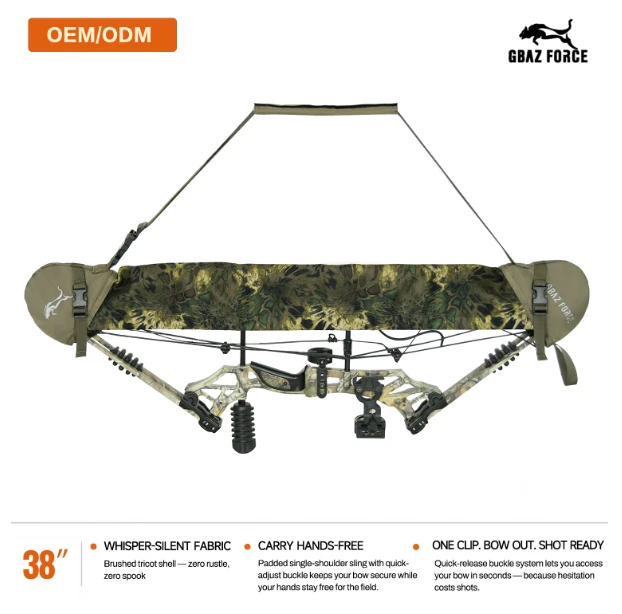
End caps take the hits, not the limb tips - and one clip puts the bow back in your hand
Technical Part 3: Transport Scenarios and B2B Selection
Four scenarios and the protection each one needs
1. Short trail walk. You shoulder the bow up a trail to a stand. What you need: tip protection, position restraint, silence, and fast access. A sleeve is the correct tool; a hard case is not required.
2. Truck bed or ATV. The bow rides in a bed or on an ATV rack. What you need: tip protection, restraint, and resistance to shift-on-bump. A sleeve is the baseline; for a rougher or longer ride, the step up is adding internal padding or moving to a case.
3. Long-haul flight or ground transport. Checked baggage, international moves, rough logistics. This is where the hard case is non-negotiable. A sleeve is not the primary protection here; at best it serves as a liner inside the case.
4. Camp storage and rainy-season use. Storing the bow at a base camp, or working in sustained rain. What you need: a moisture barrier, a place to dry off, and a storage shape that keeps the limbs neutral. A closed, wrapped sleeve helps; the discipline is in the drying and the storage position.
The combination strategy: sleeve plus case
The mature approach is not "sleeve or case" but "sleeve and case, each in its lane."
A hard case is required for checked baggage, international shipping, and any handling by third parties.
A sleeve is sufficient for daily field movement - the walk, the shoulder-carry, the short truck hop, and the stand.
Building a program around both lets the user carry the sleeve for most of the day and reach for the case only when the transport actually demands it.
Maintenance and inspection
A routine that keeps a bow transit-ready:
After mud, water, or salt: rinse or wipe the bow, dry the string and cable, and let it air-dry before it goes back into the sleeve.
Tricot care: dry brush or light damp wipe; air-dry; do not soak or machine-wash.
String and cable check: look for nicks, fraying, and flat spots before and after transport; a sleeve reduces but does not eliminate contact.
Buckles and seams: check for wear, cracking, and loose stitching, especially at the end-cap seams that take the impact load.
Long-term storage: keep the bow in its correct storage position (limbs neutral, per the bow manufacturer), and use the sleeve to hold that shape and keep grit off.
B2B selection guide
Who this program serves:
Bowhunting brands building a private-label transport line.
Archery equipment retailers adding a sleeve category to their shelf.
Hunting supply chains that need a consistent, brandable product across stores.
Clubs and competition channels that buy in volume for members.
What is customizable in an OEM/ODM build:
Length and bow-type fit - match the sleeve to the actual axle lengths in your market.
Color and camo - body and end-cap color schemes tuned to your brand.
End-cap reinforcement - the limb-first protection level.
Strap form - single-shoulder, dual-strap, or no strap.
Buckle brand and specification - for example Duraflex or an equivalent, sized to your cost and load targets.
Lining material - the barrier and the feel.
Logo process - print, patch, or hardware.
Factory backing. GAF OUTDOOR works on Design Supported / Production Guaranteed: we can put out design drawings, we bring new models to market every month, and we support logo, size, and color customization. With 10+ years of experience and served 80+ brands, the factory can take a sleeve program from a concept sketch to a production run.
Conclusion
A bow's fragility in transit is not random. It concentrates on the limb tips, the cams, and the string path, and it comes from impact, entanglement, and the elements. A well-designed sleeve answers all three: limb-first end caps absorb the impact at the tips, position restraint keeps the bow stable, a closed brushed-tricot body slows the environment, and the quiet fabric keeps the sleeve from betraying you. It is a different tool from a hard case, not a worse one - and the brands that give their users both, each in its proper lane, give them a transport system that matches the actual way a bow moves through a day in the field.
FAQ
Q1: Is a soft sleeve enough, or do I need a hard case?
It depends on the transport. For field movement - walking, shoulder-carrying, short truck hops - a sleeve is enough. For checked baggage, international shipping, or rough third-party handling, use a hard case. Many users carry the sleeve daily and reach for the case only when the transport demands it.
Q2: How does the 38-inch length map to my bow?
Size the sleeve to your bow's axle-to-axle length. 38 inches is the reference fit for this product; the sleeve must fully contain the bow tip to tip, with the end caps seated. Too long and the bow slides inside (defeating the restraint); too short and it will not fit. If your bow is a different length, that is exactly the customization point in a B2B build.
Q3: What happens if it rains?
The brushed tricot surface beades water - droplets form on the surface and run off - which is useful in a drizzle. Treat it as a beading behavior, not a formal waterproof rating. After sustained rain, dry the bow and the sleeve, inspect the string, and let everything air-dry before storage.
Q4: Is the quick release a security risk if I leave the bow unattended?
The quick release is designed for fast access - one clip and the bow is out. That same speed means an unattended sleeve can be opened quickly too. If you leave the bow in a vehicle or an unmonitored space, that is a context where you may want to reconsider how fast the closure should open. Under your own control, it is a feature.
Q5: How do I clean the brushed fabric?
Dry brush off loose mud and dust, or use a light damp wipe. Air-dry. Do not soak or machine-wash. The soft, low-friction hand of the fabric is part of why it was chosen, so gentle care preserves it.
GAF OUTDOOR - Design Supported / Production Guaranteed. 10+ years experience, served 80+ brands. New models every month, with logo, size, and color customization for OEM/ODM partners.


