

Introduction
When a brand owner starts building a waterproof product line, the first structural decision is not "what is the biggest bag in the catalog?" but "which format do I lead with?" For the backpack format, GAF OUTDOOR's answer is the 906-001: a 37L pack in dark camo, built on 840D nylon double TPU shell fabric, with an IPX7 airtight and watertight zipper running the full height of the main compartment.
The 906-001 is not the largest waterproof item we make, and it is not the smallest. It is the model that defines the shape of the line: a big waterproof main chamber carried on two shoulder straps and opened with a long vertical zipper instead of a roll-top closure. This article takes the specification in three parts - format, material and closure, front panel - and states exactly where each figure comes from, because for a B2B buyer, precise language is itself part of the product.
Technical Part 1: A Backpack Is a Format, Not a Size
Duffels, waist packs, and crossbody bags all carry waterproof volume. What none of them do is distribute that volume across two shoulders and a back panel. That is the fundamental difference of the backpack format, and it is why the 906-001 sits in its own line rather than alongside a duffel or a waist pack.
Where the load goes. A 50L or 100L waterproof duffel is carried by the hand or the arm: the force path runs from the handle to the hand to the shoulder, and the bottom panel takes the impact every time the bag is set down. A 4L waist pack puts the load on the hip; a 10L crossbody puts it on one shoulder. A 37L backpack puts that volume over two shoulder straps, with the back panel as the second contact surface. The load is split, the hands stay free, and the pack rides on the body's midline - which is exactly why the all-day hiking use case is a backpack use case.
Why the vertical long zipper matters. The main compartment of the 906-001 opens with a long vertical zipper that follows the height of the pack. This is the "roll-free" side of the product: the user opens a zipper, not a roll-top. Two design consequences follow.
First, the closure line becomes the load line. In an upright pack, the zipper runs along the central axis of the main chamber, and every time the pack is loaded, lifted, and set down, the shell fabric stretches slightly around that line. The spec sheet identifies the zipper - not just the fabric - as the IPX7 airtight and watertight component, and that is the component that sees the most repeated movement over the life of the product.
Second, the tension is different from a duffel's. A duffel's opening is horizontal and its load sits low and forward; a backpack's zipper is vertical, and its load is pulled down through the straps from behind. The same 37L of gear therefore presses the shell against the back and loads the zipper in a direction a duffel's closure never sees. The closure has to be engineered for that axis of force, which is another reason the zipper carries its own specification.
What a buyer should take away from this part. When you market the 906-001 against roll-top dry bags or duffels, the claim is about the format: two-shoulder carry, hands free, vertical zip access to the whole chamber. It is a different product to the end customer than any other waterproof format, and it is the reason a waterproof backpack line needs its own lead SKU.
Technical Part 2: Fabric, Dimensions, and Where IPX7 Actually Sits
Here is the documented specification for the 906-001, as it appears in the product material:
Model: 906-001, 37L waterproof backpack, dark camo
Dimensions: H 19.9" (50.5 cm) × W 12.6" (32 cm) × D 9.1" (23 cm)
Main fabric: 840D nylon double TPU
Zipper: IPX7 airtight&watertight
Buckle: Duraflex
Weight: 1.35KG
Reading "840D nylon double TPU." 840D is a high-denier nylon - a heavy, abrasion-resistant shell yarn count - and "double TPU" means the fabric is coated on both faces with TPU. For the buyer, this is a fabric specification: it tells you what the shell is made of and how tough the surface is. It is not a whole-bag waterproof rating, and no bag-level IP claim is derived from it. The honest way to sell this fabric is as a dense, stiff, abrasion-resistant shell - and that is also what explains the next number.
The 1.35KG trade-off. A double-coated 840D shell is not a featherweight construction. The documented weight is 1.35KG, and the trade-off is deliberate: a stiffer, heavier fabric holds the pack's upright shape, keeps the vertical zipper line under even tension, and resists abrasion where a loaded backpack contacts the ground or the gear it carries. A lighter shell would cost shape and surface toughness. For a 37L format that is designed to be carried full, the empty weight is what the structure the shell provides is paid for. We state 1.35KG as the documented figure and make no load-capacity claim beyond it.
Where IPX7 sits - read this before writing listing copy. The spec sheet places IPX7 on the zipper: "IPX7 airtight&watertight." That is a component-level statement about the closure, and it is the entire waterproof claim the product makes. To be explicit: the 906-001 is not a waterproof bag that can be submerged whole in water, and no submersion depth or duration is claimed for the pack. What the specification states is that the zipper - the part the format analysis in Part 1 shows to be the working closure - is an IPX7 airtight and watertight component. The correct listing language is "IPX7 airtight and watertight zipper," not "submersible bag."
What is not on the spec sheet, and therefore not in this article: no load-capacity figure, no internal frame or back-structure documentation, no published compression ratio, no price, MOQ, or lead time, no certification list. Those items, where they exist, come from commercial terms - not from the product sheet.
37 L on a vertical IPX7 zipper - the format, not the size, is the entry point
Technical Part 3: Front Panel System and the Category Entry Point
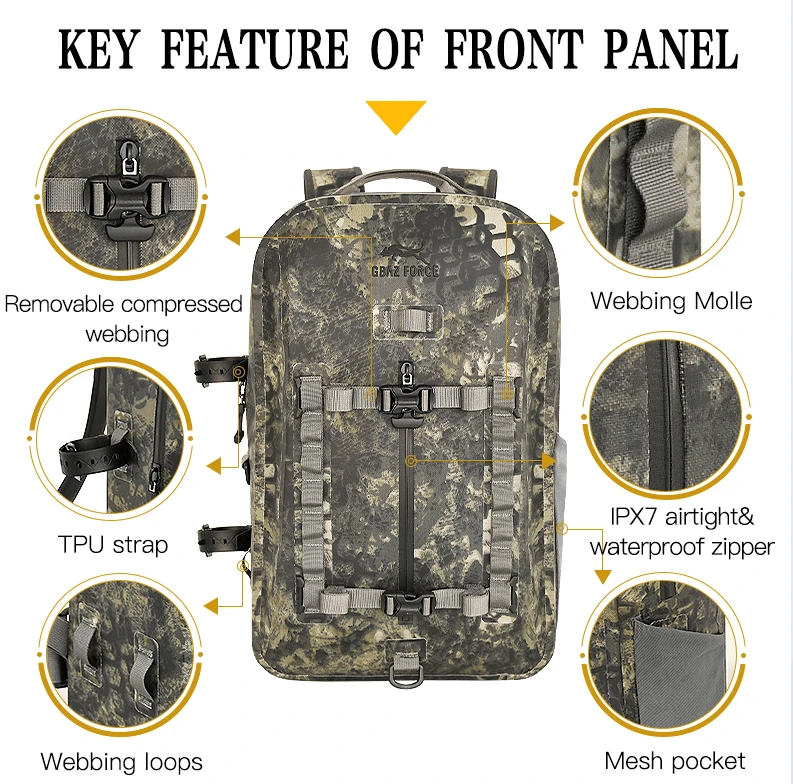
The front panel, item by item. The material documents six items on the front panel of the 906-001, and each has a functional or merchandising reason.
Removable compressed webbing. This is the item with the most dual-state logic. Unloaded - on a retail shelf, in a car, on the way to the trailhead - the compression webbing can be loosened or removed, and the pack presents a clean, flat front that shows the full 37L profile and the dark camo. Loaded, the same webbing cinches the shell against the contents, so the profile stays tight and the vertical zipper line is not fighting a bulging chamber. Because the webbing is removable rather than fixed, one pack merchandises as a shelf product and works as a field product. No compression ratio is published, and none is quoted here.
TPU strap. TPU is the same family of coating material as the shell: flexible and smooth. Side TPU straps with buckles are attachment points that stay supple in cold and wet conditions, and they pair with the Duraflex buckles documented on the spec sheet.
Webbing loops. Simple attachment points for the buyer's accessory ecosystem - pouches, gear, brand-specific add-ons. Loops are the least expensive way to let an end customer make the pack their own.
Webbing Molle. Molle-style webbing gives the front panel a modular attachment surface for pouches and accessories, the same attachment language outdoor gear lines already use, so the pack slots into an existing accessory ecosystem instead of requiring a new one.
IPX7 airtight&waterproof zipper. The main vertical zipper, listed on the front panel because the front is where the closure sits and where it is seen. It is the working closure of the pack, and the component-level statement from Part 2 applies exactly as written.
Mesh pocket. An open-front pocket for quick-access items. One honest note for listing copy: mesh is an open weave, and this pocket is a convenience pocket, not a sealed one. It does not keep contents dry.
Why 37L is the entry point - in the category sense. GAF OUTDOOR's waterproof catalog already covers a wide range: a 1L sealed pouch, a 26L cooler-style pack, a 10L crossbody, a 4L waist pack, and 50L and 100L duffels. Within all of that, the 37L is not the smallest capacity - it is the first product in the backpack format. That is what "entry point" means here: if a wholesale buyer or a brand owner wants to offer a waterproof backpack line, the 906-001 is the SKU they start with, because it is the model that introduces the format - two-shoulder carry, vertical IPX7 zipper, roll-free access - to their customers.
There is a commercial reason as well. A 37L pack sits in the daypack volume that most hiking, outdoor, and work scenarios actually buy. It is large enough to be a serious pack for a full day of gear, and small enough to stay inside standard use cases without special justification. Lead the category with 37L, and the other formats read as extensions of the line rather than competing products: the duffels for group and travel loads, the crossbody and waist pack for light carry, the 26L for a cooler role.
Conclusion
The 906-001 is GAF OUTDOOR's answer to the question "which format leads the waterproof backpack line?" It is a 37L, dark camo pack on 840D nylon double TPU shell fabric, 1.35KG, H 19.9" (50.5 cm) × W 12.6" (32 cm) × D 9.1" (23 cm), with Duraflex buckles, removable compressed webbing, TPU straps, webbing loops, webbing Molle, a mesh pocket, and a vertical IPX7 airtight and watertight zipper as its working closure. The format argument is simple: the backpack is the waterproof format that carries a large main chamber on two shoulders and opens it with a roll-free vertical zip. The specification argument is equally simple: the IPX7 claim sits on the zipper component, and the fabric is a fabric specification - say exactly that, and the product markets itself honestly. For a buyer building a waterproof backpack line, this is the first SKU to order; the rest of the catalog is the rest of the line.
FAQ
1. Can the 906-001 be submerged in water?
No. The product is not presented as a submersible dry bag, and no submersion depth or duration is stated. The spec sheet identifies the zipper as "IPX7 airtight&watertight," which is a component-level statement about the closure, and the main fabric is documented as 840D nylon double TPU.
2. What does "840D nylon double TPU" mean, and is it a waterproof rating?
It is a fabric specification: a high-denier (840D) nylon shell coated with TPU on both faces. It describes the shell's toughness and surface. It is not a whole-bag IP rating, and no bag-level waterproof rating is claimed from it.
3. What are the dimensions, capacity, and weight?
The documented figures are H 19.9" (50.5 cm) × W 12.6" (32 cm) × D 9.1" (23 cm), 37L capacity, and 1.35KG weight, with Duraflex buckles and a dark camo colorway.
4. Is the compression webbing really removable, and what is the point?
Yes. The front panel documents removable compressed webbing. Unloaded, it can be loosened or removed so the pack displays a clean, flat front; loaded, it cinches the shell against the contents and keeps the profile tight. No compression ratio is published on the spec sheet, so none is quoted here.
5. What does "roll-free" mean, and does the pack have an internal frame?
"Roll-free" refers to the opening: the main compartment opens with a long vertical IPX7 zipper rather than being rolled up. The spec sheet does not document an internal frame or back structure; the documented front-panel and attachment items are the removable compressed webbing, the TPU strap, the webbing loops, the webbing Molle, the mesh pocket, and the IPX7 airtight and watertight zipper.


