

Introduction
Getting meat out of the field is not a packing problem. It is an engineering problem with a clock on it: the job is to move a specific weight from the stand to the vehicle inside a cooling window you do not control. Heat, humidity, distance and the animal's residual temperature set the pace, and the container you carry changes none of those variables - it only decides how much friction they add.
This article uses one product as its working sample: the GAF OUTDOOR 905-41, a rectangular nylon meat bag offered in two sizes. The 10 L version measures 18" (45.7 cm) long by 7.1" (18 cm) wide by 5" (14 cm) thick and weighs 0.12 kg; the 20 L version measures 22.4" (57 cm) long by 10.2" (26 cm) wide by 5.5" (14 cm) thick and weighs 0.13 kg. Both use a nylon body, a central YKK zipper, orange X-configuration compression webbing and a short webbing handle, and both are built to lash to the outside of a hunting frame rather than to sit inside a main compartment.
We will work along three separate engineering lines - fabric, heat and load - because they pull in different directions. A bag that solves one badly often breaks another. The point is not a feature list. It is to show how a closed, lightweight nylon body makes specific trade-offs, and what a user or a sourcing team has to do to keep those trade-offs working in the field.
Technical Part 1: Fabric - What the Bag Must Survive
Meat is the harshest payload a soft pack will ever carry, and the fabric requirements differ from a gear bag or a dry bag. Four forces define the specification.
Blood and fat
A field-dressed animal is wet, and the bag meets that wetness at the moment of loading - often while the contents are still warm. The fabric has to present a surface that does not drink the liquid in, so the stain stays on the outside where it can be rinsed rather than wicking into a substrate where it dries dark and sets a smell. That is why a smooth, non-absorbent nylon face is the standard choice: it is easy to wipe, easy to hose down, and easy to confirm is actually clean - which matters more on the hill than it looks on paper.
Friction and dragging
A loaded meat bag does not travel the way a rucksack does. It is lifted, set on a rail, dragged along a fence line, pressed against rock and leaned over a vehicle edge. The body fabric and the load-bearing webbing absorb that abrasion over and over, season after season. Nylon is valued here for a simple reason: it keeps most of its strength when wet and it sheds surface wear far better than cotton or open weaves. (The exact denier and weight of the 905-41's face cloth are a sourcing detail, not a field fact, and no number is claimed here.)
Self-weight
This is the number most people overlook and the most important one in the whole bag. At 0.12 kg for the 10 L and 0.13 kg for the 20 L, the 905-41 is essentially massless as a container. Think about what that does: the total weight budget of the trip is handed entirely to the payload. There is no foam, no insulated liner and no rigid frame eating into the kilos you could otherwise carry. That is a deliberately opposite engineering stance to the heavy insulated cooler box, which trades a lot of container weight for a long internal holding time. In a lightweight hunting system, where the human is the engine and every extra kilo is carried up and down the hill, the near-zero-self-weight bag remains the mainstream choice precisely because it costs nothing when empty and scales with the load.
Cleanability
This is the first requirement made operational. A white or natural-white body is not a styling accident. Against a dark, blood-stained surface a stain is invisible and you cannot tell when the wash is done; against a white face the stain, the rinse and the moment it is truly clean are all obvious. The white body also reads well in snow and in low light, a secondary but real visibility benefit when you are moving a heavy, awkward package after dark.
The zipper boundary
The one component that deserves a hard boundary is the YKK zipper running down the central face. It is the bag's primary closure, and done well it is the most reliable moving part on the pack - sized for the load and built to cycle thousands of times. But it is a zipper, not a seal. It closes the mouth of the bag; it does not waterproof it, does not hold a vacuum, and is not a barrier you should lean on for temperature. If your spec or your pitch relies on the zip keeping something in or keeping something out, that is the moment to re-read the boundary.
Technical Part 2: Ventilation, Heat and the Closed-Bag Question
Why heat still matters
The honest starting point is that the 905-41 is a closed nylon body with a single central zipper. It has no mesh panels, no ventilation gusset, no airflow channel of any kind. Anyone who sells it to you as a "breathing" or "ventilated" bag is selling you something it does not have. That is not a defect; it is the design, and it forces a specific - and correct - way of working. The rate at which meat loses its own residual warmth is what protects quality, and the danger is the warm period after the shot, when internal temperature is at its peak and bacterial activity is fastest. The common field mistake is the opposite of the right move: sealing the meat hot and tight, trapping its own heat in a closed shell, and carrying it up the mountain that way. A closed bag will hold whatever temperature you put into it. It does not lower it.
The correct operating logic
The fix is a sequence, not a container trick:
Cool the meat before it is sealed. Give the quarters time to come down in open air before they ever go into the bag.
Pack only after the cool-down. The bag's job is protection and transport, not refrigeration.
Minimize the gap between packing and the box or the fridge. The shorter that window, the less the closed bag has to do - and the closed bag has very little to do on its own.
Portioning as a thermal strategy
A single heavy mass cools slowly from the core; the same meat cut into quarters or separated by body part presents more surface, loses heat faster, and lets you load and unload in pieces. Quartering is not just a butchering convenience - it is the thermal strategy a bag with no airflow channel depends on.
The open-versus-half-open trade-off
You can carry a bag open or half-open to let the contents breathe, which improves cooling and lets you see the load; the cost is exposure to flies, wind-blown debris and splash. In a hot, humid environment, where the cooling window is shortest and insects are the worst threat, many hunters accept the open bag with a cover and a fast carry. In a dry, cold environment, where the air is doing the cooling for you, a closed bag is often safer and cleaner because the ambient temperature has already done the work the bag cannot. The choice is environmental, and it should be made before you climb, not on the hill.
Visibility and hardware
The reflective loops catch headlight and torch beams in the dark, which matters for a hunter moving alone after dark and for any search-and-rescue scenario. The orange webbing against the white body gives high-contrast recognition at range - a loaded package you can actually find in timber, brush or snow. And the webbing loops and the short handle are not decorative: they are the grip points for carrying, the lash points for tying the bag to a frame, and the hanging points for airing and drying the empty bag after the wash.
The frame
The 905-41 is specified to lash to the outside of a hunting frame, and that is a deliberate decision. Meat is heavy, and heavy weight belongs close to the back, not dangling a metre away in a main compartment where it shifts. External mounting keeps the center of gravity tight to the spine, keeps the bloody load out of your gear, and - most importantly - makes unload at the vehicle a five-second job: cut the webbing, set the bag on the tailgate, done. A bag you have to dig out of a stuffed main compartment at the end of a hard carry is a bag you will curse.
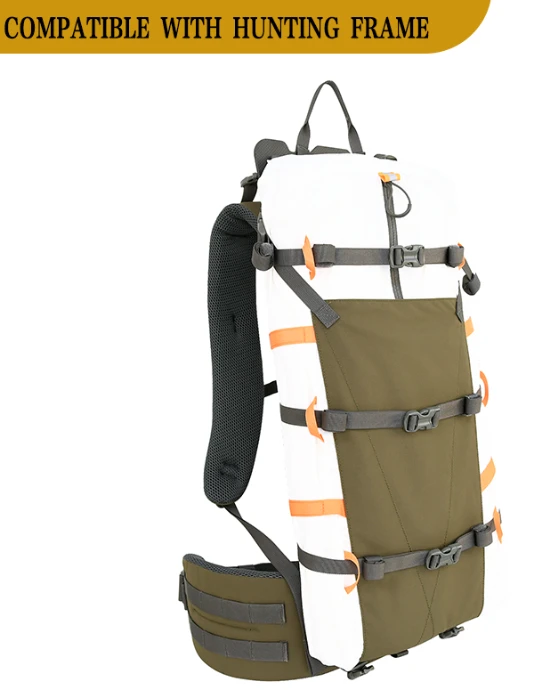
Compatible with a hunting frame - the bag rides outside, close to the spine
Technical Part 3: Load, Field Workflow & B2B Selection
The field workflow
The workflow is a decision sequence, and it is the part that separates a bag that works from a bag that only looks good in a catalogue. Start on the ground, not on the trail: quarter or separate the animal into pieces before anything is loaded. Decide a single-carry weight you are willing to repeat, and work out how many round trips that implies between the stand and the vehicle. Then split the difference between the frame and a second pack - the frame takes the heavy external bag close to the back, and a rucksack carries tools, spare bags and the lighter pieces. The whole plan is about controlling weight per trip and the number of trips, not about stuffing the most meat into one load and hoping the trail is short.
Choosing between 10 L and 20 L
Once the workflow is fixed, the size choice is straightforward. The 10 L is the tool for small game and for a single quarter - one piece, one carry, in and out. The 20 L is for larger animals and for loading by body part, where you want a bigger rectangular envelope that swallows a leg or a rack without a tight fight. There is also a strong case for running the same size in parallel: two bags of the same capacity let you split the weight across two carries and, more usefully, let you track each body part separately - fore and hind, left and right - so nothing gets mixed up between the field and the freezer. For a guide service moving several animals a day, parallel bags are the difference between an organized unload and a pile of anonymous meat.
Hygiene: cleaning and storage
This is the part of the spec that protects the next user and the next season. Work the blood down first, before it dries - a dry stain is a much harder stain than a wet one. Rinse with clean water and a mild detergent, working the fabric and the webbing, then dry the bag completely before it is stored. A wet bag in a closed case grows what you do not want it to grow; a fully aired bag, hung by its loops, does not. Keep the meat bag out of your gear pack on its own loops and lines, and you avoid the cross-contamination a shared, half-dried bag quietly introduces.
Inspection checklist
A short, repeatable check catches a failure months before it catches you on the hill. Check the webbing and its loops for fraying, especially the compression straps that take the load. Run a finger along the seams for any thread that has begun to lift. Open and close the YKK zipper fully and watch the teeth for any that have jumped and the tape for any that has pulled away from the edge.
B2B selection
For a buyer, the selection logic is about the customer segment and the customization you actually need. The natural channels are hunting-goods distributors, hunting-clothing and gear brands that white-label, hunting-travel and guide services that need reliable, cleanable bags at volume, and meat-processing and outdoor-food channels that touch the product. The OEM/ODM surface on a bag like the 905-41 is genuinely useful: capacity specification (the 10 L / 20 L split, or your own), body colour, webbing and reflective-component configuration, logo application (the product carries a Customizable LOGO position), zipper specification and handle form. The backing for that is practical rather than theatrical: Design Supported and Production Guaranteed, design drawings you can review before a run, a cadence of new styles every month, more than ten years in the field, and a record of serving more than eighty brands.
Conclusion
The 905-41 is a closed, near-massless nylon bag, and its value is exactly the shape of its limitations. It does not cool meat; it protects already-cooled meat, keeps it out of your gear, sits tight to your back on a frame, and comes off in seconds when you reach the vehicle. Fabric, heat and load are not three separate features - they are three constraints on one lightweight system, and the bag works when the user respects all three: cool before you pack, portion the load, and keep the bag clean and aired. That is the whole engineering, and it is why a bag this simple still does the job at the end of a long carry.
FAQ
Can I put hot meat straight into the bag?
No - that is the exact mistake the design warns against. A closed nylon body holds the heat you put into it; it has no airflow to carry it away. Cool the quarters in open air first, then pack. The bag's role is transport and protection, not cooling.
Do I need a cold chain between the field and the vehicle?
You need a cooling window, which is different from a refrigerated chain. The practical version is: cool the meat, minimize the time from packing to the box or the fridge, and keep the closed-bag window short. A closed bag is not a cooler, and it should not be treated as one.
Can it be hung on a frame?
Yes. The 905-41 is specified to be compatible with a hunting frame. You lash it to the outside of the frame with the webbing loops - not into a main compartment - so the heavy load stays close to the back, out of your gear, and ready to drop at the vehicle.
Is the bag waterproof?
The central YKK zipper closes the mouth of the bag; it is a closure, not a seal. Do not rely on the zip for waterproofing, temperature holding, or anything the nylon body does not do on its own.
How do I clean and store it?
Treat the blood while it is still wet, rinse with clean water and a mild detergent, then dry it completely - ideally hung by its loops - before storage. A fully dry bag is the only bag that stores well.
GAF OUTDOOR - Game Bags and Meat Transport. Design Supported, Production Guaranteed. 10+ years experience, serving 80+ brands, with new styles every month.


