

Introduction
Walk into any serious waterfowl hunting camp from the Louisiana bayous to the Saskatchewan pothole region, and you will notice one piece of gear that separates seasoned guides from weekend hunters: the pack they carry into the blind. Waterfowl hunting does not share the same rules as upland bird hunting or big-game backpacking. The terrain is not a trail - it is a half-solid, half-liquid transition zone where a single misstep can put your entire kit underwater.
Standard hunting packs fail in these conditions. A traditional 500D Cordura bag with standard YKK zippers might handle a drizzle, but it cannot survive the moment a hunter wades through chest-deep cordgrass, slips off a submerged log, and watches his pack disappear into silty marsh water. When that pack resurfaces - assuming it floats - every piece of ammunition, every electronic call, every spare layer is soaked and ruined. Worse, if it sinks, the hunt is effectively over.
This article examines why full-submersion protection is not a marketing gimmick but an engineering requirement for waterfowl hunting bags. We will break down the environmental threats marshes and swamps impose on gear, the technical methods used to achieve IPX8-level waterproofing, the product design trade-offs between floating and sinking packs, and the material science behind modern submersible hunting packs. For B2B buyers sourcing waterfowl hunting bags, a factory profile of GAF Outdoor provides context on what to look for in a manufacturing partner.
[ IMAGE INSERT - Marsh environment / waterfowl hunter wading ]
The Marsh Environment Challenge
Marsh and swamp environments present a convergence of threats that no other hunting discipline demands gear to withstand. Understanding these threats is the starting point for any buyer evaluating a waterfowl hunting bag.
Silty Water Ingress. The water in a tidal marsh or freshwater swamp is not clean. It carries suspended silt, decaying organic matter, and fine particulate that behaves like liquid sandpaper. When this slurry enters a zipper coil or seeps through a stitch hole, the abrasive particles lodge between zipper teeth and coat the inner surfaces of the waterproof membrane. Over repeated exposure, the zipper loses its ability to seat properly, and the membrane develops micro-abrasions that compromise the waterproof barrier. A bag rated IPX6 (powerful water jets) may pass a lab test with clean water but fail after three hunts in silty conditions.
Salinity and Corrosion. Coastal marshes - the Gulf Coast, Chesapeake Bay, the Pacific Flyway estuaries - add salt to the equation. Brackish water accelerates corrosion on every metal component: zipper sliders, D-rings, buckles, and strap adjusters. Even stainless steel hardware will pit over time if the grade is insufficient (304 stainless versus 316 marine-grade). The corrosion problem also extends to fabric coatings; salt crystals that dry inside a seam can act as nucleation points for delamination.
Vegetation Abrasion. Cattails, phragmites, sawgrass, and buttonbush are not passive obstacles. Phragmites stalks in particular have silica-rich outer layers that act like low-grit sandpaper when a hunter pushes through dense stands. A pack's bottom panel and side gussets take repeated abrasion from these plants, and any weak point in the fabric coating or seam sealing becomes an entry point for moisture.
Repeated Submersion-Drying Cycles. Few products in the outdoor industry experience the cycling stress of a waterfowl hunting pack. A bag may go from fully submerged in 4°C (39°F) water at dawn to baking in direct sunlight on a boat deck by late morning. The thermal expansion and contraction of dissimilar materials - TPU film bonded to nylon, rubber gaskets around zipper tracks - creates shear stress at every bonded interface. A seam that holds at first use may begin to separate after thirty such cycles if the bonding process was not engineered for this specific stress profile.
Impact and Puncture. Marshes hide submerged obstacles: broken timber, steel fence posts from abandoned agricultural plots, jagged oyster beds in tidal zones. A pack dropped onto or dragged across these surfaces must resist puncture. A pinhole in a dry bag renders it useless; in a submersible hunting pack, the same pinhole means water will find its way inside during the next wading crossing.
These five threats - silt, salt, abrasion, thermal cycling, and puncture - define the engineering challenge. A waterfowl hunting bag is not a dry bag with shoulder straps. It is a fully engineered system designed to survive an environment that attacks gear from every angle.
Full Submersion Engineering: What IPX8 Means in Practice
IP ratings (Ingress Protection) are the standard for classifying waterproofing, but the difference between IPX7 and IPX8 is significant in a marsh context.
IPX7 certifies that a product can withstand immersion in 1 meter of water for 30 minutes. That is a static test in clean, still water. IPX8 goes further: the depth and duration are specified by the manufacturer and typically exceed IPX7 parameters. For waterfowl hunting bags, manufacturers aiming for genuine submersion protection target IPX8 at 2 meters for 60 minutes or longer. The higher rating matters because marsh water is rarely still, and submersion times in real-world scenarios - retrieving a dropped pack, crossing a deep channel - can exceed the 30-minute IPX7 window.
Achieving IPX8 on a bag designed for daily gear access requires solving three distinct engineering problems.
RF-Welded Seams versus Stitched-and-Taped. Stitched seams create needle holes, and needle holes leak. The conventional approach in mid-tier waterproof bags is to stitch the seam, then apply waterproof seam tape over the stitch line. This works for rain exposure but fails under submersion pressure because the tape is an adhesive bond subjected to peel stress as the fabric flexes. Radio Frequency (RF) welding eliminates the stitch entirely. Two layers of TPU-coated fabric are fused at the molecular level using high-frequency electromagnetic energy. The resulting bond is a homogeneous polymer joint with no mechanical perforation. When executed correctly, the welded seam is stronger than the surrounding fabric.
This distinction matters for B2B buyers because RF welding requires specialized equipment and operator expertise. Not every factory producing "waterproof bags" owns industrial RF welding machines, and the skill to dial in frequency, pressure, and dwell time for different fabric weights is built through years of production experience.
Roll-Top Closures versus Waterproof Zippers. The roll-top closure is the simplest reliable path to submersion protection. A fabric throat at the top of the pack is folded over three to four times and secured with side-release buckles. No zipper, no gasket, no mechanical failure point. The trade-off is access speed - a roll-top requires unfastening buckles and unrolling the throat every time the hunter needs to reach inside.
Waterproof zippers (TIZIP, YKK AquaSeal, or custom-molded variants) solve the access problem but introduce complexity. A waterproof zipper uses interlocking flexible teeth and a compression gasket - when the slider closes, it presses the two halves together to form a seal. The weakness is at the zipper ends, where the fabric tape enters the zipper housing. RF welding or high-frequency bonding at this junction is critical; any gap creates a leak path.
The design decision between roll-top and waterproof zipper depends on the product's intended use case. A decoy bag that is accessed once at setup and once at takedown can use a roll-top with no penalty. A blind bag that holds calls, shells, and snacks - accessed dozens of times during a hunt - benefits from a waterproof zipper, provided the zipper is rated for the depth and cycle count expected in the field.
Seamless Bottom Construction. A pack's bottom panel takes the most abuse: ground contact, abrasion, and submersion pressure from below. In a stitched bag, the bottom seam is a failure point. In a welded bag, the bottom panel can be formed from a single piece of reinforced fabric with no seam at all, or the bottom-to-side junction can be RF-welded with a reinforced overlap that distributes stress across a wider bond area than a butt-weld.
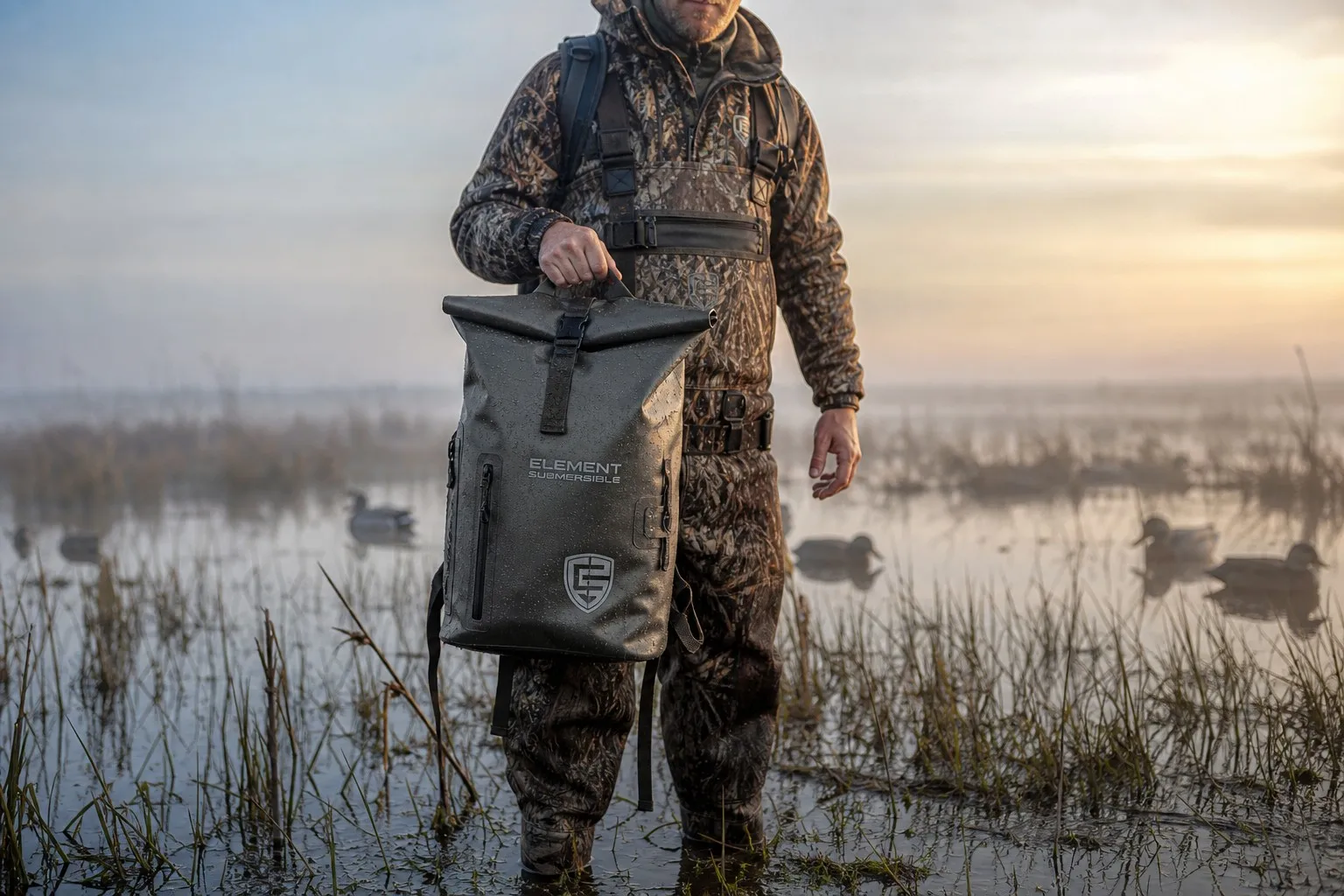
Full-submersion protection in action - marsh hunting demands IPX8-rated construction
Floating versus Sinking: A Product Design Decision, Not a Flaw
Among waterfowl hunting bags, there is a deliberate split between packs designed to float and packs designed to sink. Both are valid; the choice depends on the hunter's scenario, and B2B buyers should understand the logic behind each.
Floating Packs. A buoyant waterfowl hunting bag incorporates closed-cell foam panels sewn or bonded into the back panel, side walls, and sometimes the bottom. When dropped in water, the pack floats with its load. This is essential for layouts where gear is staged on the water - johnboat setups, floating blinds, or walk-in wading where the hunter sets the pack down in shin-deep water while setting decoys.
The engineering challenge with a floating pack is maintaining buoyancy under load. A pack rated to float with 15 kg of gear requires enough foam displacement to offset that weight plus the pack's own mass. Foam panels take up internal volume, so floating packs tend to be slightly larger externally for the same carrying capacity. The foam also adds manufacturing complexity: it must be bonded into the pack body during assembly, and the bond between foam and fabric must survive the same submersion-drying cycles as the waterproof seams.
Sinking Packs. A pack that sinks is not a failure - if it is designed to be fully submersible and the contents are protected regardless. Some hunters prefer a non-buoyant pack because it sits lower on their back, hugs their body more closely for pushing through vegetation, and has a slimmer profile that does not catch on brush. A sinking pack in IPX8 construction means the gear inside stays dry even if the pack goes under, and the hunter retrieves it by feel or by a tether line.
The practical distinction for retailers: floating packs appeal to boat-based and wading hunters who set their pack down in water; sinking packs appeal to walk-in hunters and those who prioritize a low-profile carry. A complete product line should offer both, clearly differentiated in the catalog so the end consumer understands the trade-off.
Material Selection for Long-Term Marsh Performance
The fabric and hardware choices on a waterfowl hunting bag determine whether it survives one season or five. Here are the materials that define the category.
TPU-Coated Nylon and Polyester. TPU (thermoplastic polyurethane) is the coating of choice for submersible packs because it bonds well to RF welding and remains flexible at low temperatures - critical for late-season hunts when temperatures drop below freezing. A 500D nylon base with a 0.5–0.8 mm TPU laminate is common for pack bodies; heavier 840D or 1000D variants are used for bottom panels and high-wear zones.
The key specification is the TPU film's hydrolysis resistance. Standard TPU degrades when exposed to water over extended periods through a chemical process called hydrolysis, where water molecules break the polymer chains. Hydrolysis-stabilized TPU (often marketed as "ether-based" TPU) resists this degradation and is the correct choice for a product that will spend its life in wet environments. A bag made with standard TPU may delaminate after one season of heavy use; a bag made with ether-based TPU should last through multiple seasons.
Hypalon Reinforcement. Hypalon (chlorosulfonated polyethylene, or CSM) is a synthetic rubber that offers exceptional resistance to UV, chemicals, and abrasion. In waterfowl hunting packs, Hypalon is used as a reinforcing layer on wear points - bottom corners, lash points, and the base panel. It bonds well to TPU-coated fabrics via RF welding and provides a second layer of defense in the areas most likely to contact sharp objects or abrasive surfaces.
Anti-Corrosion Hardware. Zippers, D-rings, buckles, and strap adjusters on a marsh hunting pack must be spec'd for saltwater exposure. Plastic hardware (acetyl/Delrin buckles and adjusters) eliminates corrosion entirely but does not carry the same load rating as metal. Metal components should be 316-grade stainless steel or brass with a corrosion-resistant coating. Zipper sliders in particular - the most failure-prone component - should be stainless steel with a nickel-plated finish for smooth operation in sandy or silty conditions.
Thread and Edge Finishing. Even on an RF-welded bag, some components require stitching: webbing attachment points, MOLLE loops, handle reinforcements. The thread must be bonded nylon or polyester with UV inhibitors, and every stitch hole on the exterior should be back-coated with liquid seam sealant. Edge binding on webbing and strap ends should be heat-cut to prevent fraying, not simply scissor-cut.
Factory Profile: GAF Outdoor (Guangzhou, Est. 2011)
For B2B buyers evaluating manufacturing partners for waterfowl hunting bags, GAF Outdoor represents a focused capability set worth examining.
Background. Founded in 2011 and based in Guangzhou, China, GAF Outdoor specializes in waterproof bags and packs for hunting, fishing, and watersports applications. The company operates its own production lines rather than outsourcing, which gives buyers direct visibility into quality control and production scheduling.
Core Technical Capabilities. GAF Outdoor's waterfowl hunting bag production centers on three technologies: high-frequency RF welding for seam construction, TPU lamination and coating application, and anti-corrosion hardware integration. The factory runs multiple industrial RF welding stations with the capability to handle fabric weights from 300D to 1000D with TPU coatings from 0.3 mm to 1.0 mm. This range covers everything from lightweight roll-top decoy bags to heavy-duty submersible blind packs.
Key Quality Control Protocol: Every welded bag undergoes a 100% inflation test - the bag is inflated with air and submerged in a water tank to detect bubble streams from seam or zipper leaks. For IPX8-certified products, batch samples additionally undergo pressurized submersion testing at the rated depth for the full rated duration.
Production Flexibility. GAF Outdoor accepts OEM and ODM orders with MOQs that are accessible to mid-sized hunting retailers and regional distributors - not just big-box chains. Customization options include fabric color matching (useful for retailers who want exclusive camo patterns), logo placement via screen printing or embossing, and zipper configuration based on the intended use case.
What to Verify as a Buyer. When working with any waterproof pack manufacturer, including GAF Outdoor, buyers should request: (1) third-party IPX test certificates for the specific bag model being ordered, not just the factory's internal test reports; (2) hydrolysis-resistance documentation for the TPU film being used; (3) a production sample with the actual hardware package specified in the purchase order, since hardware substitution is a common source of discrepancies between samples and bulk production.
[ IMAGE INSERT - GAF Outdoor factory / QC testing / product lineup ]
B2B Strategy: The North American Waterfowl Hunting Market
Understanding the technical side of the product is necessary, but the business side determines whether inventory moves. Here is how the seasonal rhythm and channel structure of the North American waterfowl hunting market shapes procurement strategy.
Seasonal Procurement Window
Waterfowl hunting seasons in the United States and Canada run from early September (early teal and resident goose seasons) through late January (extended goose and sea duck seasons), with peak activity from October through December. Retailers begin placing orders for the upcoming season between January and March, with production lead times of 60–90 days putting delivery windows in the May–June timeframe. This gives retailers 2–3 months to merchandise and market before the season opens.
B2B buyers who miss the January–March ordering window face two problems: factory capacity fills up, and shipping delays from Asia - whether via ocean freight or air - compress the available selling window. Late-arriving inventory means markdown risk in January when retailers begin clearing hunting inventory.
Channel Strategy
Waterfowl hunting gear moves through three primary channels:
1. Specialty Waterfowl Retailers. These are the highest-margin channel and the most discerning buyer. Stores like Mack's Prairie Wings, Rogers Sporting Goods, and independent waterfowl-focused shops carry deep inventory in blinds, decoys, calls, and packs. They demand product differentiation - they do not want the same bag sold at a big-box store - and they expect factory-direct pricing with MAP policies.
2. General Outdoor Retailers. Bass Pro Shops, Cabela's, Sportsman's Warehouse, and regional chains carry waterfowl packs as part of a broader hunting assortment. Their buyers prioritize turnkey products: private-label packaging, UPC codes, retail-ready hangtags, and compliance with retailer-specific vendor requirements (routing guides, EDI, chargeback policies).
3. Direct-to-Consumer and Amazon. A growing share of waterfowl gear moves through DTC brand sites and Amazon's hunting category. This channel rewards strong product imagery - a submersible pack photographed underwater with dry contents is a compelling visual - and keyword-optimized listings that capture search traffic for terms like "waterfowl hunting bag" and "waterproof duck hunting backpack."
MAP and Brand Protection
Minimum Advertised Price policies matter in the hunting gear market because discounting erodes the specialty channel's willingness to stock a product. A brand that sells direct and through Amazon must enforce MAP consistently, or it will lose its specialty retail placements - and those placements drive the in-store exposure that builds brand credibility among serious waterfowl hunters.
Warranty as a Sales Tool
A submersible waterfowl hunting bag carries a higher price point than a general-purpose waterproof backpack. A strong warranty - two-year or lifetime coverage against manufacturing defects, with clear language on what is and is not covered - reduces the perceived risk for the end consumer and gives the retailer an answer when a customer questions the price. For B2B buyers, negotiating warranty terms that the factory backs (not just the brand) is a critical part of the sourcing conversation.
Conclusion
The waterfowl hunting bag market exists at the intersection of materials science, manufacturing precision, and seasonal retail timing. A bag that reliably protects gear through repeated submersion in silty, corrosive marsh water represents an engineering investment - in RF-welded seams, hydrolysis-stabilized TPU, marine-grade hardware, and multi-point quality inspection - that separates it from generic waterproof packs.
For B2B buyers, the sourcing decision should be driven by three factors: the factory's demonstrated capability in RF welding and TPU lamination, the product's IPX certification backed by third-party testing, and the manufacturer's ability to meet the January-to-March ordering window that aligns with North American hunting retail cycles.
A waterfowl hunter who has lost a phone, a box of shells, or a set of custom calls to a submerged pack does not need to be convinced of the value of full-submersion protection. The buyer's job is to make sure that conviction translates into inventory that is on the shelf when the customer walks in - and that the product delivers on the promise.
For inquiries about waterfowl hunting bag sourcing, including OEM/ODM capabilities, minimum order quantities, and IPX8-certified product specifications, contact GAF Outdoor's B2B sales team through their Alibaba.com storefront or official website.


