

Introduction: The Most Expensive Thing You Carry
Aspotting scope is the single most expensive precision instrument in most hunting and birding kits. $500 gets you an entry 60mm; $3,000+ buys a 95mm fluorite objective with matched eyepieces. Unlike a rifle or a pair of binoculars, it never travels alone - it is always one half of a two-piece system, married to a tripod that has to arrive with it, intact, at the same moment.
The optics carrier backpack that carries both has to solve three problems at once. First, shock: a $2,000 lens group is a precision assembly that survives a pack's life only if the carrier absorbs the abuse. Second, the tripod: a dangling carbon tripod turns every hike into a balance fight and every ridge line into a snag hazard. Third, speed: the bird flies, the elk steps over the ridge - the gap between "scope in pack" and "scope on tripod, focused" decides whether the gear earns its place.
Every design decision in this category is a compromise between those three demands. Compression padding fights pack weight. Tripod attachment fights balance. Quick deploy fights compartment security. This article walks through the engineering of each, and what contract manufacturing for the category actually looks like at Guangzhou GAF Outdoor.
Part 1: The Optics Protection Problem
Why glass dies on your back
Most people assume a spotting scope is fragile because the glass can scratch. Scratches are cosmetic. What actually kills a scope is shock, and it fails in three distinct ways.
The lens cell. A modern objective is a compound element: two or three lenses of different glass types, seated in a metal or composite cell with spacing tolerances measured in microns. A 20g impact on the objective rim - the kind of hit a scope takes bouncing inside a soft bag against a pack frame - can shift that seating. The shift is invisible to the eye. It shows up as a soft edge at 40x. The owner blames the eyepiece, sends the scope in, and the technician finds a decentered cell.
The optical axis. The erecting prism system and the eyepiece are aligned on an axis that must hold across a 5–70x zoom range. Factories collimate at build, lock the adjustments, and expect the assembly to stay put. Every hard shock micro-fractures the thread lock. Over a season of bouncing in a vehicle or a pack, the image drifts and the scope "won't focus sharp" at high power - the classic symptom of a de-collimated unit. Nothing broke. No warranty part. Just a cumulative fatigue failure and a rebuild bill.
Thermal fog. Carry a scope on the pack all morning at −5°C, step into a warm truck, and it fogs inside the tube - not on the outside lens. Interior fog means the nitrogen purge has leaked and the tube has been breathing humid air. Rapid temperature swings and repeated pressure cycling from impact flexing the tube's O-rings both accelerate it. A carrier that holds the scope in constant compression can't stop this; a carrier that lets the scope rattle and flex absolutely contributes to it.
EVA molded liner versus soft padding
This is where molded EVA earns its price tag. A 35–45° density EVA liner, CNC-cut to the negative of a specific scope profile, does three things flat soft padding cannot.
It spreads a point impact across the whole contact surface - point load divided by surface area is the difference between a dent and a flex. It holds the scope in place, so there is no free travel for the tube to accelerate into a wall. And it creates a compression channel around the objective housing, the most vulnerable part, so a lateral blow deforms foam instead of the lens cell.
Soft "camera cube" padding - 10mm closed-cell foam walls - passes the drop test and fails the vibration test. Drop tests measure peak G. Field use is sustained vibration: the scope's mass times the frequency times the travel distance inside the bag equals the energy the liner must absorb, hour after hour. Molded EVA absorbs it. Loose soft padding transmits it. That distinction is the whole optics protection design argument.
Part 2: Scope Compartment Architecture
Zoning the interior
Three decisions separate a real optics carrier from a padded bag with a logo.
Separate objective and eyepiece zones. The objective housing is the heavy end - a 95mm scope's objective can weigh 1.2kg of glass and metal on its own. The eyepiece is the light, protruding end, and the most mechanically exposed: a straight eyepiece is a lever arm sticking out of the tube. In a shared compartment it takes the first hit in any side drop. Independent molded cradles mean the eyepiece never shares the objective's movement, and the tube floats between two support points - exactly what a precision instrument wants: supported at both ends, unloaded in the middle.
Center-axis support. The scope must sit with load distributed along the optical axis, not across it. Gravity pulls the tube down; the cradle counteracts along the full length. If only the objective touches a foam wall, every step of the hike is a repeated bending moment on the barrel - the slow-death scenario. The carrier needs a full-length trough with molded channels gripping the tube near both ends.
Hard top versus soft flap. Honest tradeoff. A rigid top - 10–15mm semi-rigid EVA, or ABS sheet over 8mm foam - protects against compression: a pack stacked in a truck bed, a bag loaded under other gear in an airline hold. The cost is weight, and a hard shell flexed on a curved contour can fatigue at a hinge point. A soft flap is lighter and packs flatter but stops surface abrasion only - nothing against a 15kg cooler landing on the pack. The serious answer is a hybrid: soft exterior flap, molded EVA plate inside, so compression resistance sits where it matters (over the objective zone) and flex where it doesn't (the flap edges). Buyers should ask one question: is there a hard panel between my scope and the top of the bag? If the answer is "just foam," it's a scratch guard, not a shock carrier.
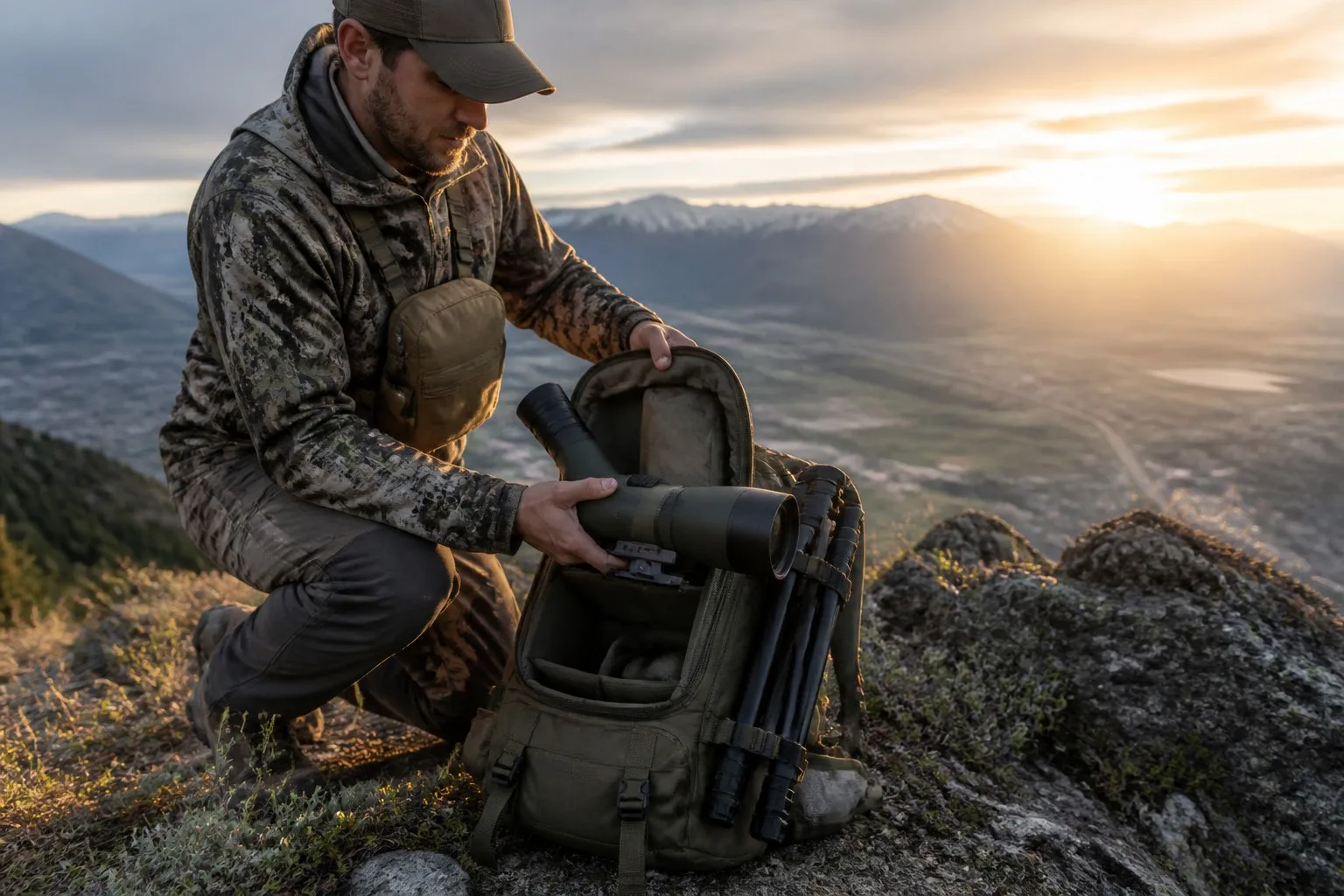
From trail to glass in under 30 seconds - padded cradle and tripod side-pouch working as one system
Part 3: Tripod Carry Integration
Most spotting scope backpacks fail on the tripod. The scope is treated as precious cargo; the tripod is an afterthought - straps on the side dangling a $300 carbon tripod like a rifle on a sling.
A dangling tripod does three kinds of damage. It swings, transferring momentum into the pack and from the pack into the scope compartment. It snags on brush - that's how legs get bent. It shifts the center of gravity backward, putting the whole load on the lumbar pad and turning a 20-minute hike into a backache.
Side pouch. A dedicated tripod sleeve - full length, compression strap at the top, and a boot at the bottom that cups the tripod feet - holds the tripod close to the pack body so the center of gravity stays within the frame. The boot is the critical detail. Without it the tripod rides on the bottom strap, feet poking out the side, bouncing with every step.
Bottom strap system. Straps across the pack base carry the tripod under the pack, parallel to the ground. Best possible weight position, lowest center of gravity - but you must take the pack off to deploy. It suits a setup-and-stay camp, not mobile birding.
The deploy math. The number that matters: walking-to-observation time. Serious carriers design to under 30 seconds. Count the operations:
Stop and reach the scope compartment.
Unzip the closure.
Draw the scope from its cradle.
Seat it on the tripod head.
Tighten the head.
Focus.
Six operations. With a side pouch and a scope compartment that opens away from the body, both components are reachable at the same time without removing the pack. That geometry - not padding thickness - is what makes a tripod carrying backpack fast.
Quick-Deploy Access: Quiet Is the Feature
Hunters and birders share one constraint most consumers don't: noise. At 40 meters, the sound of a zipper is the sound of the animal leaving. Closure choice is engineering, not cosmetics.
A zipper gives full closure security and a weather-tight seal, but it is a metallic rattle source: pulls swinging, sliders vibrating against stops. The fix is a large-gauge damped zipper, a TPU-coated or finger-loop pull that doesn't flop, and a storm flap covering the track so the zipper never takes direct rain.
Magnetic closures - two or three neodymium pairs per opening - solve noise differently: no track, no slider, silent one-hand opening. The catch is magnet spec. Under-specced, the flap pops open under load; over-specced, it snaps shut with an audible click. The compromise is a soft-close design: angled magnet pairs, a fabric hinge that decelerates the flap, and a one-hand draw so the non-dominant hand closes the flap while the dominant hand is already reaching for the scope. One-hand operation is the real point of quick-deploy.
Weather Protection: Sealing Against Four Seasons
Aspotting scope pack lives outdoors. The threats are water, humidity, and the interface between them. The scope is a sealed tube; everything else in the pack is not - tripod head, spare eyepieces, lens cloths, the rangefinder battery.
The standard answer is three layers. A stowable rain cover in a base pocket, elasticized, deployable over the entire pack including the tripod pouch. A moisture-wicking interior lining, because wet foam stops being a cushion and becomes a sponge. And a sealed scope compartment - gusseted overlapping flap or water-resistant zipper with a storm lip - since that is the one opened most often in the field.
Temperature is the sneaky one. A scope carried against the body side heats up; the pack set down in shade cools it; condensation forms on the optics. A vented back panel and breathable compartment walls let air equalize. Small detail. It's the difference between a scope that fogs at the eyepiece every morning and one that doesn't.
Factory Profile: Guangzhou GAF Outdoor (Since 2011)
GAF Outdoor, in Guangzhou since 2011, is the kind of factory optics carriers get built in when the buyer knows what to ask for. Their core competence for this segment is precision liner cutting. A molded EVA liner is only as good as its negative space: a cradle cut 2mm loose lets the scope shift; 1mm tight and you fight the foam every time you seat the scope. GAF cuts EVA liners on CNC foam-cutting equipment with sub-millimeter repeatability, so a compartment is engineered to the actual CAD profile of a specific spotting scope case application - not a generic "fits up to 95mm" cavity.
That precision matters more here than in any other bag category, because optics tolerances are the tightest in outdoor gear. GAF's OEM experience across hunting and shooting bags means their pattern teams already know the field constraints: which pockets need silent closures, where a tripod boot needs reinforcement, how a shoulder strap routes around a waist belt. For a private-label buyer the practical value is concrete: bring a scope model, GAF does the 3D scan and liner cut, and the resulting compartment belongs to that product line. That is the difference between an optics carrier backpack and a bag that merely carries optics.
B2B Strategy: Selling Protection of an Expensive Investment
The market splits in two, and the two halves buy differently. Hunters buy on durability and deploy speed - a broken scope is a failed hunt, not a repair bill. Birders buy on protection density and quiet - they carry $3,000 alpha scopes to a boardwalk and worry whether the eyepiece is safe when the pack is set down to digiscope. Both decide the same way: the scope is the insured asset, the carrier is the premium.
That is the wholesale pitch, and it's honest. A $700 scope in a $25 soft bag is a misallocation; a $40–80 optics carrier backpack with molded protection, tripod integration, and a deployable rain cover is the cost of keeping the scope alive. Wholesalers who sell the carrier as insurance for the most expensive item in the customer's kit - not as "a backpack" - are selling against the scope's price, not against other bags. That framing holds a completely different price point and a completely different margin, because the buyer compares the carrier against the cost of a de-collimated $700 scope, not against a competitor's catalog.
Stock in tiers that mirror the scope market: an entry molded carrier for the $500–900 tier; a full-integration build - tripod system, hard top, rain cover - for $1,000–2,000; a premium version for the alpha buyers who spent $3,000 and will spend $150 to protect it without blinking. The story is the same in every tier, and it has never been hard to tell: the most expensive thing a hunter or birder carries deserves better than a padded bag.


