

Ask a group of hunters to name the one pack size they would keep if they could only keep one, and a surprising number land on the same answer: around sixty-five litres. Not because 65 litres is a magic number, but because it sits on the seam between two very different kinds of hunting. Below it, you are on a day hunt, carrying food, water, a mid layer and the tools of one method. Above it, you are moving a camp or moving meat, and the pack stops being an accessory and becomes the piece of equipment that decides whether you can do the trip at all.
That seam is where the 65-litre pack has to be honest about itself. A 65L that carries badly is worse than a well-built 40L, because it invites you to load weight it cannot distribute. A 65L that carries well disappears on your back and lets you forget the number printed on the lid.
The GAF Outdoor 905-030 sits in exactly this class, and the way it is sold tells you how the manufacturer thinks about the problem: it is offered as a set, frame and pack together. This article looks at what actually carries the weight in a pack like this, how the frame and harness architecture should be judged, and how a B2B buyer should specify a 65L-class product for a retail or brand program.
Technical Part 1: Why 65 Liters, and What Actually Carries the Weight
Start with the load profile. A 65L pack is designed around trips that begin with an overnight and top out at roughly two to three days, or around day trips that need to carry out something bulky and heavy at the end. The load list that pushes a hunter out of a day pack looks like this: a sleeping system reduced to a bag and a pad, a minimal shelter or bivy, an extra insulation layer that the day pack could not swallow, food for more than one meal, more water than a single bottle, illumination and spare power, and - the item that breaks most day packs - game bags and the prospect of carrying meat out in one trip rather than two.
Notice what that list does not include: anything that is heavy in isolation. Sixty-five litres is not a weight class in the way a 150-litre expedition pack is. It is a volume class. The reason it deserves its own engineering discussion is that a pack of this size is very easy to overload, and once overloaded, everything depends on whether the load can be transferred off the shoulders.
That is the single most useful mental model in pack design: the load transfer chain. Weight does not sit where you put it. It travels - from the pack body, into the frame, along the frame, into the waist and hip belt, and finally into the pelvis and legs. Every link in that chain either holds or leaks. A pack body that sags when compressed leaks load into the stitching. A frame that flexes under load leaks load into the shoulder straps. A waist belt that closes but does not wrap leaks load back onto the spine. A correct 65L design is not one with a lot of compartments or a long feature list; it is one where the chain from top of load to hip is short, stiff and continuous.
The practical consequence is that torso length matters more than litre count. A 65L frame sized for a 20-inch torso placed on an 18-inch torso will put the waist belt in the wrong place no matter how much it is tightened, and the shoulders will take load the hips should have taken. This is why the harness in this class has to be adjustable rather than merely padded - the asset for the 905-030 set specifically highlights an adjustable shoulder strap system for different body types, which is a much more meaningful claim in a 65L pack than in a day pack.
Three more load mechanics deserve attention in this tier. First, height of load beats total weight. A tall, top-heavy 65L raises the centre of gravity and makes every off-camber step a balancing problem; packing the dense items - water, food, ammunition - low and close to the back panel is not a preference, it is the difference between a stable walk and a wobbly one. Second, the further a load sits from the spine, the more leverage it applies; the front webbing panel on a pack like this is for light, flat and occasionally-used items, not for the heavy core of the load. Third, volume follows weight. Once the 65L is genuinely full, the load is usually heavy enough that the harness is doing most of the work, and harness quality - not fabric, not pocket count - sets the ceiling on how far the wearer can go.
Technical Part 2: Frame Architecture and Harness Engineering
Frame material: aluminium versus carbon fibre
Both frame families appear in this lineup, and the honest answer is that neither wins outright. The external frame options here include 905-045 and 905-046 in aluminium, while the carbon fibre side of the range is represented by 901-001, 905-049, 905-050 and 905-051. Treat this as a specification decision with a customer segment attached.
Aluminium is the traditional choice because it is tough, tolerates abuse, can be field-bent back toward shape after a fall, and costs less. Carbon fibre trades that forgiveness for mass: it is the reason a 65L set in this range can be quoted at 6.1 lbs complete, frame plus pack, with the specification sheet splitting that as a 1.43 kg frame and a 1.32 kg pack body. For a buyer, the practical split is: aluminium for value-focused, hard-use retail tiers; carbon fibre for weight-obsessed customers who are counting grams on multi-day climbs, and who accept that a carbon frame does not want to be dropped onto rock or forced into shape.
Two engineering points matter regardless of material. The first is frame geometry: a frame only transfers load if its shape matches the human back, with a lumbar curve that presses the load onto the top of the pelvis and a top section that stays far enough from the head to allow it to tilt. The second is stiffness under compression: the frame must not bow inward when the pack is cinched down, because bowing pulls the pack away from the spine at the top and drops the load back onto the shoulders.
The frame-plus-pack set: an underrated commercial decision
The asset for the 905-030 states it plainly - one set includes frame and pack. That is worth more than a line of marketing copy. A separable frame means the pack body can be replaced without replacing the harness system; it means the frame can be used alone for hauling, which is exactly what meat transport demands; and it means the dealer can stock and replace components rather than scrapping a whole unit. In a 65L class where the same frame serves more than one pack body, that modularity also lets a brand offer several volumes on one harness platform - which is how this range is structured across its tiers, with 905-034 and 905-030 at 65L, 1931 at 80L, and 905-033, 905-031 and 905-032 at 85L.
Harness and back system
The harness is where a 65L earns or loses its money. In this set, the back contact area is an ergonomic padded back with a ventilated mesh panel, and the waist assembly is a padded, mesh-backed belt. The ventilation panel is not decoration: a fully sealed back panel puts fabric across the whole back and traps sweat, while a mesh structure holds the pack slightly off the spine, allows some airflow between the load and the body, and reduces the wet-back problem on long climbs.
The belt is the load-bearing member. Two details distinguish a belt that carries from a belt that merely closes: how much of the pelvis it wraps - a correct belt contacts the iliac crest and the top of the glutes rather than cutting in at one point - and whether it can be re-tightened under load without opening the buckle. The shoulder straps, in turn, should sit as shock absorbers rather than load-bearers, with load lifters at the top allowing the wearer to change the angle of pull and pull the top of the pack in toward the shoulders on steep terrain.
Fabric, closure and stability features
The build sheet here lists 500D nylon as the main fabric, with a YKK zipper, a Durflex buckle and nylon webbing. 500D is a sensible middle density: dense enough to resist abrasion against rock, branches and pack straps over seasons of use, light enough not to be the reason the pack is heavy. Nylon also has the quiet, low-sheen character that hunting equipment wants, versus the louder hand and gloss of some coated fabrics.
On the outside, a front webbing panel in the MOLLE style gives the pack external mounting points - a small pouch, a light, a sling, a strap-run of gear - and it also acts as a stiffening element across the front of the body, helping a loaded pack keep its shape instead of folding in on itself. Twin compression straps are the adjustment that keeps a partly-loaded pack quiet: cinched, they stop the load shifting on descents, which is far more tiring than the weight itself.
Dimensionally, this 65L tier measures 84 cm tall, 30 cm wide and 23 cm deep. The width and depth are the walkable numbers - 30 cm across is narrow enough to slip between trees and to keep the elbows clear, while 23 cm of depth is the amount that puts the core of the load reasonably close to the spine. The 84 cm height is the number that matters most for retail fit: on a shorter wearer, the top of a tall pack sits above the shoulders and every head movement pushes against it, so the torso-size adjustment range and the load-lifter range become the difference between a pack that is usable and one that is not.
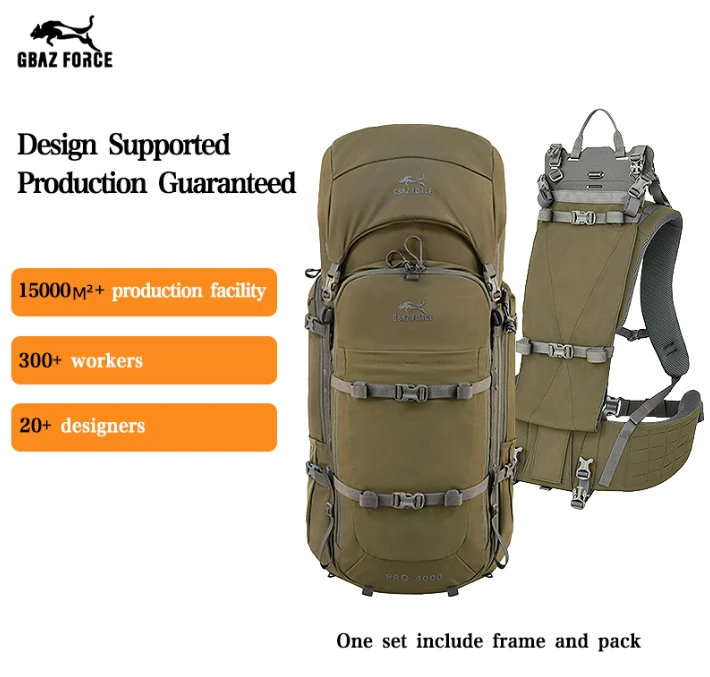
One set includes frame and pack - the frame is what takes the load off the shoulders
Technical Part 3: Field Scenarios and B2B Selection
Three scenario profiles should drive how a buyer positions a 65L pack.
Multi-day static hunting - a base camp, hunting in a radius, days in one place. The pack is loaded heavy once, then carried short distances. Priorities: comfort under maximum load, a stable frame, and easy access to the load without fully unpacking.
High-relief mountain hunting - long climbs with significant elevation. Priorities: total weight, load stability on off-camber ground, and a harness that can be re-tightened on the move. This is the profile that justifies carbon fibre and rewards disciplined packing.
Meat-haul hunting - the pack is carried light to the point of the kill and heavy on the way out. Priorities: frame stiffness, external lashing, and the ability to run the frame with a separable bag or with meat bags lashed directly to the pack. This is where the frame-plus-pack construction pays for itself, and where the 65L tier earns its reputation: it can carry one heavy load without requiring a 90L monster.
Packing order matters in all three. Heavy items close to the back panel and around the level of the shoulder blades; light bulk above and behind them; the day's quick-access items in the lid and front pocket. Then re-cinch the belt and the compression straps after twenty minutes of walking, because a load settles and a settled load is a loose load.
Maintenance is what keeps a frame pack alive across seasons. Wash mud off the fabric rather than letting it dry into the weave; check the frame for cracks or bends at the terminals where it meets the belt; inspect the buckle gates and strap stitching, which are the failure points on any pack of this class; keep the zipper clean and waxed; and store the pack dry and uncompressed, because a plastic or composite frame held under load in a damp storeroom for six months is a frame that has learned the wrong shape.
For B2B buyers, the selection logic runs as follows. Retail tier one is a value aluminium-frame 65L with a durable harness; tier two is a carbon-fibre-frame set for weight-sensitive customers; tier three is a factory-program build. All three can come from the same platform, which is the commercial advantage of a modular frame system. On the sourcing side, the manufacturer behind this range operates a 15,000 m² facility with 300+ workers and 20+ designers, and can bundle customization of belt sizing, capacity tiers within the family, colour and camo options, frame material, and logo treatment into a single development cycle. For a brand assembling a hunting pack line, that combination - a frame platform that scales from 65L to 85L, several frame materials, and an OEM program - is a more useful starting point than any single model number.
Conclusion
The 65-litre class is not defined by its capacity. It is defined by the moment it occupies: the first size at which a hunter carries enough weight that the pack, not the hunter, has to be engineered. Everything that matters in this tier follows from one question - does the load reach the hips, and does it stay there on a slope?
That is why the 65L judgement order is frame material and geometry, then harness and belt, then fabric and features, and only then compartment design. A pack that gets the first three right will be used for years. A pack that gets them wrong will be sold in the first season, whatever its feature list says.
FAQ
How many days can a 65L pack actually cover?
It is designed around the overnight-to-multi-day range: one night comfortably, two to three days with disciplined packing, and more only if shelter, food and water are reduced or resupplied. Its other strength is the single heavy load - a day hunt that ends with a large volume of meat to carry out.
Should buyers choose aluminium or carbon fibre frames?
Aluminium for hard-use, value-focused tiers and for customers who want a frame that tolerates abuse and field reshaping. Carbon fibre for weight-driven customers on multi-day climbs. Offering both on one pack platform lets a brand cover both segments without developing two harnesses.
Can the pack be used with the frame alone?
That is one of the reasons the frame-plus-pack set is sold as a set. A separable frame can be used for heavy, bulky transport - most obviously meat - and it lets a dealer replace a worn pack body without retiring the frame.
What is the most common specification mistake in this class?
Specifying volume and fabric while leaving torso fit to chance. If the belt does not sit on the pelvis, the shoulders take the load, and no amount of padding compensates. Adjustment range in the harness and load lifters should be treated as primary specifications.


