

Introduction: A Distinction That Determines Product Success
Walk through any outdoor gear trade show, flip through a dozen supplier catalogs, or scan Alibaba listings for hunting backpacks, and one pattern becomes unmistakable: the terms "water-repellent" and "waterproof" appear so frequently and so interchangeably that the distinction between them has been all but erased in the minds of many procurement professionals. This confusion is not trivial. A buyer who specifies a DWR-treated daypack when their customer expects a submersible dry bag has created a product destined for return-and a return that erodes margin, damages retail relationships, and undermines brand credibility.
In the B2B hunting and outdoor gear sector, where end users subject equipment to rain, river crossings, boat spray, snow, and humidity, the boundary between Durable Water Repellent (DWR) treatment and true waterproof construction is not a marketing nuance. It is a binary engineering decision with cascading implications for material selection, manufacturing cost, product weight, breathability, and long-term customer satisfaction. This article provides a technically grounded, procurement-relevant analysis of both technologies-what they are, how they work, why they fail, and when to specify each one.
Part 1: The Science of Durable Water Repellent Coatings
Surface Tension and the Lotus Effect
DWR coatings function on a principle that is mechanically simple but chemically sophisticated: surface energy manipulation. When water contacts an untreated nylon or polyester fabric, the relatively high surface energy of the synthetic fibers allows water molecules-which are strongly polar and cohesively bonded-to spread across and ultimately penetrate the textile structure. The fabric wets out, and moisture reaches whatever lies beneath.
A DWR treatment changes this dynamic at the molecular level. By depositing a thin layer of hydrophobic compounds onto individual fibers-typically at thicknesses measured in nanometers-the coating drastically reduces the fabric's surface energy. Water encountering this treated surface now experiences greater internal cohesion among its own molecules than adhesion to the fibers. The result is a high contact angle: water beads up into near-spherical droplets that sit on top of the fabric rather than spreading into it. Premium DWR formulations achieve contact angles between 100 and 120 degrees, creating the characteristic "lotus effect" where droplets roll freely across the surface, collecting dirt particles as they go and leaving the fabric visibly dry.
This beading behavior is more than cosmetic. It serves a functional purpose: by preventing water from spreading into a thin film across the fabric surface, DWR preserves the fabric's breathability. A wetted-out jacket loses its ability to pass moisture vapor-the wearer's perspiration condenses inside, creating the counterintuitive situation of being soaked from within while standing in the rain.
C8, C6, and C0: The Chemistry Evolution
The history of DWR chemistry is inseparable from environmental regulation. Legacy C8 fluorocarbon treatments, based on perfluorooctanoic acid (PFOA) chemistry, delivered outstanding hydrophobic performance and durability. They also introduced persistent environmental contaminants that accumulate in groundwater and biological tissue-concerns that drove regulatory phase-outs across North America, Europe, and increasingly Asia.
The industry's first major transition was to C6 short-chain fluorocarbon chemistry. C6 formulations retain a fluorinated backbone but use carbon chains of six atoms rather than eight, dramatically reducing bioaccumulation potential while preserving most of the hydrophobic performance. C6 DWR remains the standard for mid-tier to premium outdoor gear, offering contact angles in the 105–115 degree range with reasonable durability across 30–50 wash cycles.
The current frontier is C0-fluorine-free DWR. These formulations replace fluorocarbons entirely, relying instead on hydrocarbon, silicone, or dendrimer-based hydrophobic chemistries. The performance trade-off is real and measurable: C0 treatments typically achieve initial contact angles of 95–105 degrees and show faster degradation under abrasion and laundering than their C6 counterparts. However, advances in cross-linking agents and booster additives have narrowed the gap significantly, and for B2B buyers marketing to environmentally conscious consumer segments-a fast-growing portion of the hunting and outdoor market-the C0 designation has become a meaningful differentiator.
DWR Durability: Why It Fails and What That Means for Buyers
Understanding DWR degradation is essential for managing downstream customer expectations. DWR is, by its nature, a surface treatment-it sits on the outside of fibers and faces constant attack from abrasion (pack straps, brush, rocks), contamination (body oils, dirt, sunscreen), flex fatigue, and laundering. Even the best-applied DWR treatment loses effectiveness progressively: after 20 wash cycles, beading performance is visibly reduced; after 50–80 cycles, it may be functionally gone.
The critical insight for B2B buyers is that DWR failure is not product failure-it is a predictable lifecycle characteristic that requires customer education. Heat reactivation-simply tumble-drying a garment on low heat for 15–20 minutes-can temporarily restore beading by re-melting and redistributing the polymer chains on the fiber surface. Wash-in or spray-on DWR renewal products provide a longer-lasting refresh. Products shipped with prominent, multilingual care instructions explaining these maintenance steps generate measurably fewer "waterproofing failed" complaints. Products shipped without such guidance leave customers to assume defect where none exists.
Part 2: True Waterproofing - The Three-Pillar System
If DWR is a surface enhancement, true waterproofing is a structural engineering achievement. A genuinely waterproof product-one that prevents water ingress even under sustained hydrostatic pressure-cannot be achieved through any coating applied to the fabric face alone. It requires three integrated components: a continuous barrier layer, fully sealed construction, and waterproof closure systems.
Pillar One: The Barrier - PU, TPU, and Waterproof-Breathable Membranes
The heart of any waterproof construction is the impermeable layer that physically blocks water passage. Polyurethane (PU) coatings are the most widely used solution, particularly for backpacks, dry bags, and equipment cases. Applied as a liquid and thermally cured onto the fabric's inner surface, a PU coating forms a continuous, non-porous film. Its performance is quantified by hydrostatic head rating-the height of a water column (in millimeters) the fabric withstands before leaking under standardized test conditions.
A 5,000mm rating-common in entry-level waterproof packs-means the fabric resists pressure equivalent to a five-meter column of water. This is sufficient for rain exposure and brief contact with wet surfaces. Premium applications reach 10,000mm to 20,000mm and above, suitable for sustained submersion pressure. The limitation of standard PU is brittleness: at low temperatures, the coating can crack under flexing, and repeated folding can cause delamination from the base fabric.
Thermoplastic polyurethane (TPU) addresses these weaknesses. TPU coatings offer superior flexibility, low-temperature performance (remaining pliable well below freezing), and stronger adhesion to synthetic base fabrics under repeated mechanical stress. For hunting backpacks that will be stuffed, compressed, dragged through brush, and subjected to temperature swings from pre-dawn cold to midday heat, TPU represents a measurable durability upgrade over standard PU-at a corresponding cost increment typically in the $3–8 per unit range for mid-sized packs.
Where breathability matters-in hunting jackets, tactical shells, and apparel worn during high-exertion activity-the barrier layer must block liquid water while allowing water vapor to escape. This is the domain of waterproof-breathable membranes: microporous films containing billions of sub-micron pores per square inch. The physics are elegant. Liquid water droplets measure approximately 100 microns in diameter and cannot pass through pores measuring 0.2–0.3 microns-surface tension prevents them from deforming through such tiny openings. Water vapor molecules, however, measure roughly 0.0004 microns, meaning they diffuse freely through the same pores under the vapor pressure gradient created by body heat. The wearer stays dry from external precipitation while internal moisture escapes-the holy grail of outdoor apparel engineering.
Pillar Two: Sealed Seams
A waterproof membrane is worthless if water enters through the stitch holes that hold the product together. Every needle penetration creates a potential leak path, and a typical backpack or jacket contains hundreds or thousands of such penetrations. Seam taping solves this by applying a heat-activated waterproof tape over every stitched seam, creating a continuous barrier that bridges the needle holes.
The quality of seam taping varies enormously and directly predicts field reliability. Premium tape applications use tapes 20–25mm wide with polyurethane adhesives engineered for permanent flexibility and bond strength across temperature extremes. Budget applications employ narrower tapes-sometimes 12–15mm-with lower-grade adhesives that yellow, lose elasticity, and peel from the fabric within one or two seasons of use. For B2B buyers, specifying tape width, adhesive chemistry, and requesting seam-tape adhesion test data are practical quality-control measures that cost nothing to implement but pay dividends in reduced field failures.
Pillar Three: Waterproof Closures
Standard zippers are, by design, not waterproof. The interlocking teeth create gaps measured in fractions of a millimeter-more than enough for water to pass through under even minimal pressure. True waterproof zippers solve this through fundamentally different engineering: polyurethane-coated zipper tapes with interlocking sealing lips that compress together when the slider closes, or vislon-style designs where molded teeth integrate with rubber gaskets to eliminate gaps entirely.
For backpacks, the roll-top closure deserves special mention as the most mechanically reliable waterproof entry system available. A properly executed roll-top-with stiffened closure edges, multiple roll-downs, and secure side-buckle compression-creates a seal that becomes tighter as internal contents press outward against it. Unlike zippers, roll-tops have no moving parts to wear out, no tracks to clog with dirt, and no alignment to fail. For fishing packs, river bags, and any application where water exposure is certain, the roll-top closure is not a cost-saving alternative to waterproof zippers-it is the technically superior choice.
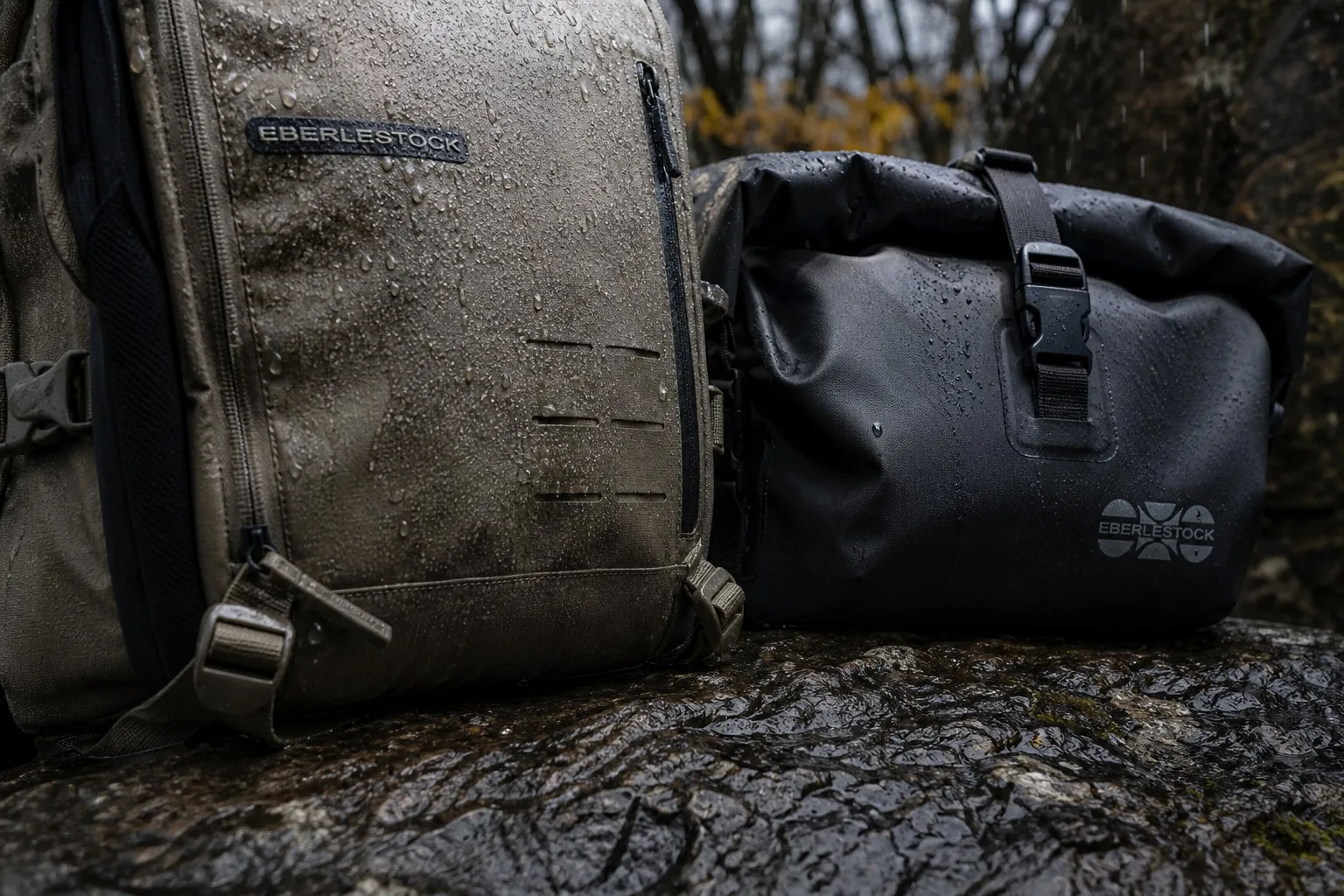
DWR beading vs. true waterproofing - the visible difference buyers must understand
Part 3: Comparative Analysis - DWR vs. Waterproof Construction
The following comparison synthesizes the technical analysis above into procurement-relevant dimensions. Each factor represents a trade-off that B2B buyers must weigh against their target market's actual usage patterns.
| FACTOR | DWR TREATMENT | FULL WATERPROOF CONSTRUCTION |
|---|---|---|
| Water Protection | Light to moderate precipitation for limited duration; fails under sustained rain, heavy downpour, or any standing-water contact | Hours of heavy rain; submersion possible at ratings above 10,000mm |
| Hydrostatic Head | 0mm (no pressure resistance) | 3,000mm to 20,000mm+ depending on specification |
| Ideal Applications | Lightweight daypacks, softshell jackets, range bags, entry-level accessories where price and breathability dominate | Fishing packs, waterfowl hunting gear, dry bags, expedition backpacks, tactical medical kits |
| Unit Cost Impact | $0.50–$3.00 added per unit | $5–$25 added per unit (membrane/coating + seam tape + zippers) |
| Weight Penalty | Negligible (grams) | 15–30% heavier than comparable non-waterproof product |
| Breathability | Unrestricted; coating sits on fiber surfaces, not between them | Zero (PU/TPU) to moderate (breathable membranes); always some resistance |
| Maintenance | Periodic reapplication (spray-on or wash-in); heat reactivation between treatments | Avoid sharp objects and abrasion; clean per spec; store dry to prevent delamination |
| Service Life | DWR coating: 20–80 wash cycles before reapplication needed | Structural waterproofing: 3–8 years depending on use intensity and construction quality |
| Failure Mode | Gradual wetting-out; reversible with treatment | Delamination, seam-tape peel, zipper leak; typically irreversible without factory repair |
Part 4: B2B Application Guide - Matching Technology to Product
The procurement decision between DWR and waterproof should be driven by a single question: what is the most severe water exposure the end user will realistically encounter? Answering this question honestly prevents the two most common specification errors in outdoor gear sourcing.
Products Optimized for DWR
Lightweight daypacks for urban-to-trail use fall squarely in DWR territory. These products are carried in conditions where users can seek shelter during heavy rain; their value propositions center on weight, breathability, and price-all of which full waterproofing would compromise. Softshell jackets and vests represent another DWR-appropriate category: worn during high-output activity where moisture vapor transmission is non-negotiable, softshells trade waterproofness for breathability by design. Range bags, competition gear, and accessories used primarily in controlled or semi-controlled environments also rarely justify the cost and weight of full waterproofing.
The common thread: DWR is appropriate when water exposure is incidental rather than sustained, when the user can mitigate exposure behaviorally (seeking shelter, using a rain cover), and when the product's competitive positioning depends on weight, breathability, or cost factors that waterproofing would undermine.
Products Requiring Full Waterproof Construction
Fishing tackle backpacks demand waterproofing by the nature of their use environment. Boats accumulate standing water in bilges; spray soaks everything on deck; rain arrives unexpectedly and persists. A fishing pack that is not waterproof is a pack full of ruined tackle. Waterfowl hunting gear faces similar certainty: marshes, flooded timber, and layout blinds involve hours of contact with standing water. Dry bags and portage packs for canoe and kayak expeditions must survive complete immersion during capsizes-a failure mode that admits no partial success.
Tactical medical packs represent a category where waterproofing carries safety implications. Contents must remain sterile regardless of conditions; water ingress that would merely inconvenience a hiker becomes a clinical risk in this context. Expedition-grade hunting backpacks for multi-day backcountry trips sit at the highest tier: when gear failure means hypothermia risk rather than mere discomfort, waterproofing specifications should err toward over-engineering.
The Hybrid Middle Ground
Between the poles of DWR-only and fully waterproof lies a commercially significant middle ground where hybrid approaches deliver optimized value. DWR-treated outer fabrics with waterproof liners in critical compartments allow a pack to shed light rain on the outside while protecting electronics and documents in a dedicated waterproof pocket. Water-resistant main bodies paired with included rain covers offer a cost-effective compromise: the rain cover provides genuine waterproofing when needed, while the base product remains light and affordable for fair-weather use. These hybrid solutions give B2B buyers room to differentiate products and hit target price points without abandoning weather protection entirely.
Part 5: Factory Profile - GAF Outdoor and Informed Specification
Since its founding in 2011, Guangzhou GAF Outdoor Products Co., Ltd. has operated at the intersection of manufacturing capability and buyer education-a positioning that reflects the reality that the best-made product is still a failure if it is the wrong product for the application.
GAF Outdoor's technical team has developed a systematic approach to new OEM and ODM inquiries that begins not with fabric swatches or pricing sheets, but with a diagnostic conversation: what conditions will the end user face, for how long, carrying what? This consultation process has proven its value repeatedly, preventing both over-engineering (full waterproofing on products used only in light-weather scenarios, adding cost that compresses margins) and under-specification (DWR-only products that fail under conditions the end user considers normal).
The factory maintains in-house testing capability that enables rapid, empirical comparison across the waterproofing spectrum. Fabric swatches treated with different DWR formulations can be tested for initial contact angle, spray rating per AATCC 22, and beading retention after standardized abrasion cycles. PU and TPU coating samples are evaluated under hydrostatic head testing per ISO 811, with failure modes documented and analyzed. Seam-taped prototypes undergo submersion testing with internal moisture indicators, allowing leak-path identification and process correction before production scales.
GAF Outdoor's material library spans C6 and C0 DWR treatments from multiple chemical suppliers, PU and TPU coating options across a range of thickness grades, and waterproof zipper solutions from established hardware manufacturers. This material breadth means the factory can match waterproofing specification to a buyer's specific cost, weight, and performance targets-rather than steering every client toward a single standardized solution.
For B2B buyers working with GAF Outdoor, the practical benefit of this approach is straightforward: the factory can discuss waterproofing options in technically precise terms, produce comparison samples that demonstrate the difference between specification levels, and recommend the solution that aligns with the buyer's actual market positioning rather than the one that is easiest to manufacture. In a sourcing environment where inflated performance claims are common, this engineering-led consultation represents meaningful competitive advantage.
Part 6: Buyer Education Strategy - Reducing Returns Through Clear Communication
The DWR-waterproof distinction creates downstream risks that extend well beyond the procurement decision. Products returned because "water got through" when the product was correctly specified as water-repellent represent communication failures, not manufacturing failures. Wholesalers and distributors who invest in clear, accurate product descriptions and labeling see measurably lower return rates on weather-protective products.
Terminology Discipline as Policy
The single most effective step a B2B buyer can take is implementing internal terminology standards and enforcing them across all customer-facing materials. "Water-repellent" or "DWR-treated" should describe products relying exclusively on surface treatments. "Waterproof" should be reserved exclusively for products with documented hydrostatic head ratings, sealed seams, and waterproof closures. The term "water-resistant"-common in consumer marketing-sits in an ambiguous middle ground that generates more confusion than clarity. Eliminating it from product descriptions eliminates a significant source of mismatched expectations.
Visual Communication Across Language Barriers
For wholesalers serving international markets, text-based descriptions face translation challenges and variable literacy levels. Simple icons and diagrams communicate protection levels faster and more reliably. A DWR icon showing water beading on fabric with a "light precipitation" indicator; a waterproof icon depicting a hydrostatic head test column with the millimeter rating prominently displayed-these visual cues work across languages and education levels. They also telegraph technical competence to the retail buyer scanning a catalog page.
Care Instructions as Customer Retention
Products that ship with prominent care tags explaining DWR reactivation and waterproof garment maintenance generate fewer "performance degradation" complaints over their service life. The instructions need not be elaborate: "Tumble dry on low heat for 20 minutes to restore water beading" is a single sentence that transforms a customer's experience from disappointment to understanding. For waterproof products, guidance on avoiding sharp-object contact, proper cleaning methods, and storage practices extends product life and reduces warranty claims.
The Power of Honest Limitation Disclosure
The most counterintuitive yet effective trust-building tactic available to B2B brands is transparent limitation disclosure. A DWR daypack listing that states "Repels light rain and splashes; not designed for sustained downpours or submersion" sets expectations that the product can meet. A waterproof hunting backpack described as "10,000mm hydrostatic head rating; keep contents dry in heavy rain and shallow submersion; not rated for deep-water immersion" communicates both capability and boundary. Customers who purchase with accurate expectations are satisfied customers who repurchase and recommend. Customers who discover limitations through field failure are former customers who leave reviews.
Conclusion: Engineering Decisions, Marketing Consequences
The distinction between Durable Water Repellent treatment and true waterproof construction is not a nuance for technical specialists. It is a procurement decision that propagates through the entire product lifecycle-from factory floor specification through warehouse receiving, retail display, customer purchase, field use, and eventual return or repurchase. B2B buyers who understand the science behind both technologies make better specification decisions. They communicate more accurately with their downstream customers. They build brands known for delivering exactly what they promise.
In an industry where water is the primary environmental adversary, understanding precisely how your products interact with moisture-when they protect, when they fail, and why-is not optional expertise for the competitive buyer. It is the foundation of every sourcing decision that determines whether a customer's next purchase comes from you, or from a competitor who got the specification right.


