

Introduction
A waterproof hunting pack has one structural weak point, and it sits on the spec sheet of every product line: the zipper. The fabric can be laminated, the seams can be taped, the hardware can be marine-grade - but the gap between the teeth of a closed zipper is a continuous open channel, and in wet-hunt environments that channel is where water actually gets in.
This is not an edge case. Rain, sleet, stream wading, and dew-soaked marsh grass are the exact conditions under which gear gets judged. A waterfowler's pack that leaks after one wet morning is a returned pack; a hunter who has a soaked phone or ruined shells does not buy the brand again. So the industry has built a complete engineering lineage around the closure: PU-coated Aquaguard zippers, welded-film waterproof zippers, reversed tooth geometry in reverse coil designs, and - the most interesting branch - drainage designs that stop trying to keep water out and manage where it goes instead.
For a brand building a weather resistant zipper hunting pack line, the zipper system is a first-order product decision, not an accessory. This is the engineering behind each option, and how to map them to your product.
Technical Part 1: The Water Path Physics
Capillary action in the tooth gap
Between the teeth of a closed coil zipper there is a gap of roughly 0.2 to 0.5 mm, running the full length of the zip. That gap is small enough that capillary forces dominate over gravity: moisture wicks along the tooth line even when the pack isn't actively getting wet. The water migrates along the teeth toward the interior, especially when the outer tooth face is exposed. Orientation is everything. A standard coil exposes the gap on the outside of the pack; a reverse coil puts the gap on the inside, where the wicking terminates against fabric instead of entering it.
Static pressure vs. dynamic impact
There are two different water regimes, and they load the closure differently. Standing water applies hydrostatic pressure across the entire closure - a pack sitting in a marsh is under continuous, depth-scaled pressure. Rain, by contrast, is thousands of discrete impacts, and it hits the top of the pack hardest. A 60 cm top main-compartment zip therefore faces dynamic impact plus wind-driven spray, while a 30 cm side pocket zip faces mostly capillary wicking and occasional splash. A zipper adequate for the side cargo pocket may be under-specified on the top of the same pack. Position and length both matter, independently of zipper type.
Zipper length is cumulative risk
Every centimeter of closed tooth gap is a statistical failure point. A 60 cm top zip carries roughly twelve times the exposed gap length of a 5 cm chest zip, and the field relationship is linear: the longer the zip, the more likely at least one weak spot exists - a gritted tooth, a worn slider path, a lifted tape corner. This is why serious wet-hunt packs pair short, critical zips with roll-top or clamshell closures: not as a style choice, but to minimize the total length of gap that has to perform.
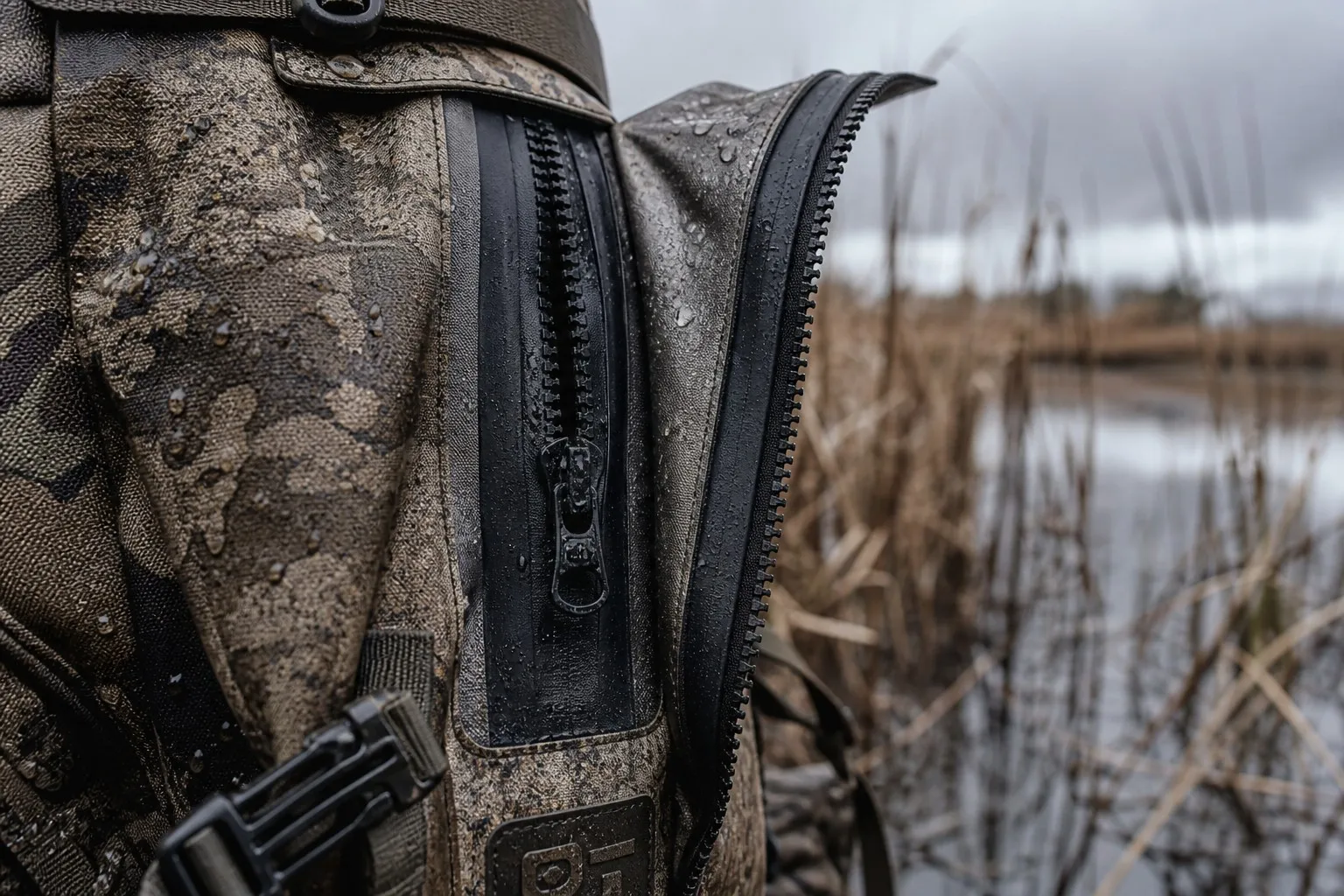
Storm flap up, PU-coated teeth - the gap that has to perform is protected on both sides
Technical Part 2: Zipper Type Taxonomy
Aquaguard zipper (PU-coated)
The aquaguard zipper is a standard coil with a PU coating on the teeth and tape. The coating changes surface energy: water beads on the closed teeth instead of wicking into the gap. It is not a sealed system - sustained submersion will push water through, and the coating itself degrades with UV and flex, typically losing beading performance after two to three hard seasons. The value is in the price-performance ratio: 15–30% above a standard coil, lighter than welded film systems, with solid cycle life. In hunting pack applications, the aquaguard zipper is the workhorse for quick-access pockets, chest pockets, and secondary compartments.
Waterproof zipper (TPU welded film)
This is the sealed class - YKK Aquaseal, TIZIP, and equivalents: a TPU film welded over the teeth to form a continuous membrane, closed by a slider mechanism that seals as it moves. Properly installed, it holds hydrostatic pressure well beyond anything a wet hunt applies; in the closed state it is functionally IPX7-class. The trade-offs are real: the film demands clean teeth (sand is fatal to it), the slider is a more complex moving part, cycle life is lower than coil, and cost runs three to six times a coated zipper. Waterproof zipper hunting use cases that justify it: main compartments, camera or gear rolls that will be submerged or sit in water for hours.
Reverse coil zipper
A reverse coil inverts the tooth geometry: the coil faces the pack's interior, and the outside is continuous tape. No capillary channel on the outside, no coating to peel, no film to puncture - just a coil with its vulnerable face pointing at the inside of the pack. A reverse coil zipper pack is not submersion-proof, but for rain and wicking it is the most durable, most maintainable solution at a mid price point, and many of the best-selling hunting packs specify it on the top main for exactly that reason.
Molded / injection zippers
Plastic molded teeth: cheap, large gaps, brittle in cold. Unsuitable for wet-hunt closures; acceptable for low-stakes interior pockets where cost and weight dominate.
Quick comparison
| System | Water resistance | Cycle life | Cost index | Best use |
|---|---|---|---|---|
| Standard coil | Baseline | Very high | 1.0× | Interior pockets |
| Molded / injection | Poor | Moderate | 0.8× | Low-stakes interiors |
| Reverse coil | Rain-shedding, durable | Very high | 1.2–1.4× | Main top (mid tier) |
| Aquaguard (PU-coated) | Rain-shedding | High | 1.3–1.5× | Pockets, secondary |
| TPU welded film | Submersion-proof | Moderate | 3–6× | Critical mains, camera rolls |
Technical Part 3: Drainage and Storm Flaps
The drainage design approach
The drainage design hunting pack philosophy inverts the problem: instead of sealing every inlet, it accepts some and manages the outlet. Bottom drainage (drain holes or quick-drain valves) plus an internal water channel routes water that did get in out of the lowest point - where the gear actually sits. For waterfowl packs this is standard practice, because a submersion event (a tipped blind, a boat wash) is more likely than the cost of a little water at the bottom of the pack.
The trade-off is a design constraint, not a defect: a drained pack is not a sealed container. Ammo, electronics, and clothing that must stay dry go in their own dry bags or sealed compartments. The engineering goal is to allocate risk, not to eliminate it.
Storm flaps
A storm flap covers the top zipper line: a fabric or TPU panel overlapping the closure, fixed with magnets, hook-and-loop, or snaps. Three parameters matter on the spec:
Overlap width should run 1.5–2× the zipper height.
Leading-edge orientation - the flap's low edge points downwind so water runs off the edge rather than into the gap.
Fixing spacing - tight enough to prevent billowing. A storm flap flapping in wind slaps the pack and pumps water into the gap. Magnets are the quiet field choice (no noise, one-handed); snaps are the serviceable choice.
Zipper garage
The ends of the zip are an under-specified failure point: even a perfect film zip will let water in at the slider tails. A zipper garage - a small 3D-cut cover at each end, or a drawcord cinch - closes the tail gap. It costs cents in material and assembly, and it belongs on the spec of every serious closure.
Fabric and Seam Interaction
A zipper only performs as well as its attachment to the pack body. Sewn attachment to 500D PU- or TPU-coated fabric is fine for low-stakes zips, but the needle punctures are potential leak points; on a main closure the zipper channel should be taped, with the tape-over-stitch line as the standard middle path. This is where a factory's tape-press capability actually shows up: adhesion, corner sealing, and temperature control are the variables, and they surface as field failures.
The area around a zipper takes cyclic stress: loaded pack weight concentrates on the zip bar, and every open-close flexes the adjacent fabric. On 500D coated nylon the fabric is fine, but the coating at the flex line cracks first - visible as hairline fissures after a season of daily use. A well-built pack distributes that load: wider bar-tacks, load-bearing webbing loops near the slider path, and bonded rather than sewn zipper tape where possible.
Maintenance and Failure
Field failure modes
In order of frequency: slider mechanism failure (the slider is the moving part; the teeth are not - most "dead zips" are dead sliders), grit loading (sand, mud, feather dust packed into the tooth gap, destroying the seal and abrading teeth), PU coating delamination (UV plus flex, visible as lost beading), and tooth wear at the ends.
Coating life and re-proofing
PU coatings degrade under UV; a waterfowler's pack sees dawn light on open water every day, and beading performance typically fades over two to three seasons. TPU is more UV-stable but costs more. A field kit should carry a silicone-based re-proofing spray and a zipper wax (beeswax/carnauba or PTFE). Wax sparingly - heavy waxing turns the teeth into a dust magnet.
Field procedure
After a wet day: wipe the teeth with a damp cloth, brush out grit with a soft brush, run the zip fully open and closed a few times to distribute wax, and air-dry with the top open. Salt exposure - waterfowl and coastal hunts - needs a freshwater rinse. Salt crystallization in the tooth gap can destroy a slider mechanism within weeks, and it is the most under-reported field failure there is.
Application Mapping by Hunt Type
Waterfowl / wetland (high exposure, submersion risk)
Main compartment on a TPU film zip or roll-top with a short critical zip; bottom drainage; storm flap; pockets in aquaguard or reverse coil. Submersion likelihood dictates drainage over total sealing.
Pack hunting / mountains (rain + long carry)
Reverse coil or aquaguard main with storm flap and taped channel. Full film zips add weight, cycle-life cost, and price that the exposure does not justify - unless the customer also carries the pack through boats and streams, in which case move to film plus drainage.
Dry climate hunts
Standard coil with PU coating is enough. Over-specifying is cost without benefit.
Hybrid system (the recommended mid-point)
Recommended mid-tier configuration: roll-top main with a short locking zip, quick-access pockets in aquaguard. Minimizes total critical zip length, keeps the BOM mid-range, and satisfies the "waterproof" claim on the hangtag. When a wholesale buyer asks for waterproof at a mid price point, this is the configuration to propose.
GAF Outdoor - Factory Profile
GAF Outdoor in Guangzhou has been manufacturing hunting packs and outdoor gear since 2011. Relevant capabilities for zipper systems: 500D PU/TPU-coated nylon production; heat-press tape sealing for zipper channels and seams, including corner-seal inspection; installation of aquaguard, reverse coil, and TPU welded-film zippers; storm flap and zipper garage assembly; drainage hole and quick-drain valve fitment. For OEM programs, zipper brand - YKK, TIZIP, or equivalent - is a line-item option in the tech pack: specify it and GAF Outdoor sources and installs accordingly, with a submersion test (30 minutes at 5 cm water depth) on the QC plan for critical closures.
B2B Strategy: Zipper Specs as a Transparent Selling Point
The zipper specification is an under-used differentiator in wholesale. "Waterproof hunting pack" is an unverifiable claim; a spec that reads "top main: 60 cm TIZIP welded film; chest: 30 cm reverse coil; bottom drainage" is a spec that can be verified. Publish the zipper brand, type, and position in the spec sheet, and the product communicates engineering discipline without a single marketing sentence.
The message to the retail buyer and the end user is simple: the zipper is the waterproof promise. In a market where ten vendors will all say "waterproof" at the same RFQ, the vendor that can specify every closure line-by-line wins the evaluation.
For OEM programs, put it in the tech pack: zipper brand and size per closure, coating type, channel tape specification, and the submersion test method. That document sells the next line for you.
Conclusion
The weather resistant zipper hunting pack question is not "which zipper is waterproof?" It is an allocation problem: where is the water coming from, at what pressure, over how much gap length, and what does the gear inside actually need to stay dry? Coatings for the workhorse pockets, reverse coil for mid-tier mains, welded film for the critical closure, drainage where submersion is likely, and a garage on every tail. Specify it line-by-line, test it, publish it - that is the pack that survives the first wet morning.
GAF Outdoor · Guangzhou · Hunting packs & outdoor gear manufacturing since 2011. OEM/ODM available - zipper brand (YKK / TIZIP / equivalent) and drainage configuration specifiable per tech pack.


