

Introduction: The Ambush Hunter's Seating Problem
Turkey hunting and predator hunting look like different sports until you sit in the woods. Both are ambush games built on the same sequence: walk in before daylight, find cover with a view, then hold still and wait. A gobbler that hangs up at forty yards and a coyote that circles downwind to check your scent both end the same way - the hunter has to be ready to shoot from a seated position after hours of near-total stillness.
For decades the standard rig was a folding tripod stool in one hand and a pack on the back. The stool carried the hunter; the pack carried calls, water, extra layers, and a decoy or two. It works, but it doubles the logistics. Two pieces of gear to carry in the dark. Two things to set up quietly. Two places for a strap to snag on a fence line or a briar patch.
The sit-down blind chair pack removes that split. The seat frame is built into the pack's backpanel, so the pack itself becomes the stool. You walk in wearing one unit, drop it, flip the frame down, and you are seated - no extra stool, no loose cushion, no pile of gear sitting on the ground behind you. It is the difference between "carrying a pack and sitting on a stool" and "the pack is the stool."
That shift matters at retail, because it changes what the hunter is buying. Not a stool plus a pack, but one integrated system with one weight, one silhouette, and one set of failure points. The sections below cover how these systems are engineered - seat geometry, fold-frame construction, silent deployment, gear access, and the dual-use logic that holds the concept together - written from the perspective of a factory that has built fold-frame furniture and sewn cushioned seating for more than a decade.
Technical Part 1: The Sit-Down Blind Workflow
A sit-down chair pack is a workflow tool, so it is worth tracing the workflow it has to survive: setup, sit, call, shoot, exit.
Setup
The hunter arrives at the chosen tree or brush line, usually in the dark. The pack comes off the back and the frame opens. In an integrated design this is one motion: release the latch, let the legs drop, set it down. There is no separate stool to unfold and no cushion to fish out of the main compartment. We time these builds on our own line; a practiced user goes from pack-off to seated in ten to fifteen seconds.
Sit
Seat height is the defining dimension, and it sits between 25 and 40 cm depending on the model. That low position does two jobs. It keeps the hunter's head below the sightline of a turkey, which scans nearly 300 degrees and picks up vertical silhouettes fast, and it holds the profile under the brush line in a ground blind. Back support matters as much as height. A slightly reclined back panel - roughly 95 to 100 degrees of seat-to-back angle - takes load off the lower spine and lets the hunter keep the torso upright for hours without slumping. Slumping is what gets you caught. Movement, not noise, ends most sits.
Call
With the torso supported and both hands free, the caller works a box or slate call across the lap. Because the seat pan is part of the pack, the gear stays within arm's reach instead of on the ground, where one fumble sends it into a creek or under a layer of wet leaves.
Shoot
The shot comes from the seated position. The rifle or shotgun rests across the support knee or on a dedicated gun rest, and the body stays low. A chair pack that wobbles under a loaded gun fails at the only moment that counts. Frame stiffness - not just the load rating printed on the datasheet - is what gets tested here.
Exit
After the shot, the hunter stands, the frame folds, and the pack goes back on. When the exit is quick - a second bird, a follow-up call, a long walk to recover the coyote - the fold has to be as fast as the setup. Thirty seconds or less, round trip, is the benchmark we hold.
The through-line is that every step happens at or below the height of the surrounding cover. The pack is not an accessory to that workflow; it is the chair that makes the workflow possible.
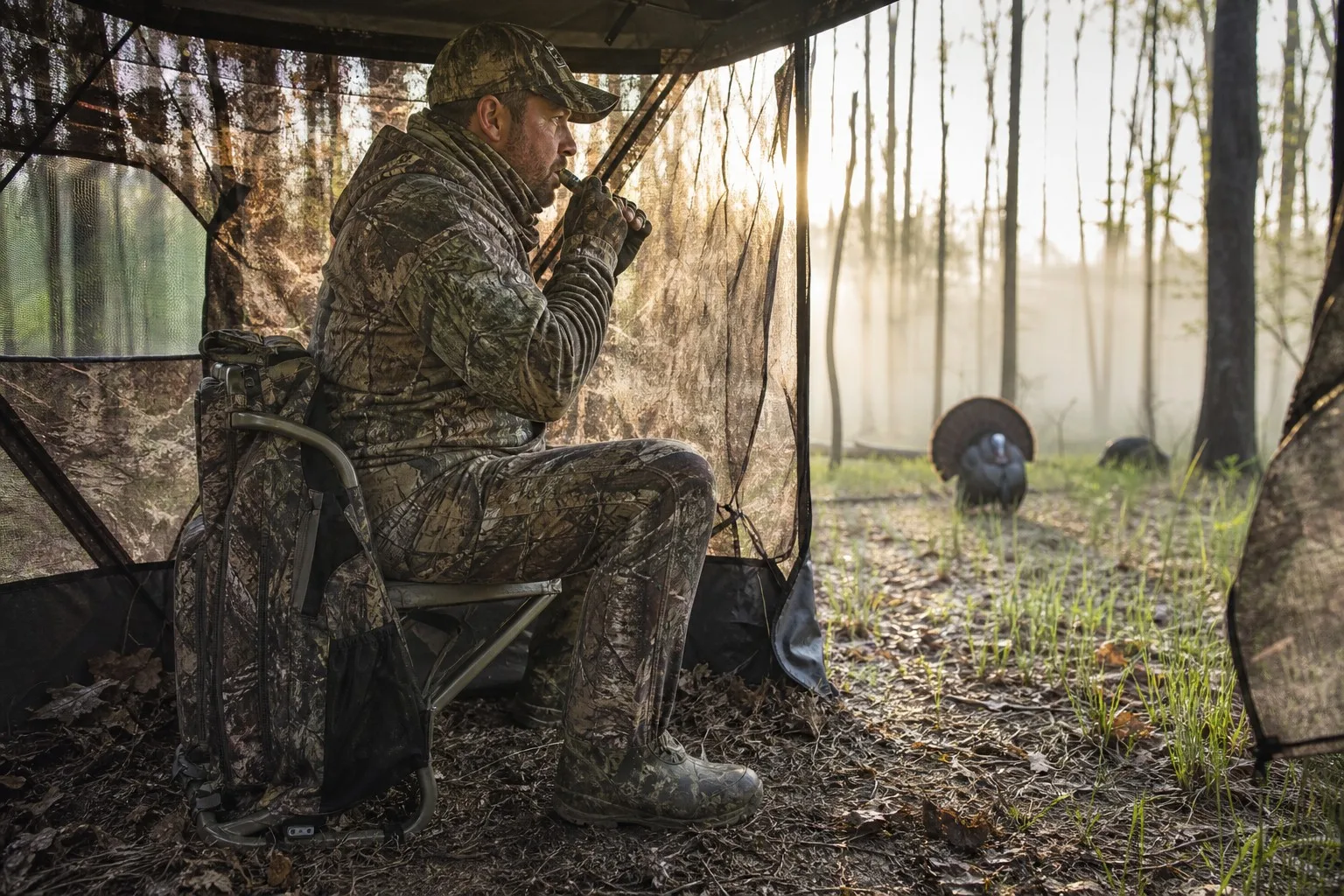
Low seat, low profile, everything at cover height - the pack is the chair
Technical Part 2: Seat Structure Engineering
The seat is the part most likely to be abused and least likely to be inspected, so it gets the most engineering attention.
Fold-frame types
Three architectures dominate. X-folds use two crossed leg sets that collapse flat against the backpanel - light, simple, and the most common choice for turkey-focused models where weight is the first spec on the datasheet. U-tube frames use a single formed tube that swings down from the bottom of the pack, giving a wider, more stable footprint and fewer pinch points, which matters on predator rigs where the hunter is often swinging a rifle across the lap. One-piece molded seat pans exist on premium lines: the pan is a rigid polymer shell that doubles as the pack's internal frame, so the seat and the load-bearing structure are the same part. Each architecture trades a little weight for a little stability, and the spec sheet has to say which one the buyer is getting.
Load and durability
A credible hunting-grade frame is rated for 120 to 150 kg - enough for a hunter in full cold-weather kit - and the rating has to survive cold soak. Aluminum tubing in the 25 to 32 mm range with gusseted joints is the industry workhorse; welded steel shows up on budget lines where weight is less critical. The frame has to pass a drop test off a tailgate and a few seasons of cold-morning use without developing play at the joints.
Fabrics and cushioning
Seat and back panels split into two schools. 500D polyester is the default for the seat and back because it shrugs off briars, wet leaves, and pack rub, and it accepts any camo print a buyer wants. Mesh panels are a deliberate trade: they breathe in early-season warmth and dump sweat faster, at the cost of abrasion resistance. The right answer is usually both - mesh where the body breathes, 500D everywhere the brush touches.
Cushioning runs 2 to 5 cm of closed-cell or laminated foam. Two centimeters keeps the pack slim and covers short sits; 4 to 5 cm is what you spec when the product description says "all-morning comfort." Closed-cell foam matters more than thickness. It does not soak water, it does not crush flat after a season, and it recovers overnight in a cold truck.
Connection to the pack
Detachable seat modules unclip from the pack body so the pack works as a plain daypack when the hunter plans to sit on the ground or on a permanent stand. Integrated frames never separate, which saves weight and removes a failure point but locks the buyer into always carrying the seat. Both have a market; the integrated version is what most "chair pack" listings actually mean, and it is what this article is about.
Technical Part 3: Quiet Deployment
A blind is a quiet space, and the pack is the loudest thing in it.
Sound control
Hinges get the most attention. Metal-on-metal pivot pins click under load, so spec-grade frames use nylon bushings, oversize pins, or soft-touch coated pivots, and the seat-to-pack latch uses silent mechanisms rather than metal snaps. Rubber bumpers at the fold points do two jobs: they damp the clack of the legs seating into place, and they keep the frame from rattling against the pack body while the hunter walks. A pack that ticks with every stride spooks the coyote that was already suspicious.
Speed
Conversion from carry mode to seated mode should take under 30 seconds, and the good ones do it in half that. The design goal is one-handed operation: the frame opens with the pack on the ground while the hunter's other hand is already reaching for the call. Anything that needs two hands, a knee, and a flashlight gets skipped on a cold, dark morning.
Balance
When the frame drops, the loaded pack becomes a chair with its center of gravity somewhere above the seat pan. A heavy blind bag or a water bottle in a poorly placed pocket tips the whole unit backward the moment the hunter leans back. The fix is a low, rear-biased geometry and load pockets that sit low on the pack - and it is a fix that has to be tested loaded, not empty.
Space inside the blind
Inside a pop-up ground blind, room is tight and the walls are fragile. The frame has to open within a radius of roughly 60 to 70 cm - the width of a chair that fits between a blind wall and a hunter's knees - without snagging fabric or knocking over a decoy on the way down. That footprint constraint is why you do not see wide throne-style seats on chair packs: the market wants a chair that deploys in the space a stool would have used.
Gun and Gear Access
Sitting changes how gear is reached, and the pack layout has to reflect that.
Gun support
The most overlooked feature is where the gun goes when the hunter is seated. A butt rest built into the side of the pack, or a webbing cradle across the front of the seat, keeps the rifle or shotgun off the wet ground and within reach. On predator rigs, where a rifle may be slung for hours, a built-in butt rest is the difference between "I can grab it" and "I have to stand up to get my gun."
Callers and decoys
The calling pocket belongs on the front or side of the seat, at lap level, so the caller works without leaning forward - leaning is movement, and movement is detection. Decoy pouches sit low and outboard, accessible without standing. The rule we use at the factory: if a pocket requires the hunter to stand or twist to reach it, it is in the wrong place.
Ammunition
Shell loops or a small dump pocket go on the side opposite the shooter's support hand, where a seated hunter can reload one-handed without breaking the low profile. It sounds like a detail; it decides whether a second shot at a circling coyote happens at all.
Warm layers
Early-morning hunts start cold and end warm, and the layers peeled off mid-sit have to go somewhere quiet. The answer is a top-loading compression pocket on the pack's lid or back - reachable while seated, openable with one hand, and flat enough that stuffing a jacket into it does not topple the chair. A good chair pack is designed around the fact that the hunter will be taking clothes off while sitting in it.
Pack and Seat Dual-Use Logic
The seat is not a bolted-on accessory; it is the structural spine of the pack.
Seat as backpanel
When the frame is folded, it becomes the backpanel of the pack. That is a feature, not a compromise: the rigid frame transfers load from the shoulder straps to the hip belt better than a soft pack, which is why a well-built chair pack carries heavy loads more comfortably than an equivalent soft daypack. The hunter who walks 800 meters into the timber in the dark gets a backpanel that holds its shape and a seat that is already in place on arrival.
Weight allocation
The seat structure - frame, pan, cushion, hinge hardware - runs 1 to 1.8 kg depending on the architecture. That is the honest price of the concept, and it is why the frame design matters so much: every gram spent on the seat is a gram not spent on the pack's own structure, and the two have to be engineered as one mass budget, not two products bolted together.
When the seat is not used
On hunts where the plan is to stand, glass from a ridge, or sit on a permanent stand, the seat module folds flat and the pack works as a normal daypack - on detachable designs, it is removed entirely. The dual-use logic is the whole point: the hunter never carries dead weight, because the seat is either working as a chair or working as structure.
Factory Profile: Guangzhou GAF Outdoor
GAF Outdoor has built fold-frame outdoor furniture and sewn cushioned seating in Guangzhou since 2011, and the sit-down blind chair pack sits at the intersection of both capabilities.
On the frame side, the factory runs tube bending, welding, and powder-coating lines that cover the full range of fold architectures - X-folds, U-tubes, and molded pans - with in-house drop testing and joint-life testing on every frame design. On the soft-goods side, the sewing floor handles 500D and mesh fabrication, foam lamination, and camo pattern application, with cushion build-up run as a dedicated station rather than a side task. That combination matters for buyers: a chair pack is a hard-goods product with a soft-goods finish, and most factories are strong at one and weak at the other.
Production runs are quoted OEM and ODM. Sampling typically takes two to four weeks, and first production runs follow at eight to twelve weeks depending on frame complexity and fabric sourcing. QC is where the product lives or dies - hinge torque, foam density, stitch tension, and camo pattern registration all get checked against the same spec sheet the buyer signs off on.
B2B Strategy: Where the Chair Pack Sits in the Market
The sit-down chair pack competes with the tripod stool, and it does not really try to replace it. The tripod stool is cheap, proven, and fine for the hunter who already owns one and does not want to change habits. The chair pack sells to a different shopper: the hunter upgrading from a daypack, the first-time turkey hunter building a kit from scratch, and the predator hunter who has learned the hard way that the coyote shows up the minute the gun is out of reach.
Positioning matters. This is not a "better stool" story; it is a consolidation story - one piece of gear, one weight, one silhouette, one less thing to forget in the truck. Retailers that sell it alongside stools rather than against them capture both buyers.
The calendar has a rhythm worth planning around. Spring turkey season runs March through May across most states, which puts consumer purchasing decisions in January and February - and puts factory orders earlier still. Buyers who want spring-shelf stock need purchase orders placed by late fall, with production slotted for December and January so units land in distribution before the first gobbler sounds off. Predator season is the compensating second wave: coyote pressure is year-round, so the same SKU keeps selling through summer and into fall, which flattens the inventory risk a turkey-only product carries.
The through-line for B2B buyers is simple: the sit-down chair pack is not a novelty category, it is a workflow category, and the factories that can build the frame and sew the seat under one roof are the ones positioned to supply it.


