

Introduction
Walk any game trail in the Rockies, the Alps, or the Scottish Highlands and you will see the same kit: a 10x42 or 12x50 strapped around a hunter's neck, bouncing off the chest with every stride. The binoculars get all the attention - ED glass, dielectric coatings, phase-corrected prisms - while the question of how to carry them is treated as an afterthought. It should not be.
For most hunters the binocular is the single most expensive item on their back, and it is also the one most likely to be dropped, swung into a branch, or worn around a sore neck for nine hours. The carrying system decides how often the glass actually gets used, how well it survives the season, and what the hunter pays for it in fatigue. That is why the argument between the dedicated bino harness and the pack-integrated approach - purpose-built carriage versus all-in-one loadout - has moved from forum debates to product-line decisions.
This article is written for importers, distributors, and outdoor brand managers who need to understand the engineering behind both solutions before committing to a SKU, a bundle, or a factory partner. We cover the physics of the problem, the design logic of each approach, the scenarios where one clearly wins, and how a manufacturing partner like GAF Outdoor (Guangzhou, since 2011) turns these requirements into production-ready product.
Technical Part 1: The Optics Carry Problem
Before comparing solutions, define the problem. A modern 10x42 roof-prism binocular weighs between 680 g and 900 g (1.5–2 lb) with armor; a 12x50 or 15x56 pushes past 1 kg (2.2 lb). Add a rangefinder, GPS, or bino adapter and the effective mass grows. Now put that mass at the end of a strap around the neck and start walking.
Swing dynamics
A hunter walks at roughly 100–120 steps per minute on varied terrain. Each heel strike sends an impulse through the body; the binocular, suspended at the end of a strap, acts as a pendulum. The strap softens the initial jolt, then the mass keeps oscillating. Every step re-energizes that swing, so the glass is rarely still. The load is not one clean shock - it is a repeated, low-frequency hammering that accumulates over thousands of steps. A 900 g binocular effectively loads the neck with several times its static weight during the deceleration phase of each stride.
Neck load and cervical fatigue
The neck is a suspension system designed for the head (4.5–5 kg), not for an extra kilo swinging off the C3–C7 vertebrae via the trapezius and sternocleidomastoid muscles. Sustained loading plus oscillation produces muscle fatigue, tension headaches, and a forward-head posture that compounds the problem. In a nine-hour hunt the hunter is not carrying the binocular - he is fighting it. Fatigue also degrades technique: a tired hunter raises the glass less often and checks fewer ridges.
Impact risk
Every time the binocular swings into a rock, a tree trunk, a rifle sling, or a truck door, it takes damage. The failures are rarely dramatic. More common: a focus knob that develops a rough spot, a cracked eyecup, a loosened hinge, and - worst of all - a prism that shifts a fraction of a millimeter, destroying collimation and producing double images at distance. Collimation repair is expensive and takes the optic out of service mid-season.
Access speed
Then there is the "why carry it at all" test. A deer appears at 300 m and stays visible for 20 seconds. The hunter must locate the animal, raise the glass, and settle into a stable position in under three seconds - ideally under two. A neck-strapped binocular requires one hand to unclip, both hands to raise, and a strap that pulls the head down. The carry system either enables that sub-3-second response or it does not. There is no middle ground.
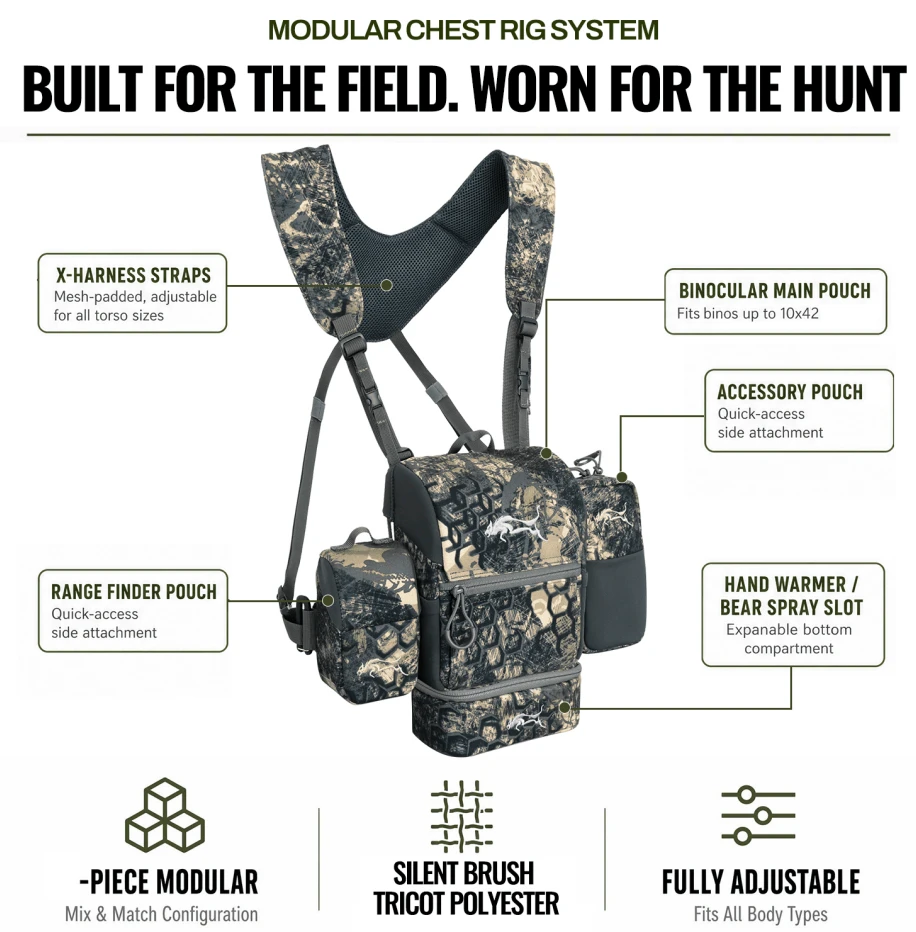
Neck-load off, shoulder-load on - the harness that enables the sub-3-second glass raise
Technical Part 2: The Dedicated Bino Harness
The dedicated harness - the chest-mounted bino harness hunting pack system in its classic form - solves the problem by moving the load off the neck and onto the shoulders, and by changing how the optic moves with the body.
Chest suspension and float
A well-built harness holds the binocular against the chest with a floating mount: elastic or gusseted panels that let the optic move with the torso instead of bouncing against it. The goal is to kill the pendulum effect. By compressing the load against the body's center of mass, swing amplitude drops dramatically compared with a free-hanging strap, and the padding spreads the contact area - which matters on a multi-day pack hunt.
Load transfer
Straps run over the shoulders, often merging with or clipping into a backpack's shoulder straps, moving the weight from the cervical spine to the stronger muscles of the shoulders and upper back. This is the same ergonomic logic that took daypacks from one-strap to two-strap designs decades ago. The load is not gone; it is relocated to a structure built for it.
Magnetic quick-release and one-hand stow
Modern harnesses add a magnetic buckle at the top. On the draw, the hunter pulls the binos up and the magnet releases instantly - no fumbling with a plastic clasp - and the glass is at eye level in under two seconds. Stowing is just as fast: the binos drop back, the magnet re-engages with a click. One hand does both jobs, because the other hand is holding a rifle, a spotting scope, or the side of a slope. For sit-and-glass sessions, some harnesses rotate the optic 90 degrees so the objective lenses face the ground when the hunter is seated - a small detail with a big effect on long sits.
Layering compatibility
A harness must work under a rain shell and over a down layer, with a pack strap crossing the chest and a rifle sling doing the same. This is where fit engineering matters: the adjustability range has to cover a heavy baselayer plus insulation in November and stay snug in August. Dual-density spacer mesh and multi-point adjustment straps keep the harness in place under pack load without pinching.
Technical Part 3: Pack-Integrated Optics
The pack-integrated approach treats the binocular as one load among many, with the pack's carrying system as the primary platform. Integration points vary, and each carries its own trade-offs:
Detachable bino pocket
A padded chest pocket that clips to the pack's shoulder straps and sternum strap, and removes entirely for standalone harness use. This is the integrated bino pouch in its most useful form: it becomes a harness when you are off the pack (glassing ridge-lines from camp) and a pack feature when you are moving. The catch is that quality detachable systems need a rigid enough interface that the pocket does not sag under a 1 kg load - a failure mode of cheap clones.
Sternum strap integrated pouch
A small pouch built into the sternum strap itself. Fast access, minimal added weight, but realistically limited to compact binoculars or rangefinders. Not viable for a full-size armored 10x42.
Top-lid optics compartment
The classic "binoculars live in the pack's brain" solution. Excellent protection from rain and trail contact; poor access - the hunter must stop, take the pack off or rotate it, open the lid, and dig. Fine for vehicle-to-camp shuttles, wrong for active glassing.
Shoulder strap side pockets
Low cost and light, but they carry the optic high and wide, off the body's centerline, which increases swing and creates an asymmetric load that pulls on one shoulder. Acceptable for light compacts, marginal for full-size optics.
The general rule: the closer the optic sits to the body's centerline and center of mass, the better it moves with the hunter. Pockets that push the load outward trade stability for access. Pockets that put it on the back trade access for protection. Pack integration can never match a harness for active use - but it does not have to, because active use is not always the job.
The Hybrid Decision Matrix
The honest answer to "harness or integration" is "it depends," and a professional lineup sells both. This is the decision logic we use with wholesale clients:
| Scenario | Primary carrier | Why |
|---|---|---|
| Vehicle/ATV to camp, short walks | Pack top-lid or detachable pocket | Protection dominates; access is a non-issue over short distances |
| Day hunt, active glassing (elk, mule deer) | Dedicated harness | Sub-3-second access and zero swing matter more than pack space |
| Long climb / technical approach | Pack-integrated (top-lid or roll-top) | Optics stay safe and balanced; you are not glassing while scrambling |
| Sit-and-glass (sheep, mountain goats) | Harness with 90-degree rotation | Hour-long sits demand neck relief and ground-clear objectives |
Load priority is the second axis. If optics are the most expensive, most-used item on the body - western hunting, birding trips - buy the harness and treat the pack as secondary. If the load is dominated by shelter, food, and tools - backcountry overnighters - the optics go into the pack and the harness stays home. The hybrid approach, a harness for the walk plus a pocket for the pack sharing one mounting interface, is where premium brands differentiate, and it is where our OEM work concentrates.
Integration Design Details
Engineering quality separates a professional product from a clone, and it shows in the details:
Rain cover and optics compartment linkage
On pack-integrated designs, the optics compartment should share the pack's rain cover system - or have its own dedicated cover that deploys without opening the main bag. On harnesses, the binos sit under the shell in rain, but a zippered storm flap or a dedicated rain hood matters in prolonged weather. A seam-taped, DWR-finished optics pocket is not a luxury; it is a requirement for a product sold in Scotland or the Pacific Northwest.
Eyecup protection
Eyecups are the first casualty of a loose carry system. A soft interior lining - brushed tricot or micro-fleece over a molded EVA or PE board insert - protects the eyecups and the eyepiece lenses. The padded insert also creates the compression fit that keeps a 1 kg optic from rattling inside the pocket. Liner spec matters: too soft and it adds bulk, too hard and it transmits shock. A proven build is dual-density - 8 mm high-rebound EVA for the floor, 5 mm firm PE for the walls, wrapped in a non-abrasive knit.
Force transfer to the pack suspension
This is the point most brands miss. When a binocular rides on the pack's front, its mass adds to the pack's forward pull, shifting load off the hip belt and onto the shoulders, and dragging the shoulder straps backward. Compensation comes from three levers: a load-lifter strap tightened to pull the pack top into the back, a hip belt that is actually snug, and a sternum strap placed so the pack cannot lean back. A rigid or semi-rigid frame handles front-mounted optics far better than a frameless stuff-sack pack. If you are building a hunting pack with bino holder, the frame, the shoulder straps, and the sternum strap are all part of the optics carry system - not just the pocket.
Factory Profile: GAF Outdoor
GAF Outdoor (Guangzhou, established 2011) is a soft-goods manufacturing partner specializing in padded inserts, harnesses, and modular carrying systems. The factory's core competency is the work that is hard to get right: multi-layer padded insert sewing with a consistent compression fit, magnetic hardware integration, and modular attachment - MOLLE/PALS-compatible webbing, quick-release buckles, and proprietary clip interfaces for detachable chest pockets. Every padded insert is cut, sewn, and QC-inspected in-house, with pattern development and sampling support for brands that want a custom bino harness hunting pack, a binocular harness backpack, or a hunting pack with bino holder rather than an off-the-shelf import. OEM and ODM programs cover optics carry systems in production runs from several thousand units upward, with mixed-SKU container loads for bundle programs.
B2B Strategy: Building the Optics Carry Lineup
For distributors and brands, the optics carry category rewards a portfolio, not a single SKU:
Harness as a standalone SKU
A dedicated bino harness sells to the core hunter who already owns a good pack and a good binocular. It carries the highest perceived value per unit of fabric, earns premium margins, and is the entry point for the brand's optics-carry story. Sell it to dealers as a margin item, with a demo harness hanging in the shop.
Pack-integrated accessories
Detachable bino pockets and packs with integrated bino holders sell through the pack channel, to the hunter buying a new pack anyway. Per-unit margin is lower, volume is higher, and the integration upgrades the whole pack line. This is also where cross-selling lives: a pack buyer is a harness prospect, and the reverse is equally true.
Wholesaler bundles
The highest-leverage play is the bundle: binoculars plus harness plus pack (or harness plus pack for hunters who already own glass). For the wholesaler, a bundle moves three categories on one invoice, raises average order value, and simplifies landing-cost negotiation with the factory. For the retailer, the bundle anchors the optics-carry conversation at the counter. For the factory, the bundle makes the most efficient use of one production line and one QC batch. GAF Outdoor supports bundled programs with mixed-SKU container loads, co-branded hang tags, and a shared accessory interface across harness and pack SKUs - so the bundle is a system, not a coincidence.
Conclusion
The neck strap is not a carry system; it is a failure mode. The dedicated harness wins on access speed, swing control, and neck relief. The pack-integrated approach wins on protection and load discipline. The hybrid system wins the premium end of the market. The brands that lead this category will be the ones that treat optics carriage as an engineered subsystem - measured in grams of swing, seconds of access, and millimeters of padding - rather than a pouch on a strap. That is the standard we build to at GAF Outdoor, and it is the standard we recommend to every buyer.


