

Introduction
A multi-day hunt forces a decision that no one-day pack has to make: how much do you carry, and how do you carry it without paying for it on the final climb? A hunter who leaves the vehicle for three or four days needs shelter, food, water, a fire kit, spare layers, ammunition, and a weapon - and every one of those items has to be reachable when the light is bad and the hands are cold. A soft day pack can hold a single day's kit, but on a long approach the weight sits entirely on the shoulders and shifts with every stride.
The 901-09 answers that problem at the 50L mark, which is where the multi-day segment of hunting pack demand actually concentrates. This article breaks the pack down the way a procurement team should: what the 50L class is for, how the internal aluminium frame and the compartment layout turn a heavy load into a stable one, and which details - from the hydration exit to the rain cover that can also cover a carried rifle - separate a well-built multi-day frame pack from a heavy bag that merely hangs on the back.
Technical Part 1 - Where the 50L Line Sits
What a multi-day load actually contains
A two-to-four-day hunting load is not "a day pack plus more." The cargo list grows in categories:
Food and water. Enough food with margin, plus a trail hydration system and reserve capacity for refills at camp.
Shelter and sleep. Tarp or tent portion, sleeping bag or liner, insulating pad.
Clothing. Spare base layer, insulation layer, weather shell, dry socks for camp.
Weapon and ammunition. Rifle or bow, ammunition, and a place to keep cartridges accessible.
Field tasks. Stove, fuel, pot, first aid, navigation, knife and tools.
Packed for real hunting conditions, that list routinely grows past the 30L class, and it is dense: water, ammunition, and metal gear concentrate weight into small volumes. Density, not just total weight, is what makes a multi-day load punishing.
The boundary with one-day packs
The same series offers the 901-08 in 30L, and the two sizes split the use cases. A 30L pack covers a day out from a vehicle base: food for one day, water for the day, a spare shell, and a weapon stowed or carried. The moment the plan extends past one night, the math changes - you are no longer carrying a day's kit, you are carrying camp. The 50L class is the first volume at which a full camp fits without forcing the user to split loads or run resupply.
When a frame becomes necessary
A soft pack with no structure works while the load is light and low. Three conditions push a buyer into frame territory:
The load goes up. Overnight loads plus dense cargo raise total weight until the shoulders alone can no longer hold the line.
The terrain goes steep. On long approaches with elevation, a soft load sways and walks away from the back with every stride.
The carry gets long. When the same weight stays on the body for most of a day, load transfer to the hips stops being a comfort feature and becomes a necessity.
That is the design brief behind the 901-09: a 50L pack with an internal aluminium frame, built to hold a multi-day load up, close to the body, and off the shoulders.
Technical Part 2 - Technical Breakdown of the 901-09
Before the component walk-through, the headline specifications of the model:
Capacity: 50L
Pack weight: 1.92 kg
Dimensions: 24 in (61 cm) H × 13.8 in (35 cm) W × 7.5 in (19 cm) D
Main fabric: Brush Tricot Polyester
Frame: aluminium frame inside the back panel
The internal aluminium frame
The 901-09 carries an aluminium frame inside the back panel - an internal frame, not an external cage. Its job is to create a rigid chassis between the load and the body. When the pack is loaded, the frame takes the load's tendency to slump and walk, and instead routes the weight through the harness down to the hip belt. In practical terms:
Load transfer. The hip belt becomes the primary load-bearing element; the shoulder straps act as stabilizers rather than the only thing holding the pack.
Stability. A rigid frame keeps dense, low-sitting cargo - water, ammunition, food - from shifting on steep ground, which is what causes shoulder fatigue on long approaches.
Back clearance. The frame lifts the load off the spine, letting the back panel move air and keeping the pack stable against the body's motion.
"Aluminium frame inside" is the full technical statement of the design: no alloy grade, tube diameter, or load-rating figure is published for this model, and a buyer should size the program around that.
Brush Tricot Polyester main fabric
The shell is Brush Tricot polyester: a polyester weave with a brushed, tricot-textured surface. For a pack that rubs against tree lines, branches, rocks, and the ground along its base, the fabric has to survive abrasion while staying easy to field-clean. Polyester holds its shape under load, dries quickly when wet, and takes field washing without fuss, and the brushed tricot surface gives the pack a softer-touch exterior than a plain weave. For a buyer specifying colorways or logo placement, note that brushed surfaces take embroidery and screen printing differently from smooth weaves - approve a swatch before finalizing branding.
Two main pockets and the bottom-access zipper
The front of the pack is organized around two main pockets, supported by a top pocket and a front pocket for quick items, plus a zipper that runs to the bottom of the main volume. That bottom access is the key to the retrieval logic:
Heavy gear goes deep. Sleeping bag, shelter, food - placed low and close to the spine, where the frame and hip belt hold it.
The main volume opens like a box. Instead of digging down through the top opening, the user lays the pack on its back and opens from the base, which is the fastest way to reach the heavy items at the bottom.
Quick items stay up. The top pocket and the front pocket carry day-to-day items - snacks, map, hand-warmer, small tools - without opening the main volume.
Compressed strap, MOLLE webbing, loops, and the bottom strap
Compressed strap. Keeps the load tight against the frame. A load that is not compressed sways; compression reduces the sway and keeps the pack profile compact, which also helps when the pack is clipped to a sled, a vehicle, or a tree stand.
MOLLE webbing. MOLLE webbing lets the user add pouches and attach gear without tools - the modifiability hook for a brand that wants a platform its customers can build on.
Webbing loops. Reinforced loops on the shell for straps, gear, and tie-downs.
Bottom strap. Secures external loads at the base of the pack - a rolled pad, a tarp, or part of a carried weapon - so the external package moves as one.
The hydration system
The 901-09 is wired for hydration in three places: a hang point for the hydration bladder inside the back panel, a hydration pocket that keeps the bladder seated, and a hydration exit on the back through which the drinking tube comes out to the chest. The bladder itself is a mountable system rather than a spec-listed component, so a program can supply its own or pair the pack with a standard bladder. The chest belt also helps keep the drinking tube in place during movement, so it does not flap against the face on the climb.
Airflow padding, hip belt, chest belt, handle, and ammo holder
The back panel combines airflow padding - cushioning with an open-air structure that keeps the panel moving air even under load - with the hip belt, the primary load-transfer element, and the chest belt, which stabilizes the shoulder straps. A top handle covers short carries where the straps come off. An ammo holder on the back keeps ammunition or small items secured and reachable - a genuinely useful detail on a hunting pack where the user's hands are otherwise full.
External carry of rifle or bow
The 901-09 is specified to carry shooting equipment or a bow on the outside of the pack, secured through the front webbing system and the compressed strap. External carry keeps the weapon accessible and out of the main volume, and the bottom strap helps lock the package down. This is the feature that pushes the pack from "camp carrier" into "hunting platform" - and it is the detail a buyer should stress at sample stage, because the webbing and compression points have to hold a rigid object against the load.
The rain cover - and covering the weapon with it
A rain cover pocket on the back stores the cover when it is in use. Two things matter to a buyer:
The cover closes over the carried weapon too. In the external rifle or bow configuration, the rain cover covers the pack and the carried shooting equipment together.
The cover is a rain-protection accessory, not a waterproof rating. No IP rating or whole-pack waterproof performance is published for the 901-09, and the pack itself should not be treated as waterproof - zippers, seams, and fabric are not rated as a sealed unit. For wet-weather duty, the cover is the protection layer.
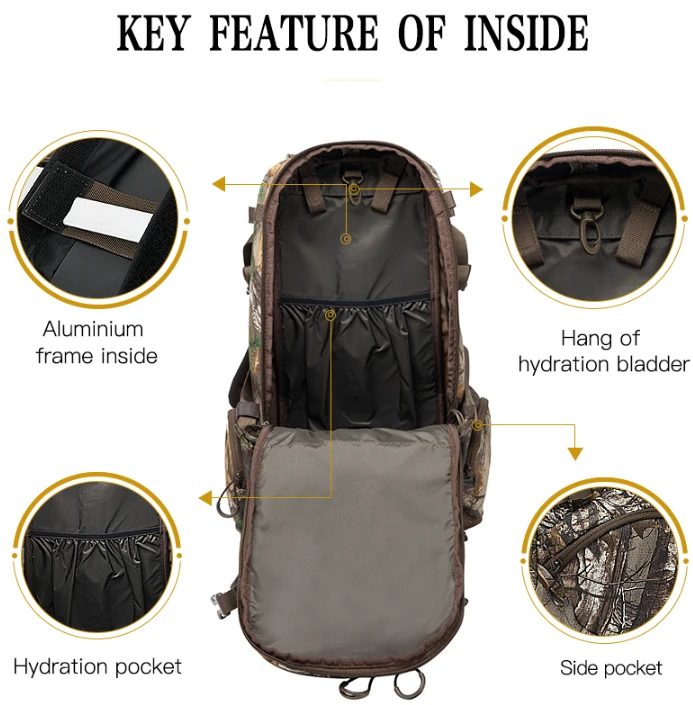
Inside the 901-09: the internal aluminium frame, the hydration bladder hanger and sleeve, and the side pocket
Technical Part 3 - Procurement and Customization View
Why 50L is the multi-day volume workhorse
In a hunting pack line, 30L sells as the day pack and larger expedition volumes come with a bigger frame and a higher empty weight. The 50L class sits in the middle, and it is where the volume of multi-day hunting demand actually is: enough room for a two-to-four-day camp, a pack weight of 1.92 kg that leaves most of the carry budget to cargo, and a profile that still moves through brush without being expedition-sized. A program that needs both ends of the use case can pair the 901-09 with the 901-08 (30L) from the same series, covering day trips and multi-day trips from one line.
What to verify at sample stage
The sample round is where a frame pack is made or broken. Four areas deserve specific attention:
Frame assembly. Inspect how the internal aluminium frame is integrated inside the back panel: the fit, the attachment points, and any contact between the frame and the fabric or padding. The frame should sit quiet - no shifting under load, no rubbing, no edges working against the shell. Also work out how a damaged frame would be handled: can it be replaced as an assembly?
Hip belt fit. The hip belt is where the load actually lands. Check the padding shape, the adjustment range, and how it behaves on a loaded pack: it should hold the line without digging, and the adjusters should be workable with gloves on.
Rain cover size and coverage. Fit the cover in both configurations - pack only, and pack with an externally carried rifle or bow. Confirm full coverage including the top pocket and the carried weapon, and that the cover can be put on quickly.
Attachment point strength. Pull the webbing loops, MOLLE rows, compressed strap anchors, and the bottom strap under representative loads. External carry of a rigid weapon puts a sustained load on the front webbing that a casual tugging test will not reveal.
Inspection checklist for production lots
Frame seated correctly inside the back panel, attachments intact, no rubbing or edge wear
All zippers operate smoothly through the full stroke, including the zipper to the bottom; pulls secure
Pocket layout as specified: two main pockets, top pocket, front pocket, all aligned and stitched
Hydration: bladder hanger intact, hydration pocket stitched, exit opening clean and tube-routable
Harness: hip belt and chest belt adjust through full range, stitching solid at stress points
Webbing: loops, MOLLE, compressed strap, bottom strap - no frayed ends, consistent tension
Fabric: Brush Tricot surface consistent, color matched to approved swatch, no skipped stitches
Rain cover: fits both configurations, stored in its pocket
Dimensions checked against the spec sheet: 24 in / 61 cm H × 13.8 in / 35 cm W × 7.5 in / 19 cm D
Accessories: handle, ammo holder, and all small hardware present and secure
Conclusion
The 50L class is where multi-day hunting demand lives, and the 901-09 is built to be the workhorse of that class: an internal aluminium frame that moves the load to the hip belt, a compartment plan with bottom access that keeps the heavy gear deep and the quick gear close, a full hydration mount, and an external rifle or bow carry with a rain cover that closes over both. At sample stage, four verification points - frame assembly, hip belt fit, rain cover coverage, and attachment point strength - are where the difference between "good on the datasheet" and "good in the field" shows up. For a line that needs both a day pack and a multi-day pack, the 901-09 (50L) and the 901-08 (30L) in the same series cover both ends.
FAQ
Is the pack waterproof?
No waterproof rating is published for the 901-09. The pack includes a rain cover, stored in its own pocket on the back, and the cover is a rain-protection accessory for wet-weather use; it can also close over an externally carried rifle or bow. No IP rating or whole-pack waterproof performance is disclosed, and the pack itself should not be treated as waterproof - zippers, seams, and fabric are not rated as a sealed unit.
Is the frame internal or external?
Internal. The 901-09 carries an aluminium frame inside the back panel. No alloy grade, tube diameter, or load figure is published for the frame.
What is the rated volume versus the listed dimensions?
50L is the pack's nominal (rated) capacity; the listed dimensions - 24 in / 61 cm H × 13.8 in / 35 cm W × 7.5 in / 19 cm D - are the pack's external measurements. They are two independent measurements and are not converted into one another.
Can it carry a bow or rifle?
Yes. The 901-09 is built to carry shooting equipment or a bow externally, secured through the front webbing system and the compressed strap, with the bottom strap helping to lock the package down. The included rain cover can also cover the carried weapon together with the pack.


