

Introduction
When distributors build a fishing line, they usually start with a small day pack and a large expedition roll, and the gap between them becomes a recurring complaint: customers who fish full days on a lake, river, or surf need more than a 12L pack but do not want to carry a 30L bag. The 16L waterproof fishing pack sits in that gap. It is the mid-size option for a long day on the water - enough for a full day of gear, food, and clothing changes, without becoming a climbing-style load on a kayak deck or a fishing pier. In this article, we break down the 16L model in depth: where its loading boundary sits, how the 420D nylon double TPU shell and RF welded construction hold up under real use, how the zipper protection tiers (IPX7 on the main pocket, IPX4 on the front pocket) should be read on a spec sheet, and what procurement teams should check when ordering or customizing this size. If you are selecting mid-size packs for your market or building a fishing series, the 16L is often the SKU that sells most steadily, and here is why.
Technical Part 1
Where 16L sits: a full day on the water, not a multi-day trip.
The 16L class is the "one full day" size for fishing, and its boundary is defined by the actual load a full day of fishing carries. A typical full day includes a food box or small cooler, two to three water bottles, a sun-protection layer, a spare set of clothes, a tackle box or a few rod pouches, a rain jacket, a first aid kit, a headlamp, a phone, keys, and a small towel. That is a genuine fifteen-liter-plus list of items, and it fits into this pack's main pocket with interior organization without overstuffing it.
What 16L does not cover is a multi-day camping load. A two- or three-day lake trip needs a tent, a sleeping bag, a stovetop, and cooking gear, and that is the domain of a larger capacity or a roll-style solution. The honest way to sell a 16L pack is as a full-day pack: the size that handles a sunrise-to-dark cast session, a full-day boat or kayak trip, or a surf-cast morning with a lunch stop.
The loading logic is a two-compartment discipline. The main pocket - the sealed compartment - is for the gear that must stay dry: spare clothes, electronics, a first aid kit, food. The front pocket is for the quick-grab items: a wallet, a phone, keys, a headlamp. This division of labor is intentional, and it is backed by the two zipper protection tiers, which are covered in the next section.
A few packing rules that distributors should pass on to end users:
Place heavier items (the food box, water bottles) low and close to the back so the load sits over the hip belt.
Use the interior pocket for a tablet or small electronics; the spec describes it as an interior iPad pocket, so a slim device is a natural fit.
Keep the top opening clear for quick access to snacks and water while fishing.
Mount the rod on the external rod holder last, so the rod is not swinging over the pack while you are still loading.
At 0.87 kg empty, the pack sits in a moderate weight band for its size. That matters because the pack's value is in a full load, not in the empty bag. The EVA pad, hip belt, and adjustable chest strap exist to keep a full 16L load comfortable for a full day of standing, walking a bank, and moving around a boat.
Technical Part 2
The technical breakdown: shell, seams, zippers, and carry.
The shell: 420D nylon double TPU
The main fabric of this pack is 420D nylon double TPU - a 420-denier nylon base with a TPU laminate on both faces. For a mid-size fishing pack, this is the right weight class. The denier number tells you about puncture and abrasion resistance: a 420D shell shrugs off rocky banks, sharp boat fittings, and tackle box corners, and the double-sided TPU means the waterproof membrane is continuous on both faces. If the outer layer is nicked, water does not pass through the fabric; the laminate holds. The same fabric also carries the RF-welded seams described below, because RF welding works by fusing the TPU layers together.
The seams: RF high-frequency welding
The shell construction is RF (radio frequency) welding. Rather than stitching through the waterproof membrane, RF welding fuses the TPU layers at the panel seams, so the critical seams carry no needle punctures at all. Stitching is the classic weak point in any waterproof bag - every stitched seam is thousands of pinholes - and welded construction removes that weak point from the critical waterproof path. Under the use a fishing pack sees - constant rubbing against a boat hull, a rod butt, a deck rail, a tackle box - welded seams do not fray or pull loose the way stitched seams can. For a pack at this size that is sold as a waterproof pack, RF-welded construction is the difference between "water-resistant" and "genuinely sealed."
Zipper tiering: IPX7 on the main pocket, IPX4 on the front pocket
This is the part of the spec sheet that buyers must read carefully, and the part most often misstated in product copy.
Main pocket zipper - IPX7, airtight and watertight. The spec describes the pack as a double main pocket fitted with IPX7 zippers. The performance claim applies to the zipper itself: a closed main pocket zipper holds even when fully submerged.
Front pocket zipper - IPX4, water-resistant. The front pocket is built for quick access, not for submersion, and its protection tier is set to match that.
The practical meaning: the "must stay dry" gear belongs in the main pocket. Items carried in the front pocket are protected from rain and splashes at IPX4 level, but the front pocket is not a submersion-rated compartment. The tiering is also a deliberate cost and design balance. Putting a full IPX7 seal on every zipper would add cost and opening friction, so the design puts the top seal where it matters - on the main pocket. When you write product descriptions, be precise: IPX7 belongs to the main pocket zipper, and the pack as a whole is not a submersion-rated product.
External dimensions and the carrying system
The external dimensions of the pack are 30 cm (11.8 in) wide × 45 cm (17.8 in) high × 19.5 cm (7.7 in) deep. The tall, moderately deep profile suits the vertical loading of a fishing day: the food box at the bottom, clothing in the middle, and quick-grab items near the top. At this silhouette the 16L sits comfortably on the back without the footprint of a full-size climbing pack. (16L is the rated capacity and the dimensions are the external silhouette; see the FAQ for how to read them together.)
The carrying system is built for a load that moves:
EVA pad: a molded EVA insert keeps the back comfortable under load and gives the shell a rigid rear panel.
Hip belt: transfers part of the load from the shoulders to the hips for long days of standing, walking a bank, or wading.
Adjustable chest strap: stabilizes the pack during paddle, cast, and reach motions.
Top handle: one-hand carry over a boat rail, through a trail gate, or out of a vehicle.
External and internal storage
The storage layout is designed around the fishing workflow:
Removable fishing rod holder - external, in multiple sets. A rod can be fixed to the pack for a hands-free carry, or the holder removed entirely, and the pack doubles as a regular day pack for the drive home.
Webbing holder: strap attachment points for a headlamp cord, a carabiner, or accessory loops.
Mesh pocket: for quick-dry or soft items where drainage or breathability is preferred.
Interior pocket: the spec describes an interior iPad pocket, a lined compartment for a tablet or small electronics inside the main compartment.
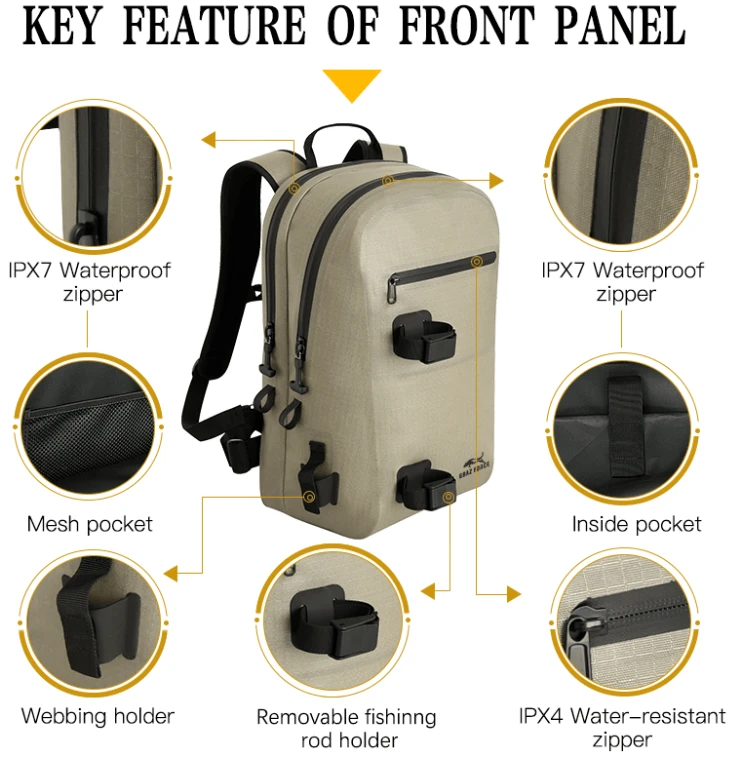
Front panel of the 16L: removable rod holders and webbing holders on the outside, with the IPX7 main-pocket zippers and the IPX4 front-pocket zipper called out
Technical Part 3
Procurement and customization perspective.
Why 16L works as the series anchor
For a fishing or water-activity line, the mid-size is usually the SKU that moves the most. Most end customers do not want a small day pack plus a large expedition pack; they want one bag that handles a full day on the water. The 16L is the size that covers the widest use case on a single SKU - bank fishing, boat fishing, a kayak day, a surf-cast session, a water-access hike - so it is a natural flagship for a series. It is also the size at which a full customization scope is most economical to run: the panels, tooling, and hardware of a mid-size pack are shared across a series, and the customization options below are all achievable at this size without a disproportionate cost step.
How to talk about the customization scope
This model supports full-range customization from fabric, webbing, and hardware to style. A typical conversation with a buyer covers:
Fabric: 420D nylon double TPU is the baseline for this model. Discuss color, logo placement, and the finish of the TPU face.
Webbing: color, width, and placement of straps, handles, and the rod holder and webbing holder attachments.
Hardware: zipper pulls, buckles, and adjustment hardware - color, finish, and the specific version of the rod holder.
Style: pocket layout, color blocking, exterior attachment points, and the overall silhouette.
One rule protects both sides: keep the waterproof core intact in any customization. The RF-welded construction, the IPX7 main pocket zipper, and the double TPU shell are what make this a "waterproof fishing pack" in the first place, and any change that weakens the sealed path - a stitched-through seam, a non-rated zipper on the main pocket - changes the product and the claim it supports.
What to check at inspection
A practical inspection checklist for this size:
Seam weld continuity: no visible stitch-through on the main pocket; welds clean and continuous.
Main pocket zipper: closes fully, latches, seals. Verify the IPX7 claim with a water test on the closed main pocket zipper, not on the whole pack.
Front pocket zipper: smooth operation at IPX4 level.
Rod holder: removal and reattachment work; secure with a rod in place.
Chest strap and hip belt: full adjustment range, no hardware looseness.
Logo and print: position, color, and durability.
Weight: spot check against 0.87 kg per pack.
Dimensions: spot check against 30 × 45 × 19.5 cm.
Conclusion
The 16L waterproof fishing pack is a mid-size built for the full day on the water: a 420D nylon double TPU shell with RF-welded seams for a genuinely sealed main compartment, IPX7 main pocket zippers and an IPX4 front pocket zipper for a deliberate protection tier, and a carrying and storage layout - EVA pad, hip belt, adjustable chest strap, removable rod holder, webbing holder, mesh pocket, interior pocket - designed around the fishing workflow. For a distributor building a fishing or water-activity line, it is the SKU that covers the widest use case in a single size, and it is the size at which full-range customization is most economical to run. Read the spec sheet as written: IPX7 belongs to the main pocket zipper, 16L is the rated capacity, and the dimensions are the external silhouette. Do that, and the 16L is a straightforward, defensible, and sellable middle option in your line.
FAQ
Is the whole pack IPX7 rated?
No. IPX7 is the rating of the main pocket zipper - airtight and watertight, holding even when fully submerged - and the spec describes the pack as a double main pocket fitted with IPX7 zippers. The front pocket zipper is IPX4, water-resistant. The pack as a whole is not a submersion-rated product, and product copy should not describe it as one. "Must stay dry" gear belongs in the main pocket.
What is the difference between 16L rated volume and the listed dimensions?
They are two different measurements. 16L is the rated (nominal) capacity of the main compartment. 30 × 45 × 19.5 cm is the external silhouette of the finished pack. The two are stated independently on the spec sheet and should not be arithmetically converted into each other. Treat 16L as "what it holds" and the dimensions as "how big it sits on the back."
Can the rod holder be removed?
Yes. The fishing rod holder is an external, removable fixture, and it comes in multiple sets. A rod can be fixed for a hands-free carry, or the holder removed entirely, and the pack works as a regular day pack for the drive home or for non-fishing use.
What can be customized on this model?
Full-range customization is supported: fabric, webbing, hardware, and style. 420D nylon double TPU is the baseline fabric, and color, logo placement, strap color and hardware finish, pocket layout, and exterior attachment points can all be discussed within that scope. The waterproof core - RF-welded construction and the IPX7 main pocket zipper - should be kept intact in any customization.


