

Ask a bowhunter where their equipment actually gets damaged, and the answer is rarely the highway. The real wear happens in the hundred small collisions between the truck bed and the treeline: a limb tip raking a low branch on the walk in, a cam knocking against a ladder stand, the riser set down on gravel while a glove is pulled back on. These are low-speed, high-frequency impacts, and they are cumulative. A sleeve that lives on the bow during that whole window solves a different problem than a case that stays in the vehicle. The 1944 Bow Sleeve was built for that window - a bar-shaped wrap that shields the limb area and both tips, fastens with a quick-release buckle, and rolls down small enough to disappear into a pack when the hunt begins.
Technical Part 1 - Where a Bow Actually Takes Damage in the Field
A compound bow is not uniformly fragile. Damage concentrates in three zones, and they fail for different reasons.
The limb tips
These are the thinnest, most highly stressed points in the limb structure and the ones that sit furthest from the archer's body. On a narrow trail, they are precisely at branch height. A limb tip that takes a sharp knock can delaminate or chip, and because the tip is where the string track terminates, even a small defect changes how the bow tunes. This is the single highest-risk contact point during transport on foot.
The cams and modules
Cams are machined, they have edges, and they carry the string and cable in a very specific geometry. A cam that strikes a tailgate or a rock can be knocked out of alignment or have its module screws disturbed. Cams are also the part of the bow most likely to catch on brush, because they protrude laterally from the limb line.
The strings and cables
These do not need impact to degrade - abrasion is enough. Dragging a bow across a truck bed liner or pushing it through a hawthorn thicket introduces grit and plant material into the string bundle. Over a season, that shows up as fraying and premature string replacement.
Now consider what most protection products actually do. A full soft case envelops the entire bow, which is excellent for storage and for vehicle travel, but it is bulky, and on foot it either gets carried in hand or strapped to a pack where it becomes a sail. A hard case is better still for airline and truck transport, and worse for everything else, because it is heavy and it cannot be worn.
The insight behind an end-cap design is that protection should be localized where the impacts occur rather than evenly distributed over a surface that mostly does not need it. A sleeve that wraps the limb span and reinforces both extremities puts material exactly at the two points that take the hits, and leaves the riser and sight to be handled by the archer's own carry discipline. That is a lighter, faster, more wearable answer to the specific failure mode of walking to a stand in the dark.
Technical Part 2 - Structure, Materials, and the Carry Equation
Brush Tricot: Quiet by Construction
The shell fabric is Brush Tricot, chosen for two properties that matter more in bowhunting than tensile strength. The first is surface softness - described by the mill as whisper-soft, it presents a non-abrasive face to the bow, so the sleeve itself does not become a wear source against the limb finish or the string. The second is silence. Brush tricot has a brushed, low-sheen hand that does not crackle or rustle the way coated nylon or laminated fabric does when it brushes against vegetation or a pack frame. For a hunter closing the last eighty yards, fabric noise is a functional defect, not an aesthetic one. The interior is lined, which keeps the outer shell from direct contact with the limb and adds a second, softer interface.
Reinforced End Caps
Both ends of the sleeve terminate in reinforced caps sized to cradle the limb tips. This is the structural argument of the whole product: the cap is the part that absorbs the collision, and by cradling the tip rather than simply covering it, the load of a knock is spread into the reinforced cap structure instead of concentrating on the limb's thinnest section. The caps also close off the openings, which keeps dust, grit, and plant debris out of the interior - the abrasion pathway described above.
Duraflex Quick-Release Buckle
Closure is a single Duraflex quick-release buckle. Duraflex is a recognized hardware brand in outdoor equipment, and the side-release format is the right choice here for a specific reason: it can be operated with one hand and with gloves on, in the dark, without looking. The buckle is also the tension point that holds the wrap closed around the limb span, so it needs to release predictably and re-engage positively every time - a hunter may open and close this sleeve twice a day for a full season.
Dimensions and Coverage
The sleeve measures 38.6 in (98 cm) in length and 5.9 in (15 cm) in height. Read those two numbers together rather than separately: the length defines the span that runs along the limb axis, and the height defines how much of the limb-and-cam profile is wrapped at any point along that span. Together they describe a bar-shaped envelope over the limb region - which is exactly the coverage the design intends. It is not a full-body enclosure, and it is not marketed as one. What it does is put continuous protection across the full limb span and hard protection at both termini.
Roll-Fold Storage and the 0.271 KG Carry Cost
The closure logic is roll-fold: the sleeve wraps around the limb area and then rolls up on itself, using the buckle to hold the rolled bundle. Rolled, it becomes a compact package rather than a long limp bag, which is what makes it viable to carry on the bow all morning and then stow when the hunt starts.
Weight is 0.271 KG (0.60 LBS). In a category where buyers compare grams, this is the number that decides whether the product gets used or left in the truck: at roughly a quarter of a kilogram, a hunter has no practical reason to remove it before the walk in. Add the shoulder strap, and the sleeve can be slung across the body for hands-free carry on the approach, with the bow protected the entire time rather than only in transit.
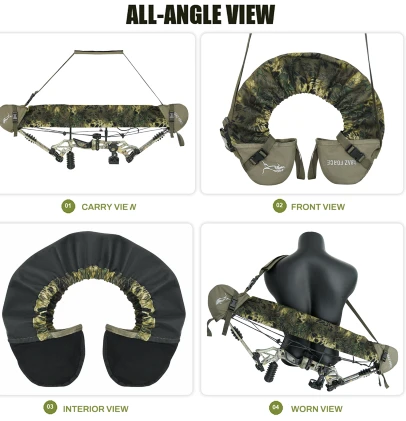
The 1944 in four views: slung carry, the front face with its reinforced end caps and Duraflex buckles, the interior lining, and the sleeve worn over the shoulder
Technical Part 3 - The Buying Case: Why Bow Accessories Are a Low-Friction Entry Category
A structurally simple SKU
From a sourcing standpoint, bow sleeves sit at the favorable end of the accessory spectrum. Three factors drive that.
Low unit weight. At 0.271 KG per piece, freight cost per unit is small and carton density is high. For a distributor adding a protective accessory line to an existing bow or archery program, that means a low landed-cost commitment relative to the retail price band these products occupy.
Few size variables. The sleeve is built around one length and one height spec for standard compound bows. There is no size matrix to forecast, no broken-size inventory risk, and no per-size tooling. A buyer can commit to a single SKU and a color range instead of a grid.
Color as the differentiation lever. Because the size architecture is fixed, color becomes the main variable a brand can use - and it is also the cheapest one to change. Camo patterns, solid earth tones, and private-label colorways can all be run on the same construction, which is why this category supports both OEM color programs and ODM design work.
What to Inspect in a Pre-Production Sample
Four checkpoints carry most of the quality risk on this product:
End cap reinforcement stitching. The caps take the impacts, so the seam that attaches and reinforces them is the critical stitch line. Check stitch density, check for back-tacking at the stress points, and pull-test the cap under load rather than judging it by eye.
Buckle engagement. Cycle the Duraflex buckle repeatedly. It should seat with an audible, definite click and release without binding. Check that the webbing or strap interface does not slip under tension.
Rolled volume. Roll the sleeve to its stored state and measure it. The specification claims a compact roll; verify the actual bundle against the pack or pouch it is meant to fit, because this is the number that determines whether hunters actually carry it.
Fabric pilling and lining integrity. Brush tricot's brushed face is its advantage and its vulnerability. Run an abrasion and pilling check on the shell, and confirm the interior lining is secured so it does not shift or bunch when the sleeve is rolled and unrolled.
MOQ, OEM/ODM, and What It Means for a Color Program
The published commercial terms are straightforward: MOQ 300 pcs per color, with OEM/ODM ready for custom logo, custom size, and custom color.
The "per color" structure is the part buyers should plan around. Because the minimum applies to each color rather than to the order as a whole, a multi-color launch multiplies the commitment - 300 pieces per colorway, not 300 pieces total. That favors a phased approach: launch with one or two core colorways at the minimum, validate sell-through, then extend the palette. It also makes color choice a merchandising decision rather than an afterthought, since each additional colorway carries its own MOQ.
Custom logo, size, and color together mean the product can be taken to market either as a branded accessory or as a private-label item. Logo work typically lands on the cap or the body panel; size customization is relevant for brands serving non-standard bow builds; color customization is the highest-leverage option because it is visible at retail and does not alter the construction. Packaging should be scoped at the same time as the color program - the rolled format has a specific bundle shape, and a pouch or hang-tag configuration designed around that shape protects the retail presentation and keeps the shelf footprint consistent across the color range.
Conclusion
The 1944 Bow Sleeve is a focused answer to a specific problem: the limb tips and cams of a compound bow get damaged in the field, not on the highway, and the damage is caused by repeated low-speed contact rather than a single catastrophic event. By wrapping the limb span in a silent, non-abrasive brush tricot shell, reinforcing both ends to cradle the limb tips, and closing with a one-hand Duraflex quick-release buckle, the design puts protection where the impacts actually land - and at 0.271 KG with a roll-fold storage format and a shoulder strap, it stays on the bow instead of in the truck. For buyers, that combination of low unit weight, a single size architecture, and color-driven differentiation makes it an efficient accessory to add to an existing archery range.
FAQ
Is it waterproof?
No. No waterproof or water-resistance rating is published for this product, and none should be represented in marketing. The sleeve provides scratch protection, dust and debris protection, and impact absorption at the limb tips. It is not a dry bag and should not be described as rain protection.
Will it fit my compound bow?
It is designed as a bow sleeve fitting standard compound bows. The sleeve measures 38.6 in (98 cm) in length and 5.9 in (15 cm) in height, wrapping the limb region with reinforced caps cradling both limb tips. It is not a full-coverage case, so fit should be confirmed against the specific bow's limb span rather than assumed for every configuration.
How does it differ from a bow case?
A bow case encloses the entire bow. This is a sleeve: a bar-shaped wrap that covers the limb area and both tips, fastened with a quick-release buckle, and it rolls up into a compact bundle for storage or pack carry. It is lighter and wearable on the approach, and it protects the highest-risk contact points rather than the whole silhouette.
What is the MOQ?
300 pcs per color. OEM/ODM is available for custom logo, custom size, and custom color, so a brand can build a private-label colorway on the same construction. Note that the minimum applies per color, which affects planning for multi-color launches.


