

Introduction
Every expedition runs two parallel logistics systems. The first is personal: a backpack full of clothing, a sleep system, a headlamp and personal hygiene items - sized around one body and moved by one person. The second is collective: the tent that sleeps the whole group, the stove and fuel, the shared rations, the spare clothing for the wet member of the party, the repair kit, the electronics, the water containers. That second system does not move in a backpack. It moves in a duffel, and at expedition scale the relevant size is one hundred liters.
The design goal of a 100-liter expedition dry duffel is not lightness. It is closer to a promise: move the group's gear in one lift, keep absolutely no water in, and be able to carry it more than one way - on the back, by the handle, over the shoulder - because a portage from a boat to a riverbank, a drive over a track, and a walk across a deck all use different muscles and different handholds.
This article breaks down the engineering and the camp logistics behind that one-hundred-liter class. It covers capacity boundaries, sealing systems and their real-world failure modes, the structural cost of each carry mode, basecamp handling procedures, and what B2B buyers should specify when ordering in volume. The reference product is the GAF Outdoor 906-004, a 100L waterproof duffel in a camo (Optifade-style) pattern, built around an IPX7 airtight & waterproof zipper, and offered across a range of fabric and zipper configurations.
Technical Part 1: Why 100 Liters, and When It Is Wrong
Capacity is a team-size and trip-duration decision, not a fashion choice. A working rule: a small party camped for a week generates well over a hundred liters of shared dry goods. A four-person tent plus poles, a stove and fuel, a week of shared food, spare clothing, first-aid and repair stores, and electronics will easily fill one hundred liters - and usually more. A two-person basecamp on a short float can get by with less, while a multi-week hunting camp that stocks food, ammunition and cold-weather spares may need two or three units of this class.
The right home for a 100L duffel is transfer, not traverse. Its intended scenarios are the boat to shore, the truck bed to the trailhead, the ATVs to the camp, the heli-pad to the ridge, the warehouse to the floor. In each of them the bag is lifted, carried for tens or hundreds of meters, stacked, tied down and unloaded. In every one of those cases a large, flat-stacking volume with a reliable seal beats a narrow hiking pack.
It is the wrong tool for a solo long-distance walk. A 100-liter frame is physically too large to balance on one spine for a full day, and a 25–30 kg load (which is realistic once packed - see below) is well past what a single hiker should carry. It is also the wrong tool for anything that requires climbing, scrambling or rapid hands-free movement; a duffel is a logistics object, not a mountaineering object.
Where the trade-offs sit against alternatives:
Duffel vs. pack frame (internal or external frame): a frame shifts load onto a hip-belt system and is far more comfortable for long carries, but it is expensive, bulky and fragile, and it only pays off if the same person will carry it for hours. A duffel with shoulder straps handles the short, heavy, repeated lifts that dominate basecamp logistics.
Duffel vs. roller / hard case: a wheeled case wins on smooth surfaces and for fragile cargo, but it dies at the first deck, the first track and the first door, and it cannot be sealed against water the way a welded duffel can.
Duffel vs. soft expedition box: boxes stack beautifully and can be rigid, but they are heavier, cost more, and do not compress around irregular loads.
The hard constraint everyone underestimates is weight. Volume is only half the specification. A 100-liter bag packed with tents, poles and down insulation weighs far less than the same 100 liters packed with fuel canisters, dehydrated food, water bottles and hardware, which can reach 25–30 kg depending entirely on the density of what is inside. That number - not the liter count - decides how many hands you need, whether the straps are rated for it, and whether the handles survive the fifth lift. It also decides wet weight: anything that gets splashed while unsealed gains water weight in liters, and one liter of water is one kilogram.
Finally, plan the human logistics: a full 25 kg duffel is a two-person lift for anything over a short distance, or one strong porter for a brief carry. Count the hands before you count the bags.
Technical Part 2: Sealing, Carry Modes and Structure
The zipper is the failure point - so grade it
Every waterproof duffel is a sealed membrane with one deliberate hole: the opening. The fabric, welded or taped, does not let water in. The zipper is where water gets in. That is why the seal grade of the zipper is the single most important line in the specification.
The GAF Outdoor 906-004 references are worth citing precisely. The main caption reads IPX7 - Airtight & Waterproof, and the same asset family carries the nominal claim of submersion for up to 30 minutes at a depth of one meter - the standard test condition for IPX7 and, as always, a specification of the zipper solution rather than a field guarantee. The product line is offered in four optional zipper grades, which is a realistic range for a B2B buyer:
IPX4 - water-resistant zipper. Protects against splashing and rain at angles. The grade for dry-weather logistics and short wet exposure. Do not buy it for boat decks.
IPX5 - waterproof zipper. Adds resistance to jets and sustained spray. The grade for river crossings in open boats and heavy rain during portages.
IPX7 - airtight & waterproof zipper. The full-immersion grade: one meter of water for 30 minutes, and enough sealing that the bag can be deliberately submerged and, with a vent valve, inflated for a rafted or floated transfer.
IPX7 - plastic-teeth airtight & waterproof zipper. The same immersion class with plastic teeth instead of metal.
The plastic-teeth variant is the engineering compromise worth understanding. Metal-tooth zippers are strong and familiar, but they can corrode in salt water and, more importantly, their two rows of metal teeth leave micro-gaps that a fully airtight seal works harder to close. A plastic-tooth (coil-style) airtight zipper runs a continuous, flexible tape that seals more cleanly against a gasket, which is why it is the preferred construction for bags that must actually float, be submerged, or be pressure-vented. The trade-off is abrasion: plastic teeth wear faster under dirty, gritty conditions, so a good bag pairs the airtight zipper with a storm flap or a sealed placket over the top run.
Fabrics and seams
The 906-004 platform is offered in PVC, TPU, PU and Nylon-Polyester coated constructions. PVC is the classic heavy-duty marine fabric - tough, abrasion-resistant and low-cost, with a permanent plastic smell. TPU is lighter, cleaner and more flexible in the cold, and is the better choice when weight and odor matter. PU sits between the two. Nylon-polyester laminates give the best strength-to-weight and a fabric feel, at the cost of higher price and more demanding seam work. Whatever the membrane, the seams are welded or taped - a waterproof duffel is assembled as a single sheet, not stitched like a canvas bag. If a bag in this class is stitched at its critical seams, it is not a dry bag; it is a rain-cover bag.
The three carry modes, and what each costs structurally
A basecamp duffel is specified with three carry modes: Backpacking (dual-shoulder), Handle Carry (top handle) and Side Carry (lateral grip). This is the "one bag, many hands" logic of group logistics, and each mode has a structural price:
Backpacking requires an actual shoulder system: padded, load-bearing straps, a sternum strap, and a back panel that distributes weight across the torso. The bag must be balanced when loaded, which pushes the design toward a low center of gravity and a stable, flat base.
Handle Carry requires a top handle reinforced beyond the fabric itself - webbing that is through-stitched, riveted or bar-tacked at every load path. A 30 kg lift on a sewn handle is a puncture, full stop.
Side Carry requires a lateral grip - a padded, load-rated handle on the side of the bag. It matters more than it looks: side carry is how you move a bag over a gunwale, how you carry it two-abreast with a partner, and how a single person manages the bag in narrow spaces where the top handle would snag.
MOLLE, compression, and the structural details
The 906-004 carries a MOLLE-style webbing panel and compression straps - details that do a lot of quiet work. The MOLLE webbing is an external mounting grid: a small day-pack, a dry bag for the wet kit, a paddle, a coiled rope, or a camp crate can be attached to the shell without opening it. It also gives the bag rigidity, so a full duffel keeps its shape instead of becoming a floppy sack that drags and tears on a deck.
Compression straps do three jobs: they shrink the loaded volume (important for stacking in a boat hold or truck bed), they transfer load onto the webbing so the fabric carries less, and they keep the bag from ballooning - which is what makes a full bag hard to carry in the first place.
Finally, the stress points. Every strap, handle and piece of webbing is a load path, and a serious bag bar-tacks each load path, double- or triple-stitches the critical seams, and uses a denser, heavier coated fabric or a rubberized panel at the base, the corners, and every point that will scrape on a deck, a roof rack or muddy ground. Abrasion and puncture resistance at the contact points is as important as the seal: a bag that stays dry but shreds on a boat's chafing surface has not done its job.
The camo finish on the 906-004 - an Optifade-style pattern - is not decoration. In hunting camps and field operations a low-visibility, non-reflective color is a functional spec, and it is one of the reasons the pattern is a standing option in this product family rather than a one-off.
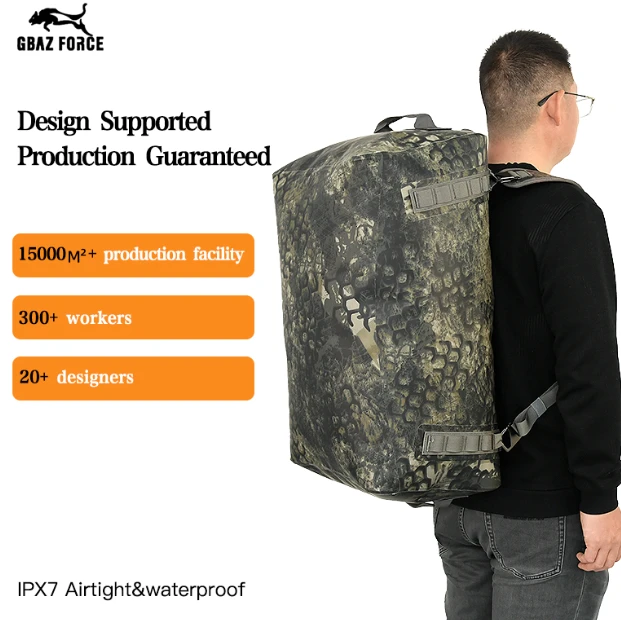
One hundred litres is a group asset, not a personal pack - three carry modes are what make it movable
Technical Part 3: Basecamp Logistics & B2B Selection
Packing order and the one-bag-one-category rule
A 100-liter bag that is packed as a junk drawer is a 100-liter bag that is never found in. The operational standard is one bag, one category: tents and poles in one; stove, fuel and cookware in another; shared rations in a third; spare clothing in a fourth. Water and already-wet items are never in a dry bag at all. The logic is not aesthetics, it is logistics: when it is dark, cold and raining, the cook finds the stove bag in seconds, not minutes, and the tent is not buried under fuel canisters.
Packing order inside the bag matters as much as the order between bags. Heaviest items at the base, near the handle and against the back panel; rigid items (stove, fuel canisters, hardware) at the bottom; compressible, light items (clothing, insulation, spare fabric) on top. Anything that is already wet goes in a dedicated wet bag or a separate duffel - never in the dry one. The rule is absolute: a dry bag's integrity is its only product, and one wet item ruins the whole cargo.
The moisture-floor rule for camp: every group dry bag should be zipped, sealed and closed before it is set down, and re-checked at every transfer - boat, vehicle, camp. Water enters these bags almost entirely during the open moments (the load, the unload, the handoff), not during the closed ones.
Transport and fixing: boat, ATV, roof
On a boat, a 100L duffel is a free-load hazard: a full bag that shifts in a turn can capsize a small craft or break a person's shoulder. The standard is to tie it down. The compression straps and MOLLE webbing give you tie-off points; lash the bag to a deck rail, a cleat or a bed strap, and keep it low and centered. On an ATV or in a truck bed, the same principle: a webbed bag strapped to the rack or bed, not a soft bag bouncing loose. On a roof, the bag rides on the roof rack's cross-bars, strapped at all four tie-down points, with the compression straps keeping it stable so the strap load does not come from the bag's own handles. The webbing and straps are the tie-down system, and they are rated as part of the load path, not as decoration.
Unloading, camp setup, and storage
At camp, unloading order is the reverse of packing order: the category used first comes out first, so the tent category is loaded last and unloaded first. Spread the bags by category around the camp - cook area, shelter area, dry storage - and never stack a wet bag on a dry one.
Cleaning and long-term storage is where cheap bags die and good ones last. Salt is the enemy of a welded duffel: it dries into the seams and the zipper. After any salt-water use, rinse the bag, wipe or brush the zipper clean, and dry the fabric fully - leaving the zipper open a few centimeters so air can move - before storing. Mold is the other enemy: a sealed, damp bag in a warehouse is a mold factory. The storage rules are the same as the field rules: dry, ventilated, zipped but not airtight, and out of direct sun. Zipper maintenance is a routine task: keep the teeth clean and dry, and never force a stuck zipper, which is how an airtight run gets destroyed.
B2B selection: who buys this, and what to specify
The customers for a 100L expedition duffel are the organizations that move group gear on a schedule: hunting camps and outfitters, guiding and expedition services, outdoor retail chains, and brand / OEM buyers who need the bag under their own label. The GAF Outdoor platform - 15,000 m² of factory, 300+ workers, 20+ designers - is built for exactly this volume and this level of specification.
The specification decisions a B2B buyer makes:
Capacity ladder: a 100L is rarely sold alone. A ladder that steps down for smaller groups and up for larger camps lets the buyer offer the right size per category.
Color and pattern: camo (Optifade-style) for hunting and field operations; solid neutrals for retail and brand OEM; bright safety colors for guiding and search-and-rescue-adjacent use.
Zipper grade: IPX4 for a cost-optimized retail line, IPX5 for river and spray exposure, and IPX7 airtight (metal or plastic teeth) for the expedition, boat and submersion market. The plastic-tooth airtight variant is the correct call for any bag that will float or be deliberately submerged.
Fabric: PVC for the tough, low-cost, marine-heavy line; TPU for the lighter, cleaner, higher-end line; PU as the middle; Nylon-polyester laminates for the best strength-to-weight in a premium spec.
Logo and branding: the platform supports screen print, TPU print, Velcro patch and embossed logo - enough options that a retail buyer, an outfitter and an OEM can all get the mark they need at the price point they are at.
Carry system: a full backpacking setup (straps, back panel, sternum strap) for the expedition and guiding lines, or a handle / side-carry-only build for a cost-optimized retail line. The three-carry-mode configuration on the 906-004 is the full-spec reference.
The selection test is simple: specify the worst case the buyer's customer will actually do - the wettest, the heaviest, the roughest surface - and grade the zipper, the fabric and the hardware to that worst case, not to the average case. That is how a 100L duffel becomes a group-gear asset instead of a first-season failure.
Conclusion
The 100-liter expedition dry duffel is not a big backpack. It is a piece of camp logistics: a sealed, heavy, multi-hand container whose job is to move the group's gear in one lift, keep it dry through the wettest transfer, and be carried by whoever happens to be holding it at that moment. The engineering is concentrated in one place - the zipper and the seams - and the rest of the bag is a structure built to survive the load paths: three carry modes, MOLLE mounting, compression, and reinforced wear points. The camp logic is equally concentrated: one bag per category, heavy items at the bottom, wet things never in the dry, and every bag tied down on every surface it rides on.
For the B2B buyer, the value is in the specification: the right capacity ladder, the right zipper grade, the right fabric, and the right branding, on a platform built to carry the volume. That is the whole product, and done right it is a product that works for a decade.
Frequently Asked Questions
Can a 100L dry duffel be fully submerged?
A bag with a true IPX7 airtight zipper - the grade on the GAF Outdoor 906-004, with a nominal 30-minute, one-meter submersion rating - can be deliberately submerged, and with a vent valve it can be inflated to float. A bag with an IPX4 or IPX5 zipper is rain- and spray-protected, not submersion-rated, and should not be put under water.
How heavy is a full 100-liter duffel?
Volume does not fix weight; density does. Packed with tents, poles and insulation it weighs far less; packed with fuel, food and hardware it can reach 25–30 kg. Plan the carry, the straps and the number of hands around the worst-case load, not the average.
Can it be worn as a backpack for a long time?
The Backpacking mode is built for short, heavy, repeated moves - the boat-to-camp and deck-to-trailhead portages. It is not a hiking pack, and it should not be worn for multi-hour, multi-kilometer carries at a full 25+ kg load. For long walks, split the group gear across two or more smaller bags or a frame.
PVC or TPU - which should a B2B buyer choose?
PVC for the tough, low-cost, marine and hunting line; TPU for the lighter, cleaner, higher-end retail and expedition line. The two are different products at different price points, not the same bag in two fabrics.
How do you keep the zipper reliable over time?
Keep the teeth clean and dry, brush out grit before closing, never force a stuck zipper, rinse salt-water exposure, and store the bag zipped but ventilated and out of direct sun. A routine maintenance habit is what separates a one-season bag from a ten-year one.


