

Introduction
Ask a wet-weather hunter what he is most afraid to lose, and the answer is almost never the rifle. It is the three smallest objects in his kit: the phone that holds his maps, his photos and his license; the electronic game caller remote that opens a hunt; and the box of premium ammo or the spare scope cap that a single river crossing can wipe out. Those three items are simultaneously the most valuable, the most fragile, and the most water-averse things on his person. A soaked phone is not a nuisance - it is a dead navigation system, a lost photo archive, and a safety risk when he is miles from the truck. A corroded electronic caller is a dead season. A waterlogged box of copper-fouled shot or a fogged scope lens ends a hunt that should have been won.
This is the exact gap that the 4-10L pocket-size dry case is built to fill. The small dry bag hunting format is not a load carrier - it does not move base layers, food, or spare shells the way a 30L pack does. It is a personal asset safe: a sealed, body-mounted volume whose entire engineering purpose is to keep a few irreplaceable, expensive, water-sensitive objects dry no matter what the environment throws at them. The category spans a waterproof pouch hip pack for the fisherman, a compact small dry bag for the upland hunter, a 10L waterproof sling bag for the river-crossing waterfowler, and an EDC dry pouch for the commuter and field technician who lives and works in the rain.
The reason a small dry case is harder to do well than a large one - and why the gap between a $12 novelty bag and a dependable asset safe is so wide - is that scaling down changes every sealing, structural, and access problem at once. This article breaks the category down for the buyer who specifies it: how small volumes are actually sealed and why "small" is the difficult case, how carry modes and access design determine whether the bag is a tool or a fumble, and how to select by scenario and by B2B program.
Technical Part 1: Sealing Small Volumes
The three sealing architectures
Every dry case in the 4-10L class uses one of three sealing architectures, and the choice of architecture is the first and most consequential specification decision, because it fixes the price floor, the weight, the access speed, and the repairability of the product all at once.
The first is the roll-top seal. The body is a single tube of waterproof fabric, and the top edge is rolled down three or four times before being clamped with a plastic or rubber buckle. The roll-top is the cheapest and lightest seal - there is no zipper, no tape, no hardware - and it is genuinely submersible when rolled correctly. But it is slow: loading a phone or a box of shells means unrolling, dropping the object in, re-rolling, and clamping, a four-second operation every single time. For a small bag that is opened and closed many times a day, the roll-top becomes a friction tax.
The second is the waterproof taped zipper, and it is the architecture the GAF Outdoor 906-023 10L sling bag uses at its main opening. A submersible zipper (a zip with an internal gasket and an external urethane coating) runs the length of the opening and is then covered by a welded or heat-sealed tape seam that makes the entire zip line impervious. The trade is speed for weight and cost: a taped zipper opens in one motion - the hunter or angler unzips and drops in an item with the bag hanging at the hip - but the tape, the gasketed pull, and the seam welding add mass and a real manufacturing step that separates a competent factory from a marginal one.
The third is welded seams with a quick-release buckle (the airtight-pouch approach). The body panels are ultrasonically welded or heat-welded together with no stitching at all, and the opening closes with a snap or a buckle over a gasket ring. This is the most submersible and the lightest of the durable options, but it is the least repairable: a cracked weld or a failed gasket often means scrapping the pouch, which is why the format sits at the premium end of the EDC dry pouch market.
Why "small" is genuinely harder
There is a counterintuitive fact about dry cases that most spec sheets never mention: the smaller the bag, the harder it is to keep dry per unit of volume. Three geometric reasons drive it.
The first is opening-to-volume ratio. A 10L bag and a 3L bag do not scale their opening sizes by the same factor as their volumes. A 3L pouch needs an opening large enough to admit a phone or a shell box, so the opening can be 60% of the bag's total exterior area, whereas the same opening on a 20L pack is 20% of the area. The bigger the opening is relative to the body, the more of the bag's "seal perimeter" is a place where water can get in. A small bag spends most of its exterior surface defending a single large opening; a large bag buries the opening.
The second is seal-perimeter efficiency. The taped zipper or weld line is only as good as the length of tape or weld that is in place, and on a small bag that perimeter is short and carries a disproportionate load. Every centimeter of a 3L pouch's taped seam is doing the work of a centimeter on a 20L pack, but the margin for one bad weld point is thinner because there is less body to absorb the failure.
The third is zipper bend radius. This is the detail that kills cheap small bags. A waterproof zipper's internal gasket must lie flat along the full curve of the opening. On a large bag the opening is a gentle arc and the gasket seats easily. On a 4L pouch the opening is a tight curve and, if the gasket's bend radius is too large for the pattern, the gasket lifts at the high points and water tracks straight in along the curve. The gasket must be specified with a bend radius smaller than the smallest opening it will ever see - a materials line item, not a sewing detail, and the single most common reason a "waterproof" small bag leaks at the corners of the zip.
IPX ratings on a small bag
The IPX scale that consumers see - IPX6, IPX7, IPX8 - has a different practical meaning on a 6L case than on a 25L pack. IPX7 (submersion to one meter for 30 minutes) and IPX8 (deeper and longer submersion) are meaningful test claims, but they assume the opening is sealed for the test. The real field question is not "can this bag survive a dunk" - almost every taped-zip and roll-top bag can - it is "can this bag survive a wet hand, a half-open zip in rain, and a hundred open/close cycles a season." On a small bag the answer depends on the gasket quality and the tape seam more than on the nominal rating, because the small opening is used far more often relative to its size. A buyer should ask for the test depth and the number of open/close cycles the rating was verified over, not just the IPX number on the label.
Materials and the weight budget
Small dry cases in this class run on two dominant material systems. The first is 420D polyester or nylon with a PU or TPU waterproof coating: a durable, abrasion-resistant face fabric with a waterproofing layer laminated or applied to the backer. It is the workhorse for hip packs and sling bags because it takes the strap friction and the buckle contact at the hip without tearing. The second is a TPU composite or welded TPU film body for the airtight-pouch and premium EDC dry pouch tier: lighter, more submersible, and more expensive, with a softer hand-feel that some users prefer and a shorter abrasive life at the strap contact points.
The weight budget for a 4-10L asset safe is tight because the user wears it against the body and expects it to disappear. A well-built 10L taped-zip sling bag lands in the 150-350g range: the fabric body is a fraction of that, and the rest is the zipper hardware, the taped seams, the webbing, the D-ring, and the buckle. The buyer who sees a "waterproof" 10L bag under 150g is usually looking at a non-submersible DWR shell with a standard zip and no tape - it will shed rain for an hour and fail the moment it is dunked.
Technical Part 2: Carry Modes and Access Design
Waist, diagonal sling, and chest: the three mounts
The pocket-size dry case is worn in three positions, and the position changes who the bag is for and how fast the contents come out. The waist / hip mount - the waterproof pouch hip pack fishing dry bag format, represented in the GAF Outdoor line by the 906-024/906-025 4L hip packs and the 906-010 waterproof waist pack - sits at the front or side of the hip on a belt or a wrap strap. It is the fastest to reach for the seated angler, whose hands are already at the hip, but it is the most exposed: it bounces on the move, it sits low enough to catch spray and splash from a boat gunwale, and its opening faces outward toward the water. The diagonal sling - the 10L waterproof sling bag, the 906-023 - crosses the torso and rests on the hip or the back, and it is the best balance of capacity and access for a hunter who is moving. The chest mount keeps the volume at sternum height, fastest for one-handed reach while the hands are otherwise occupied, but it is the least stable in a boat and the most likely to conflict with a pack sternum strap.
The shoulder strap, the D-ring, and the chest clip
The 906-023 rides on a single adjustable shoulder strap, and two details on that strap do more for stability than the bag's capacity does. The D-ring attachment point on the strap is a load anchor: it lets the strap be repositioned and locked so the bag sits at a fixed spot on the hip instead of sliding toward the back with every step, and it is the same ring that can carry a spare clip, a carabiner, or a secondary short leash for the boat. The chest clip - the sternum-style adjuster that crosses the strap over the chest - is the anti-swing device. Without it, a single-strap bag at the hip becomes a pendulum every time the wearer turns; with the chest clip cinched, the strap is held off the chest and the bag stays pinned at the hip through the turn. For a waterfowler boarding a moving boat or climbing into a stand, the chest clip is the difference between a bag that rides and a bag that bounces open at the wrong moment.
Internal compartment logic
A 4-10L asset safe is judged by how it allocates its interior, and the allocation that works is by object, not by size. The layout that separates a well-specified bag from a generic one:
Phone slot: a vertical or shallow sleeve against the body wall, sized to a phone with a case, where the hard shell cannot rattle against a shell box.
License / ID / card slot: a flat, shallow pocket or a small zip sub-pocket for the wallet, the hunting license, and the credit card - flat so it does not add bulk to the hip.
Ammo / optics slot: a dedicated vertical pocket or a zip sleeve sized to a box of shells or a scope tube, isolated so a leaking or wet item cannot soak the electronics.
Electronic caller remote slot: the single most important pocket in the wet-weather kit - a small, shallow, easy-reach pocket at the top edge of the bag where the thumb finds the remote in one motion, because a caller remote that requires digging out of a deep zip is a caller remote that is too slow when a bird is on the water.
The 906-023 carries a front vertical zip pocket that maps directly to this logic: it is a shallow, fast, one-handed access layer in front of the main taped-zip volume, so the phone, the remote, and the cards live in the front pocket while the heavier, less-frequently-touched items (the ammo box, the spare optics) stay in the sealed main chamber.
Zip direction, one-handed operation, and silence
Zip direction and pull-tab placement are access details that decide one-handed usability. A vertical zip with the pull at the top is operated with the thumb and forefinger of the hand that is already holding the bag, which is why the 906-023 uses a vertical orientation on the front pocket: the wearer reaches with the free hand, and the pull tab ends up where the thumb lands. A horizontal zip across the top of the main opening closes with the two hands working together, which is fine for a bag that is opened a few times a day and unacceptable for a remote-access pocket. And the acoustics matter: the zip should be a low-profile, slow-closing type, and the hardware should sit so the D-ring and buckle cannot rattle against the shell - a silent bag at the hip in a quiet waterfowl blind is a bag that does not give away the hunter's position.
The layering sequence with a main pack
On a loaded field kit the small dry case is almost never worn alone, and the wearing order is part of the specification. The sequence that resolves the most common conflicts: the main pack's waist and chest straps sit closest to the body and take the heavy load; the small dry case's shoulder strap threads over the pack's shoulder strap on the same side, so the two straps do not cross and fight at the shoulder; and the chest clip of the dry case cinches over its own strap only, never over the pack sternum strap, so the two systems stay independent. The result is that the 10L sling bag hangs on the hip as a sub-pack, accessible without unclipping the main pack, and it can be swung to the back or lifted off with the D-ring and chest clip doing the anchoring work.
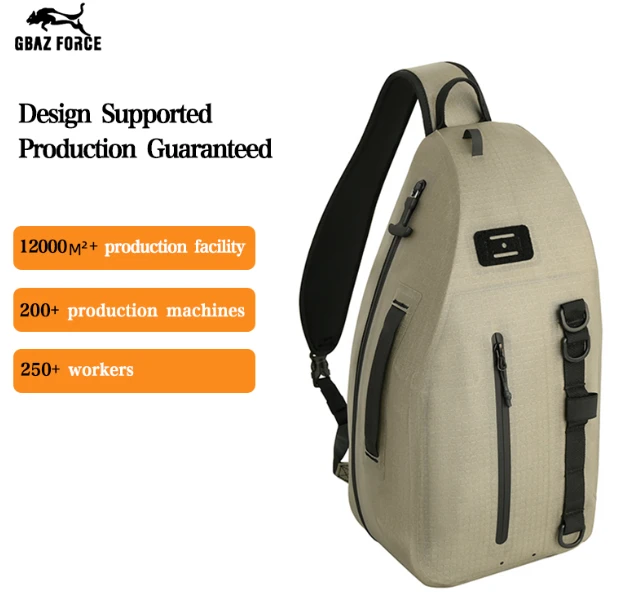
The sub-pack that rides the hip - 10L of taped-zip protection for the phone, the tags and the caller
Technical Part 3: Selection Guide and B2B Angles
Choosing capacity by scenario
Capacity in this class is a scenario decision, not a size decision. The rule that holds across the GAF Outdoor small-waterproof line:
4L waist / hip pack (906-024/906-025, and the 906-010 waterproof waist pack): the seated angler, the wader hunter, and the guide who needs phone, remote, and license at the hip while the hands are otherwise occupied. Small dry bag hunting use case - one-handed reach, low bulk, fast open.
4L fishing / boat pack (906-022): the waterfowler and the boat angler who needs a sealed volume at the hip or the stern that can take spray and occasional dunk, with the 906-014 airtight small pouch as the sub-submersible inner for the truly irreplaceable items.
10L sling bag (906-023): the moving hunter - the river-crossing waterfowler, the wading angler, the field technician - who needs the asset volume plus a real margin for a small tool, a change of gloves, and a snack, carried diagonally with a chest clip for stability.
15-20L fishing / submersible bag: the step up where the format becomes a load carrier again; at that size the submersible valuables case role is usually split, with a 4-10L asset safe worn at the hip carrying the irreplaceable items and the larger bag carrying the bulk.
The wet-weather essentials list
Across boat hunting, wading, rain, and snow, the items that should always live in a 4-10L asset safe rather than a DWR pocket: the phone (in the sealed slot, never in a jacket pocket), the electronic caller and its remote, the hunting license and ID, the ammo box for the current load, and a spare scope or cap set. A DWR pocket sheds rain for the first hour and then wicks it in; a taped-zip or roll-top dry case does not wick at all, which is the entire point of keeping these objects out of the DWR layer.
Modular collaboration with the main pack
The 4-10L format is best specified as a sub-pack in a modular kit: the main 25-35L pack carries the consumables and the bulk, and the small asset safe at the hip or on the sling carries the irreplaceable, water-sensitive items. The two are joined by the layering sequence above, and the buyer should present the small case as the "asset layer" of a hunting or fishing system, not as a standalone novelty - that framing is what makes it a repeat purchase instead of a one-time accessory.
Care, salt, and zip maintenance
Two maintenance failures drive the returns on this category. The first is salt and mineral residue on the taped zipper and the gasket: after a saltwater or brackish-water use, the zip should be rinsed with fresh water and the gasket wiped, because salt crystals in the gasket track and the tape seam slowly delaminate. The second is a dry zip left sealed overnight in the cold, where the gasket and the tape can stiffen and not seat on the next open. The care instruction that belongs on every hang tag in this category: rinse after saltwater, open the zip and let the gasket seat before storing, and re-apply a light silicone-safe zip lubricant if the pull starts to bind. A taped zip that is cared for outlives a standard zip by an order of magnitude; one that is not, fails at the first hard winter.
B2B selection guidance
When specifying a 4-10L asset safe for a program, decide five things. Customer segment: boat and wading hunters (submersible, chest-clip stability, caller-remote slot), anglers (hip mount, fast one-handed access, salt-rinse-ready), or EDC and field work (lightweight, high-visibility or neutral solids, airtight-pouch tier). Colorways: a sand / khaki body with black webbing and buckles - the 906-023's palette - covers the widest hunting and EDC terrain in a single SKU and reads as equipment rather than fashion. OEM customization points that are cheap to vary: the front-pocket depth (a 35mm remote pocket versus a 70mm phone pocket), the mount hardware (D-ring plus chest clip, or add a belt-clip for the hip-pack tier), the internal divider layout, and the color of the webbing and the buckle. Points to lock at the base model: the sealed-architecture choice (taped zip versus roll-top versus welded), the gasket bend radius, and the fabric weight - these define the submersible performance and the weight, and changing them mid-program is a retool, not a variant. Series logic: specify the line as a family - the 4L hip packs (906-024/906-025/906-010), the 4L fishing pack (906-022), the 10L sling (906-023), and the 906-014 airtight pouch as the innermost sub-submersible - so the buyer's customer can scale the asset safe up or down within one recognizable GAF Outdoor family.
Conclusion
The 4-10L dry case is the smallest piece of serious gear a wet-weather hunter, angler, or field technician owns, and it protects the most expensive fraction of their kit. It is a personal asset safe, not a load carrier, and its entire value comes from three things done well: a seal that is genuinely submersible at small scale (the taped zip, the gasket bend radius, the tape seam), a carry that stays pinned and silent (the shoulder strap with D-ring and chest clip, the layering sequence), and an interior that allocates by object so the phone, the remote, the license, and the ammo each have a place they will not share with water. The GAF Outdoor 906-023 10L sling bag - sand body, black webbing, taped-zip main opening, front vertical zip pocket, D-ring and chest clip - is the reference point for the 10L end of the category, and the rest of the small-waterproof line (the 4L hip and fishing packs, the 906-010 waist pack, and the 906-014 airtight pouch) lets a B2B buyer build a full asset-safe family around it. For the buyer who specifies it, the decisions above are the ones that separate a SKU that keeps an expensive phone, a working caller, and a dry box of shells all season from one that comes back soaked.
FAQ
Can I actually submerge it underwater?
A taped-zip or roll-top bag in this class is submersible when the opening is fully sealed - the IPX7 claim (one meter, 30 minutes) is the realistic working test. The 906-023's taped zip and the 906-014 airtight pouch are built to be dunked; the caveat is that submersibility is a property of the sealed opening, so a bag left half-unzipped in a boat is not submersible no matter the rating. For the truly irreplaceable items, keep them in the innermost airtight pouch (the 906-014 format) inside the sling, so there are two seals, not one.
If I put my phone in it, will it still get wet?
Only if the water gets past the seal, and the seal is the zip line, not the fabric. A well-taped, gasket-seated zip keeps a phone dry through spray, rain, and a dunk; a marginal one leaks at the high point of the curve, which is exactly why the gasket bend radius is the critical spec. Keep the phone in the sealed slot against the body wall, away from the ammo box, so that even in a worst-case partial failure the phone's face is not in the same pocket as the one thing most likely to be wet.
The zip started to leak or bind - can I repair it?
Taped-zip bags are the most repairable of the three architectures: a binding pull is usually a gasket or tape issue that a light silicone-safe zip lubricant and a re-seat of the tape fixes, and a small tear in the tape seam can be re-welded or re-taped in the field. The roll-top is trivially repairable (replace the buckle). The welded airtight pouch is the least repairable - a cracked weld usually means replacement - which is why it earns its premium as a sub-inner rather than as the daily outer.
What capacity do I actually need for a day of wading or boat hunting?
For the asset items alone - phone, caller remote, license, a shell box - 4L is enough, which is the hip-pack tier. The moment the bag also has to hold a small tool, a change of gloves, or a snack, 10L (the 906-023 sling) is the right size, and it is carried diagonally with the chest clip so it stays pinned through the wade and the boat ride. If you are carrying bulk on top of the asset items, step up to a 15-20L submersible bag and keep the 4-10L case as the asset layer inside or beside it.
Why is a "waterproof" small bag so much heavier than a regular 10L sling?
Because waterproof is a materials and hardware claim, not a fabric one. The weight comes from the taped or welded seams, the gasketed submersible zip, the D-ring and chest-clip hardware, and the coated or TPU body - none of which a standard DWR sling carries. A 10L bag under 150g is almost certainly not submersible; the 150-350g range is where a real taped-zip asset safe lives, and paying for that weight is paying for the phone that does not die on the river crossing.


