

Introduction: The Race From Field to Freezer
The quality of venison is decided in the first few hours after the shot, not in the kitchen. From the moment the animal drops to the moment the quarters reach a walk-in freezer, the hunter runs a compressed timeline: field-dress, quarter, bag, carry, hang, cool. Every step is a decision about heat, contamination and distance, and the margin is unforgiving in warm weather.
The single piece of equipment that touches the meat at every one of those steps is the game bag. A cheap poly bag wraps a healthy quarter in its own heat and turns it into a spoilage risk by lunchtime; a properly engineered breathable meat bag lets the field conditions do their work, keeps flies out, and carries a leg of venison from the kill site to the treeline at a pace the meat can survive. The set examined in this article is the GAF Outdoor 905-40 / 905-41: blaze orange, drawstring-closure hunting game bags in two matched sizes, built from a breathable woven synthetic fabric with webbing loops at the sides and bottom corners for rope tie-downs and hang cool.
This article breaks down the structural engineering of the external game bag and shows how it plugs into a frame-pack quarter-hauling workflow, from the first tie-down at the kill site to the final wash at home.
Technical Part 1: Why Game Bags Are Engineered, Not Just Bags
The Three Spoilage Variables
Post-mortem meat degrades through three interacting variables: temperature, moisture and contamination. Bacteria roughly double every 20 minutes in the warm range - the classic 4–60 °C danger zone - and a quarter of venison is an internal-mass problem: a leg can hold core heat for hours, and anything wrapped against that mass will warm with it. Moisture is the second variable: a wet surface invites bacterial growth and mold, while a dry surface forms a protective pellicle. Contamination is the third: flies, grit, soil, and cross-contact with boots and pack straps.
The game bag's job is to manage all three at once: let heat escape, keep the meat's surface moisture moving, and exclude contaminants through its closure, its fabric density and its off-ground handling. A bag that merely "holds" the meat fails at all three of these jobs.
Breathable vs. Waterproof: Airflow Is the First Principle
The first design rule of a meat bag is that it must breathe. A waterproof bag - including the "durable" poly trash bag - wraps the quarter in its own microclimate: heat accumulates, moisture cannot escape, and the surface of the meat stays wet against a warm mass. That is exactly the environment in which spoilage accelerates. Field dressing happens in the animal's own blood, and a breathable woven fabric lets that moisture evaporate instead of pooling on the meat.
The trade-off is real: a breathable fabric is not rainproof. But rain is the shorter enemy compared to bacteria. In wet weather, the correct response is to move the meat out of the elements faster, not to seal it inside the bag. If rain protection is needed, the answer is a cover or a tarp over the hang site - never a waterproof bag pressed against the quarter.
Fabric Choices: Fine-Knit Woven vs. Coarse Mesh
Two fabric families appear in hunting meat bags. Fine-knit nylon or polyester mesh - the construction used on the GAF Outdoor 905-40 and 905-41 sets - is a tight, uniform weave that balances breathability with exclusion. The openings are open enough to move air and pass water, yet small enough that most blowfly eggs, grit and debris cannot pass through, and small cuts stay on the surface of the meat instead of sifting out. Coarse grid mesh gives maximum airflow at low cost, but flies can lay eggs on any surface they can see, sand works into the meat, and small cuts are lost through the openings. Coarse grid is acceptable for a short haul; it is a poor choice for a multi-hour hang or for a bag you intend to reuse season after season.
For a bag that will be used repeatedly, the fine-knit woven construction wins because the weave density is the fly defense line and the fabric strength is the load-bearing defense line at the same time.
Why Blaze Orange
Safety comes first. A blaze orange game bag at the end of a rope, or stuffed into a pack, is visible at dusk, in brush, and in the snow where the meat may hang for the next day or two. The second reason is visual management: when two or four bags are hung in a row, a high-contrast color lets the hunter confirm at a glance which bag went where and which was packed first. A third, often overlooked reason: orange stands out to dogs, coyotes and bears at distance, and it marks the site as occupied. The color is a working specification, not a cosmetic choice.
Drawstring Closures vs. Zippers
A zipper on a blood-soaked bag is a failure mode: teeth catch, zips jam with dried blood, cold stiffens the pull, and one missing tooth leaves a two-centimeter gap where flies land. A drawstring closes in one hand - the other hand is holding the meat - it seals to the actual diameter of the load, and a knot or cord lock keeps the closure under tension while the bag swings. For field use, the drawstring is the correct engineering answer to "close fast, close tight, close one-handed."
Technical Part 2: Hanging, Cooling and Quarter Haul
The Physics of Hanging Cool
A hanging quarter cools faster than a grounded one for four compounding reasons: it is off the ground (no radiant heat from soil, no pooling blood), air moves over all of its faces (not just the top), it can be positioned in shade and in a wind corridor, and it is separated from the hunter's body heat. A bagged quarter hung from a forked branch in a breeze reaches safe temperature in a fraction of the time that the same quarter sits in the bed of a pickup in the afternoon sun. Hanging is not a ritual; it is the field version of a cooler.
Webbing Loops and Tie-Down Techniques
The GAF Outdoor 905-40/905-41 bags carry woven webbing loops at the sides and bottom corners. These game bag hanging loops are load points designed for three operations. First, tie-down to the pack frame: loop over the frame rail, knot, cinch - the bagged quarter becomes a stable load that carries with the pack instead of swinging. Second, hang cool: loop over a branch, bag below, meat suspended from its center of gravity so all faces dry. Third, the predator rope strategy: when the site will be unattended, the webbing loop hoists the entire bag on a single line, keeping the bag from rotating or dragging on the branch.
Quartering: Assigning Meat to Bags
The standard whitetail quarter is the front leg (shoulder and neck) and the hind leg (round and hip), with the rack pulled out or the loins removed separately. A matched two-bag set maps cleanly onto this: front quarter in one bag, hind quarter in the other. The size spread between the two bags in a set is deliberate - a whitetail's front and hind quarters are close in mass but not identical, and the spread lets the hunter fit each side or split a larger animal. For elk or moose, the quarters double, and a four-bag setup becomes the baseline for the quarter bag load-out.
Frame Packs and Split Loads
The core of the quarter hauling pack strategy is simple: two or three moderate trips beat one overloaded trip. A whitetail's two quarters can total 30–45 kg; carrying all of it in a single load wrecks your stride, your balance and the meat itself - a crushed quarter bruises. The frame pack, a backpack with an external frame and lash points, is built for loads that are not shaped like a pack: bags, bundles, awkward geometry. The workflow is to lash the first bag to the frame, walk out, return, lash the second, and walk out again; if the site is far, a third trip takes loins, rack and head. The load sits close to the frame and high on the back, and the webbing loops keep it from shifting on the trail.
Contamination Control and Wet/Dry Zoning
Blood-safe carry is a zoning problem. The bagged quarters are the wet zone: they carry the blood, and the webbing loops keep them off the body of the pack and off the straps. Everything else - food, water, spare clothing, tools - stays in the dry zone: inside the pack's own compartments, covered and separated from the frame-lashed bags. The discipline is simple: the meat touches nothing but its bag, the bag's rope touches nothing but the frame, and the frame never touches the dry load. That is the entire blood-safe carry.
Bear and Scavenger Height
A bagged quarter is more interesting to bears, coyotes and dogs than a skinned one, because the bag holds the scent concentrated. The working rule is height plus separation: 3–4 meters off the ground as a minimum (more in heavy bear country), on a branch at least 1.5–2 meters in diameter, with the bag's webbing loop hoisted on a single line so the bag hangs clear of the branch and cannot rotate or scrape. The blaze orange finish helps the hunter re-find the site - and it warns other animals that the site is occupied.
Blood Cleanup and Bag Reuse
Wash the bag in cold water first - hot water sets the protein of blood into the weave and makes it permanent. The sequence: cold rinse, mild soap, scrub the closure and the loops where grit hides, then a disinfecting step between animals (diluted bleach or a food-contact sanitizer, per label). Never blast a still-bloody bag with hot water. A well-cleaned bag that has been through a season outperforms a new one that is used carelessly, and it is the reason serious hunters buy bags they intend to keep.
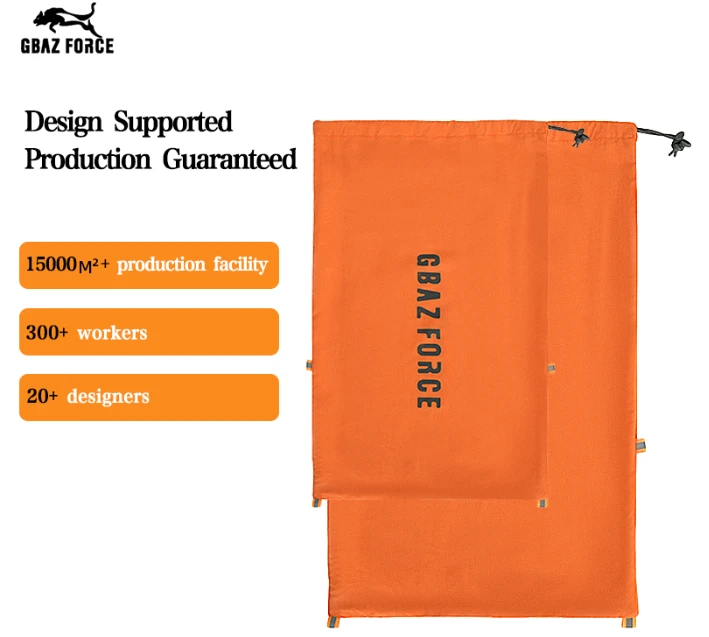
Blaze orange, breathable, looped for the hang - the game bag is the first stage of the cold chain
Technical Part 3: Selection Guide and B2B Angles
Sizing Sets and Capacity Estimation
A single larger-size fine-knit bag holds on the order of 10–15 liters, which takes a whitetail quarter (roughly 9–13 kg per side) with room to spare for the drawstring closure. The rule of thumb: one whitetail = 2 bags; one elk = 4–6 (quarters plus loins and neck); one moose = 6–8. A matched two-bag set with a size spread covers a full deer and a large part of a big game animal, which is why the set - not the single bag - is the commercial unit.
Fabric Weight and Durability
Fabric weight matters in direct proportion to load. A heavier woven construction (the 180–260 g/m² class) is the right choice for frame packs and heavy loads: it resists abrasion against the frame rail and holds the loops under a full quarter. A lighter weave (120–160 g/m² class) is adequate for short walks and small species. For a bag that will be reused season after season, buy the heavier fabric and the reinforced loops.
Stitching and Reinforcement
The two places a game bag fails are the seams and the loops. Specify double-needle or bar-tack stitching at every webbing loop, bound or flat-felled seams along the stress lines, and loops cut wide enough to spread the load across the fabric rather than concentrating it on a single stitch line. A bag that lets go at a loop on the first quarter has failed the entire design.
How Many Bags per Deer?
The minimum for a whitetail is two (front quarter, hind quarter). Three or four is better if you want the loins out and the rack out of the main load. For a B2B buyer, the sales unit is the set: one set per deer, restocked per season.
B2B Selection Advice: Three Core Customer Segments
Western and open-range hunters take elk, moose and bear over long walks in predator country. They need heavy bags, four-to-six-bag kits, blaze orange, and the strongest loops in the line.
East-coast bowhunters take whitetail in dense timber over short hauls, in high volume per season. They need lighter sets, value pricing, and matched sizes that fit a standard quarter.
Guides and outfitters reuse the same bags season after season and want brand visibility in the field. They need durable construction, logo placement, and multi-bag kits that keep every animal's meat separated.
OEM Customization
The standard baseline is the GAF Outdoor 905-40 / 905-41 pair: blaze orange, fine-knit woven fabric, drawstring closure, side and corner webbing loops, two sizes per set. OEM runs typically start with size combinations and color, then move to logo (embroidered or printed, placed on the body or the drawstring cord) and a matching storage bag for the set. Packaging and labeling round out a private-label line. The structure is fixed by the physics of the job; the skin is where the brand lives.
Conclusion
The game bag is small, inexpensive, and the most important piece of equipment in the chain: it is the only thing between the quarter and the spoilage variables. A breathable woven fabric, a one-hand drawstring, and reinforced hang loops - sold as a matched set - is the structure the quarter haul demands. For the hunter, it is the difference between meat that makes it to the freezer and meat that does not. For the B2B buyer, the spec sheet is short: fabric weight, opening size for fly defense, loop reinforcement, the size set, and the orange that keeps both hunter and meat findable in the field.
FAQ
- Q1: Can a heavy-duty trash bag replace a game bag in a pinch?
- In a pinch, yes; as a habit, no. A poly bag traps heat and moisture against the quarter and accelerates exactly the spoilage that the game bag is engineered to prevent. It is an emergency stop-gap, not a design.
- Q2: How do you clean blood out of a meat bag properly?
- Cold water first - never hot, which sets the protein into the weave. Rinse, scrub with mild soap (including the closure and the loops), then run a disinfecting step between animals. Air-dry completely before storage.
- Q3: Will bugs eat or damage a stored game bag?
- The fly threat is at use time, not in storage. A stored bag of woven synthetic is not food for insects. Keep it dry, folded, and out of rodent reach; the weave is what keeps blowfly eggs off the meat in the field.
- Q4: How high should I hang a bagged quarter?
- Three to four meters off the ground as a working minimum, more in heavy bear country, on a branch thick enough to hold the load, hoisted on a single line through the webbing loop so the bag hangs clear.
- Q5: Do I need a separate bag for each quarter, or can I put the whole rack in one bag?
- One bag per quarter is better for airflow - each side dries independently. A whole rack in a single bag works for a very short haul, but it concentrates heat and moisture in the middle of the load, which is the opposite of what you want.


