

Carrying a spotting scope and a rifle is not a packing problem. It is a time problem. The moment you reach the ridge, the saddle, or the edge of the timber, everything you decided on the walk in has to be undone before you can look through glass. A rifle slung across your back has to come off your shoulder and be laid down somewhere safe. A spotting scope buried in a side pocket has to be dug out, unzipped, extracted, and set on a tripod while your hands are already cold. By the time the glass is up, the animal has moved, or the light has gone, or the window has closed.
That cost is invisible on a spec sheet and very visible in the field. The 905-066 is built around a single design decision: put the optics and the firearm in sleeves that open from the front of the pack, so the pack does not have to come off your back for you to get to work. This article explains the access logic behind that structure, the fabric specification that supports it, and what buyers sourcing a front-opening hunting pack should be testing before they commit to a program.
Technical Part 1: Three Ways to Carry a Rifle and a Scope
Every carrying method is a trade between how the load rides on the walk and how quickly it converts into a working position. There are three approaches in common use, and each one fails in a different part of the hunt.
Horizontal scabbard packs
A horizontal scabbard carries the rifle flat across the back of the pack, barrel pointing to one side. It rides securely and keeps the rifle out of the way of branches and brush, which makes it a strong choice for long approach walks through tight cover. The cost is paid at the destination. To deploy, the pack comes off, or at minimum the shoulder straps are loosened and the pack rotated, and the rifle is drawn sideways. In a seated ambush position, with the pack against a tree, a horizontal scabbard is close to unusable without standing up first. Transitioning between firing positions means repeating the whole sequence.
Side-mounted rifle carriers
A side carrier hangs the rifle along the flank of the pack, attached by a sleeve, straps, or a butt cup. It is faster than a horizontal scabbard because the rifle can be drawn without removing the pack, and it keeps the hands free on the climb. But it moves the center of gravity off the spine, which is noticeable on uneven ground with a loaded pack. The rifle also sits in the swing path of your arm and catches on brush, and in a seated position the rifle butt digs into the ground or the rock you are sitting on. Side carry is a compromise that works well on open ground and poorly in the two situations hunters actually spend most of their time in: sitting still and moving quietly.
The front-opening dual-sleeve pack
The 905-066 takes a different route. The pack carries a front sleeve and a rear sleeve - the product data sheet describes this as a "Dual Front + Rear Sleeve System," with the front sleeve specified as "SCOPE + RIFLE COMPATIBLE - Front Sleeve Secures Spotting Scope or Firearm." The front face of the pack is closed by a single full-length vertical zipper. Open that zipper and the front panel folds down flat, exposing the sleeve behind it as a full-length opening rather than a narrow top-loading mouth.
What that changes is the sequence. You stop, you drop the pack's weight onto the waist belt, you open the front, and the optics are presented to you at chest height without the pack leaving your back. For the gun carry mode, the data sheet describes the rear sleeve carrying the firearm with the barrel oriented upward. The two modes share one pack body rather than requiring two separate bags or an add-on scabbard.
The practical difference shows up in the three movements that define a hunting day. On arrival at a glassing point, the front-opening pack converts in seconds and the spotting scope is already at the height where a tripod head sits. When you shift position to a second vantage point, you close one zipper and walk; nothing has to be re-slung across your shoulder. When you sit down to wait, the pack stays on your back or beside you with the sleeve still accessible, so a rifle in the rear sleeve with the barrel up can be brought into position without standing.
None of this makes the pack lighter or smaller than a horizontal scabbard design. It makes the transition between carrying and observing shorter, and on a short window that transition is the whole hunt.
Technical Part 2: Structure, Materials, and What the Fabric Data Means
Sleeve logic and the access path
The two sleeves are not duplicates of each other. The front sleeve sits directly behind the front panel and is sized for a spotting scope or a firearm, per the data sheet's "SCOPE + RIFLE COMPATIBLE" description. Because the entire front panel lays flat, the sleeve is loaded and unloaded along its length rather than fed in from one end. That matters for a spotting scope with a large objective housing and an angled eyepiece, which is awkward to insert through a top opening.
The rear sleeve is the gun carry position, with the barrel oriented upward. Keeping the firearm at the back of the pack and the optics at the front separates the two loads physically, so working out of one does not disturb the other. The choice of which sleeve carries what is a configuration decision for the user, and it depends on the firearm, the optic, and the terrain - the data sheet supports both placements in the front sleeve but does not prescribe a single setup.
Hydration and harness
The hydration system is a dedicated elastic inner compartment rated for a bladder of up to 3L. A quick-release clip at the top center of the pack secures the bladder, and the drink tube routes through a hang loop at the top. Inside the compartment there is also a mesh pocket and a zipped pocket for small items. The harness uses a mesh back panel, a sternum strap, and a waist belt with small pockets on both sides, plus a top grab handle. Two elastic bottle pockets sit on the sides. For a buyer, the harness detail worth noting is that the waist belt is load-bearing, not decorative - which is what allows the pack to be opened and worked out of while still on the body.
The three-layer laminate and 500D nylon
The body fabric is a three-layer composite: a DWR finish applied in-house as a surface water-repellent treatment, a 500D nylon face, and a PU (polyurethane) backing laminate. That construction is standard for load-bearing outdoor packs, and the DWR is a surface treatment on the face fabric, not a membrane.
The fabric laboratory results below are specimen-level test results on fabric samples, not measurements of a finished pack. They describe how the material behaves, not how a completed bag performs in the field.
Tensile strength, ISO 13934-1:2013: 2,100 N warp / 1,800 N weft
Tear strength, ISO 13937-2:2000: 120 N warp / 100 N weft
Fabric weight, ISO 3801:1977: 321 g/m²
Spray rating, ISO 4920:2012 (before washing): Grade 4-5
Abrasion resistance, ISO 12947-2:2016: PASS, 100,000+ cycles
Each of these numbers answers a different sourcing question, and it is worth being precise about which.
Fabric weight of 321 g/m² on a 500D nylon tells you where this material sits in the hand. It is a substantial, structurally confident fabric - heavy enough to hold a shape and resist folding into itself, which is what you want in a sleeve that has to stay open while you load a scope into it. It is not a lightweight ripstop, and buyers should expect the corresponding hand feel and packed bulk.
Tensile and tear strength are the numbers that govern seam margins. A tear strength of 120 N warp / 100 N weft is the figure that determines how much confidence a factory can place in a stitch line running close to an edge, and it sets the allowance for bar-tacks and reinforcement at high-stress points like the waist belt attachment and the sleeve mouth. These are the figures to put in front of a sewing engineer when specifying stitch density and reinforcement.
The spray rating of Grade 4-5 under ISO 4920:2012 is a measure of surface water repellency on a fabric specimen before washing. It is not a waterproof rating, it cannot be converted into a hydrostatic head or an IP rating, and it does not describe the finished pack. Read it as evidence that the DWR treatment is performing at the face-fabric level, and nothing more.
Abrasion resistance of PASS at 100,000+ cycles under ISO 12947-2:2016 speaks to surface wear life - how the face fabric holds up against repeated rubbing, which is the failure mode that matters most on a pack that gets set down on rock and dragged through brush. Combined with the PU backing, it supports the case for a 500D body in rough terrain use.
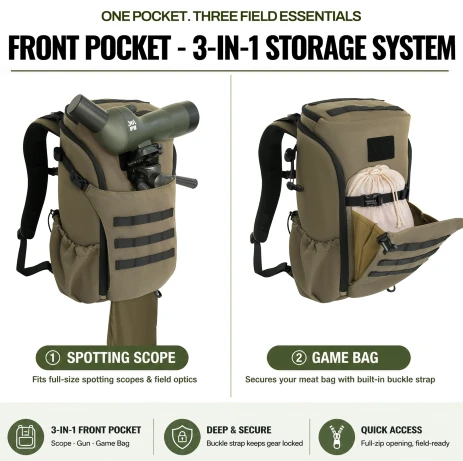
One pack, two modes: the front sleeve taking a spotting scope (left) and the rear sleeve taking a rifle (right)
Technical Part 3: Sourcing, Customization, and Program Planning
Who this structure fits
The dual front and rear sleeve layout suits buyers whose end users carry both an optic and a firearm in the same outing and who lose time converting between the two. That is primarily the western and mountain hunting market, guided-hunt operations, and the long-range and precision shooting segments where a spotting scope is part of the standard load. It is a weaker fit for buyers serving ultralight backpack hunters, who will not accept the fabric weight, or for markets where the rifle is carried separately by regulation or by preference.
Because both sleeves are built into one body, the pack also serves buyers who want a single SKU covering two use cases instead of stocking a dedicated optics pack and a separate gun carrier. That consolidates a range, but it also means the pack's value proposition has to be communicated clearly at retail - a buyer who does not understand the front-opening access will read the pack as an ordinary daypack with an unusual zipper.
What to test in sampling
The 15-day sampling window is enough to validate the structure if the sample review is targeted. Five points are worth insisting on.
Full-length front zipper travel. The zipper runs the entire front face, so any tight spot, any change in slider resistance, or any curve that binds will be felt on every single open and close. Ask for the panel to be cycled repeatedly on the sample and check that it lays flat when fully open without the fabric puckering at the bottom turn.
Sleeve lining and optic fit. Confirm the lining height against the actual scope body, including the objective bell and the eyepiece, and check that the scope does not shift or rattle when the pack is carried loaded. Fit should be snug without requiring force to insert.
Hydration clip position. The top-center quick-release clip has to sit where the bladder's own hang point lands when the bladder is full, not where it lands when empty. Fill a 3L bladder and check.
Waist belt stitching under load. The waist belt carries the pack's weight when the front is opened, so the stitch lines and reinforcement at the belt attachment are the highest-stress seams on the product. Load the pack and open the front panel while wearing it.
Fabric upgrade effects. The data sheet lists a face fabric range from 500D to 1000D. Moving to 1000D raises abrasion and tear margins but changes hand feel, packed bulk, and the way the front panel folds when opened. If a buyer specifies 1000D, the fold-flat behavior of the front panel should be re-validated on the upgraded sample rather than assumed from the 500D version.
MOQ and scheduling
The data sheet lists a minimum order quantity of 300 pcs per color, sampling at 15 days, and bulk production at 30-45 days. The per-color MOQ is the constraint that shapes a program: a three-color range is three times the minimum, so color count should be decided before sampling rather than after, and it should be decided against sell-through expectations rather than against the sample board. The 15-day sampling window and the 30-45 day bulk window are sequential, not overlapping, so a program that needs stock on a fixed date should plan backward from the bulk window and leave room for a second sample round if the front-opening structure needs adjustment.
Color and camouflage development
Customization covers logo and brand engraving, color in both solid and camouflage, size and pocket modification, fabric upgrade from 500D to 1000D, and hangtag and packaging design. Camouflage is the item that most often extends a timeline, because a camo print has to be registered against panel shapes and the front panel is a large, highly visible surface. Solid colors are the faster path to a first production run; camo is better treated as a second phase once the structure is locked.
Conclusion
The case for the 905-066 is not that it holds more. It is that it removes a step. A rifle and a spotting scope carried in two sleeves on one pack body, with the front panel opening flat along its full length, means the transition from walking to glassing does not require unloading the pack or re-slinging a rifle. For buyers, the structure is supported by a 500D three-layer laminate with published specimen-level fabric data - 321 g/m², 2,100/1,800 N tensile, 120/100 N tear, Grade 4-5 spray, and 100,000+ abrasion cycles - which is enough to specify against, provided those figures are read as fabric properties and not as a rating for the finished bag. The front-opening hunting pack is a configuration decision. This one is built so that the configuration is the point.
FAQ
What is the waterproof rating of this pack?
There is no waterproof rating for the finished pack. The published data covers the fabric only: a DWR surface treatment applied in-house, a PU backing laminate, and a spray rating of Grade 4-5 under ISO 4920:2012 measured on fabric specimens before washing. That spray result describes surface water repellency at the fabric level and does not translate into a waterproof rating, a hydrostatic head, or an IP rating. This pack should not be treated as a waterproof bag.
What are the capacity and weight?
Capacity in liters and product weight are not published in the available specification material. Buyers should confirm both against the current specification sheet for the specific configuration being ordered, since pocket and size modifications will affect them.
Can the pack carry a spotting scope and a rifle at the same time?
The pack uses two separate sleeves, one at the front and one at the rear, so the two loads are carried in different positions on the same body. The front sleeve is specified as compatible with either a spotting scope or a firearm. Whether a specific scope and rifle combination works for a given user depends on the configuration, so the exact setup should be confirmed with us before an order is placed.
How large a hydration bladder does it take?
The dedicated elastic hydration compartment is rated for a bladder of up to 3L, secured by a top-center quick-release clip with the drink tube routed through a hang loop at the top of the pack.


