

Introduction: Two Shelves, Two Engineering Philosophies
Walk into any outdoor store with a firearms section and you will see them side by side: a black 1000D Cordura rifle bag with MOLLE webbing and a camo-printed soft case with a brushed interior. Same price band, same basic job - protecting a rifle on the way to the range or the field. But a tactical gun bag and a hunting gun bag are not variations of one product. They are two different engineering problems wearing similar silhouettes.
The tactical buyer carries a rifle into a truck bed, a patrol vehicle, or a muddy competition bay. The bag gets dropped, dragged, stacked, and thrown open under time pressure. The hunter walks four kilometres into the bush at 5 a.m. and needs a case that does not announce itself to every animal within earshot, does not weigh down a pack, and disappears against the terrain. The material, the padding, and even the zipper hardware that serve one of these users are the wrong choices for the other.
For a B2B buyer sourcing long gun soft cases, this distinction is not academic. Order the wrong spec for the wrong channel and you get three predictable outcomes: dead stock on the shelf, returns from disappointed end users, and a brand that loses the retailer's trust. This article breaks down the technical requirements of each category, the science behind gun case padding, and the practical product-mix strategy for wholesalers supplying hunting shops versus tactical gear dealers.
Part 1: Tactical Gun Bags - Built for Hard Use and Fast Access
Modularity as a Design Language
The defining feature of the tactical soft gun case is modularity. MOLLE-compatible webbing - or its newer lasercut panel equivalent - runs across the front and sides of the bag, letting the user attach magazine pouches, an admin panel, a dump pouch, or a sling. For a range bag or a patrol bag, this transforms a simple case into a mobile loadout station. The webbing must be bar-tacked at every stress point and rated for repeated attachment cycles; a MOLLE grid that tears off after three months of pouch swapping is a returned product waiting to happen.
Quick Access Architecture
Tactical bags prioritize access speed. Full-length clamshell zippers let the case open completely flat so a rifle can be drawn with one hand, and the more aggressive models add a fast-open top flap or a "deploy flap" that exposes the rifle without unzipping the full length. This requirement drives hardware selection: YKK heavy-duty zippers with rubberized pull tabs, reinforced zipper tapes, and pulls that can be grabbed with gloved fingers. In a tactical context, a zipper that snags at the wrong moment is a functional failure, not an annoyance.
Outer Fabric: 500D–1000D Cordura
The tactical exterior is an abrasion story. Standard spec across the category runs from 500D to 1000D Cordura nylon, with 1000D reserved for high-wear zones: shoulder straps, drag handles, and the muzzle-end cap. Many factories add a PVC-backed or coated nylon layer for moisture resistance, because tactical bags live in environments where a wet seat, rain, or a spilled bottle of solvent is routine. The outer shell is also where the bag earns its rating for tear strength - snag a 500D bag on a truck tailgate latch and you want a scuff, not a rip.
Built for the Abusive Environment
Tactical bags are designed against a specific failure mode list: repeated drops onto concrete, stacking under other gear, being thrown into vehicle trunks, dragging across dirt. That translates into reinforced end caps, double-stitched seams (or bartacking at every junction), an external drag handle at the muzzle end, and interior barrel retention shock cord so the rifle does not slide forward against the end pad in transit. Nothing on a tactical bag is decorative; every strap and panel exists to survive a specific abuse.
Part 2: Hunting Gun Bags - Silent, Concealed, Light
The Silence Requirement
The hunter's most valuable asset is auditory. A rifle that clinks against a buckle, a zipper that rattles, or a shell loop that scrapes a branch can end a stalk that took hours to set up. This drives the signature hunting material choice: a brushed tricot lining that cushions the rifle and muffles contact noise, wrapped around the barrel and action areas. Some hunting lines use a cotton-poly blend outer with a brushed finish for the same reason - the fabric itself is part of the noise budget.
Hardware follows the same logic. Hunting bags use quieter zipper pulls, often with cord or fabric-wrapped tabs, and zipper tracks are frequently covered or positioned so the slider does not clatter against the stock. Velcro - loud by design - is minimized on hunting bags, moved to interior compartments, or replaced with silent snaps and magnetic closures.
Camouflage That Sells at Retail
In the hunting channel, pattern is a purchase driver, not a detail. Licensed camouflage from Realtree and Mossy Oak dominates the category, and for good reason: hunters buy the pattern their local season and terrain demands. For B2B buyers this introduces a compliance dimension that tactical sourcing never touches. Licensed camo carries royalty obligations and authorized-supplier rules. Unlicensed "similar" patterns invite legal exposure and are increasingly rejected by serious hunting retailers. A factory with existing licensed-pattern supply relationships - and the paperwork to prove it - is worth more than one that simply prints camouflage colors.
Blending In, Weighing Less
Hunting bags use earth-tone hardware, non-reflective buckles, and muted trims so nothing glints in low light. And because the hunter carries the bag on foot - sometimes for miles of ridge walking - weight is a first-class spec. Where a tactical bag shrugs off an extra 400 grams for heavier fabric and reinforcement, a hunting bag cuts it. Lighter outer fabrics, trimmed hardware, and leaner padding all trade a little durability for a lot of carry comfort. The padding calculus, covered next, is where the two categories most visibly diverge.
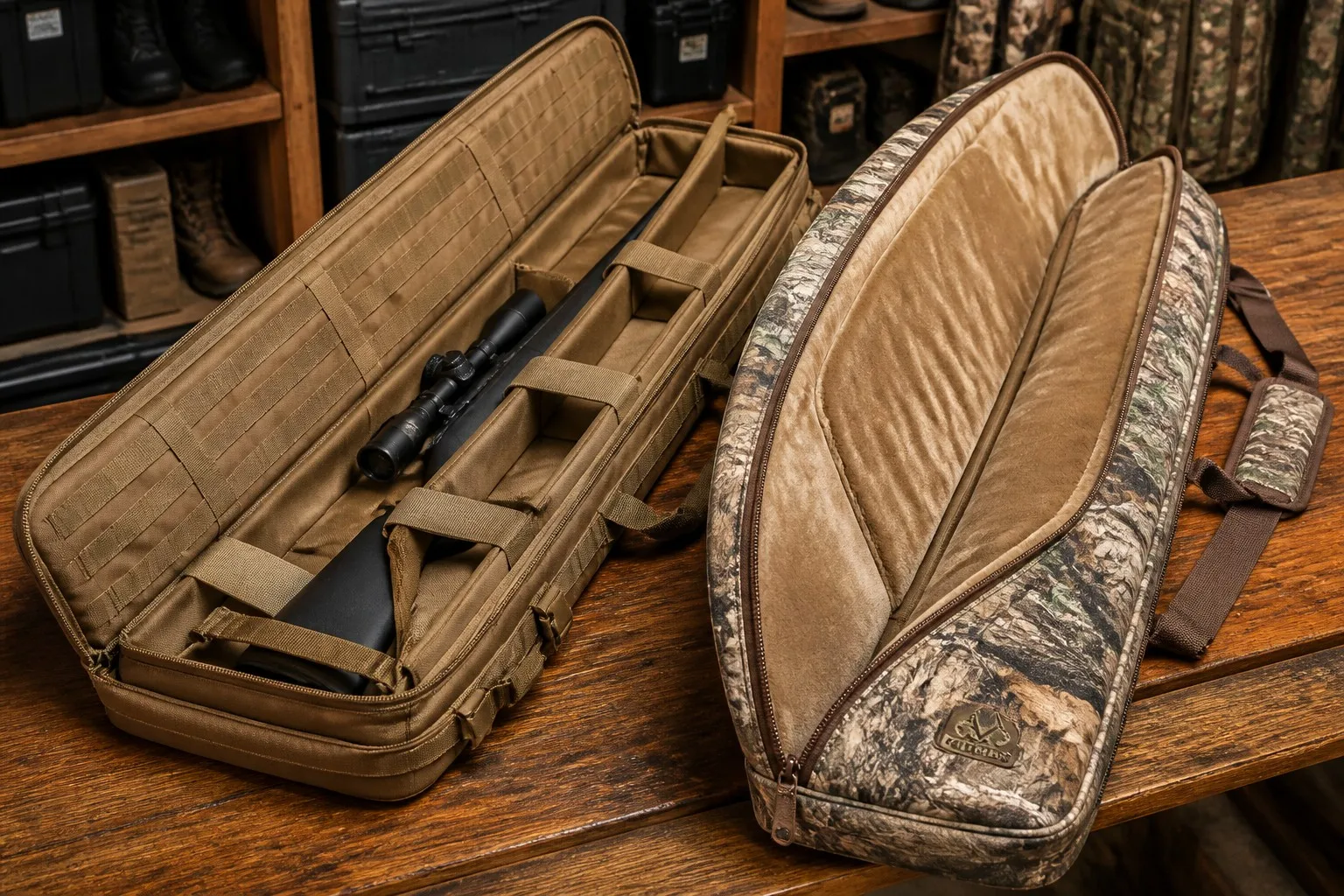
Tactical and hunting gun bags - two design philosophies, two material sciences
Comparative Matrix: Tactical vs. Hunting Gun Bags
| Attribute | Tactical Gun Bag | Hunting Gun Bag |
|---|---|---|
| Outer fabric | 500D–1000D Cordura, PVC/coated backing | Cotton-poly blend, brushed outer finish, lighter nylons |
| Inner lining | Loop liner, shock cord retention | Brushed tricot, noise-dampening fleece |
| Padding | 10–15mm high-density EVA, impact-focused | 5–10mm EVA or soft foam, weight-optimized |
| Capacity / layout | Multi-compartment, magazine pouches, MOLLE admin panels | Slim profile, barrel + stock zones, small accessory pocket |
| Access speed | Clamshell full-length zipper, fast-open flap, one-hand draw | Standard top/side entry, no rush requirement |
| Silence | Secondary concern | Primary requirement - quiet hardware, no exposed velcro |
| Water resistance | Coated/PVC-backed shells | Weather-tolerant, rarely submersion-rated |
| Hardware | YKK heavy-duty, rubberized pulls, drag handle | Quiet pulls, fabric-wrapped tabs, matte buckles |
| Weight | Heavier, reinforcement-driven | Lightweight, carry-comfort-driven |
| Target customer | LE/military, competition shooters, range users | Hunters, upland and big-game, seasonal buyers |
| Price tier | Mid-to-premium, feature-driven | Mid-tier, pattern and brand-driven |
Padding Science: What Actually Protects a Rifle
High-Density EVA - The Workhorse
Closed-cell EVA foam is the backbone of long gun protection, and for good reason. Its closed-cell structure means it does not absorb water, it returns to shape after compression, it can be CNC-cut to exact thickness, and it holds a consistent density at a predictable cost. For a soft gun case long gun, 5mm of EVA is the bare minimum for scratch protection; 10mm is the standard for scoped rifles; 15mm belongs on premium cases where the optic is the most expensive component in the bag.
Memory Foam - Conformity at a Cost
Open-cell polyurethane memory foam does something EVA cannot: it conforms around the rifle, hugging the stock, action, and barrel so the gun does not shift inside the case. That is genuinely valuable on a long trip. But the trade-offs are real. Open-cell foam absorbs moisture, it is heavier, and it compresses permanently under sustained pressure. Hunting bags use it selectively - often in the stock pocket or as a top layer - where fit matters more than longevity.
Soft Shell Lining - Protection Against Scratches, Not Impacts
The brushed tricot and fleece liners found in many hunting cases are not padding in the impact sense. At 3–5mm they prevent the finish damage a rifle suffers rubbing against buckles and zippers, and they muffle sound. A buyer who mistakes a plush-feeling liner for impact protection has specified the wrong product for the wrong use case.
What Thickness Actually Does - The G-Force Data
The difference padding makes is measurable. In factory drop testing, a rifle in an unpadded shell hitting a 1-metre drop onto concrete experiences peak deceleration in the range of 120–160 G at the receiver. Adding a 10mm layer of 80 kg/m³ closed-cell EVA cuts that to roughly 40–50 G - the difference between a scope that holds zero and a scope that needs re-zeroing. Between 5mm and 15mm, thickness does more for impact absorption than material choice does; above 15mm, diminishing returns set in and weight becomes the problem. Density matters on the second and third impacts: a low-density foam that has already bottomed out once does not recover its protective value.
For procurement, the lesson is concrete: specify density (kg/m³) and thickness in your spec sheet, not "thick foam." That single discipline separates buyers who get predictable protection from buyers who get whatever the factory had in stock.
Gun Protection Specifics: The Details That Save a $2,000 Rifle
Stock Retention Straps
A rifle is a long, unbalanced object in a case. Without restraint, it slides forward on every car ride, the muzzle hammering the end cap and the optic edge banging the side padding. A proper stock retention strap - fleece-wrapped velcro with a solid anchor point - holds the stock in place so the rifle stops moving the moment the case does. It is a small component, but its absence is one of the most common causes of damage claims on shipped and transported firearms.
The Optic Protection Pocket
Scopes and red dots are the single most expensive and most fragile component of a modern rifle, and they are the component most exposed in a flat bag. A dedicated optic pocket, or a raised pad area under the optic, keeps the scope suspended clear of the case floor. Premium tactical cases add a rigid or semi-rigid hood over the optic zone. Whatever the construction, the optic zone deserves the thickest padding in the bag - this is where the 15mm EVA belongs.
Compartment Design and Dividers
How the case opens and how the interior is divided shapes real protection. A full-length clamshell lets you lay the rifle flat and inspect the whole action before removal. A muzzle-first drop-in design protects the barrel but makes the optic area harder to pad. For takedown shotguns, an internal padded divider keeps barrel and stock from knocking together. End caps - where the muzzle and butt land - deserve reinforced padding and, on tactical bags, an extra layer of abrasion resistance, because that is the corner that gets dragged.
Factory Profile: GAF Outdoor - Two Lines Under One Roof
Guangzhou GAF Outdoor, founded in 2011, is a manufacturer that refuses the tactical/hunting either/or. The factory operates two parallel production lines: one dedicated to tactical soft gun cases in 500D–1000D Cordura with lasercut MOLLE panels and heavy-duty hardware, and one for hunting cases with brushed tricot interiors, licensed camouflage patterns, and weight-conscious construction. CNC foam cutting, dedicated sewing lines, and EVA lamination happen in-house, and the QC checklist covers zipper function cycling, seam strength, and camo pattern registration against the licensed artwork.
For a B2B buyer, this dual-line capability is a sourcing advantage: both product families can be consolidated into a single order and a single container, cutting logistics cost and supplier-management overhead. It also means the factory's engineers have direct, day-to-day experience of where the two categories differ - and can stop a buyer from asking a tactical spec to do a hunting job.
B2B Strategy: Configuring the Right Line for Each Channel
For Hunting Goods Retailers
Stock camouflage first. Licensed patterns (Realtree, Mossy Oak) drive the purchase decision, so carry a depth of pattern rather than a depth of colors. Keep the bags light, quiet, and mid-priced - the hunting buyer is paying for concealment and carry comfort, not for MOLLE webbing they will never use. Plan seasonality: orders should land before the September–November big-game season, with early-bird pricing to pull the purchase earlier. Confirm the licensed-pattern paperwork covers your territory before you commit to a PO.
For Tactical Gear Dealers
Lead with black, OD green, and coyote brown. Feature-driven product works here: buyers compare MOLLE grid density, zipper brand, and fabric denier on the spec sheet, so those details should be front and center in the packaging and the sales collateral. Demand is year-round - LE/military surplus customers and competition shooters buy continuously - so reorder planning can be steady rather than seasonal. A premium tier with 1000D reinforcement and optic hoods earns its margin in this channel.
The Mix That Works
Do not split the assortment 50/50 by instinct; let your channel data decide. A useful starting pattern is three to four tactical SKUs plus three to four hunting SKUs, with one neutral, mid-padding universal SKU that can sit on both shelves. Test before you commit: ask your factory for drop-test data, zipper cycle counts, and written fabric specs - then request physical samples of both categories and abuse them the way your end customer will. The factory that answers with data, not adjectives, is the one that will keep your return rate low and your reorder rate high.
Conclusion
Tactical and hunting gun bags look like siblings in a catalog photo, but they diverge in fabric, padding, hardware, and the customer who buys them. The tactical shelf wants modular, armored, fast-access cases built for hard use. The hunting aisle wants silent, camouflaged, lightweight cases built for the field. Matching the product to the channel - and specifying density, thickness, and zipper hardware with the same discipline you apply to pricing - is what separates a profitable long gun soft case line from a clearance bin. GAF Outdoor manufactures both under one roof and knows exactly where the line between them runs. If you are building a long gun protection assortment, ask for a sample of each and test them the way your customers will.
Check by www.gafoutdoor.com to get more information.


