

The clock on a hunt does not stop when the animal goes down. It starts. From that moment, everything that touches the meat - how fast it cools, how clean it stays, how it is carried off the mountain - decides what the processor, the butcher, or the family table receives days later. In most field breakdowns, the bag is treated as an afterthought, something pulled from the bottom of a pack after the quartering is already done. That is the wrong order. The game bag is not a container; it is the first link in the cold chain, and it is the only piece of equipment that stays in contact with the meat for the entire carry out. A bag that loads slowly costs minutes in warm weather. A bag that cannot be reopened cleanly costs organization at the tailgate. A bag that fails at the seam costs meat.
This article is written for buyers and product teams rather than for a single hunter's kit list. It examines two constructions - the 905-040 drawstring sack and the 905-041 zipped game bag - as two different answers to the same field problem, and it sets out what each one does, what it does not do, and how a sourcing program should combine them.
Technical Part 1: Drawstring and Zipper Are Two Different Machines
The most common mistake in game bag sourcing is to treat drawstring and zipper as a price tier - the cheap closure and the upgraded closure - applied to the same body. They are not interchangeable fittings on one pattern. They are two distinct constructions, and the closure dictates how the bag is loaded, how it is handled with one hand, and how it survives repeated opening and closing in bad conditions.
A drawstring sack opens as one mouth. The entire top circumference releases at once, so the aperture is as wide as the bag itself. Load direction is vertical and unrestricted: a whole quarter, a bone-in shoulder, or an unskinned section goes in from above without being threaded past a narrowing. That matters because the heaviest, most awkward pieces of a carcass are exactly the pieces that resist being steered into a narrow opening. When a hunter is working on a slope, in failing light, with hands that are wet and cold, the difference between an opening that accepts a load in one motion and an opening that requires two hands and a re-grip is not a convenience issue - it is a time and hygiene issue. The drawstring also closes by gathering, which means the closure itself does not have a fixed track to align. There is nothing to start, nothing to seat, nothing to zip past a corner. The cord pulls, the mouth gathers, the bag is shut.
The cost of that design is granularity. A gathered mouth is either open or gathered; it does not offer a controlled partial opening, and reaching into a full sack to rearrange or extract a specific piece means releasing the whole closure. That is fine when the bag holds one large item. It is inefficient when the bag holds a mixed load that has to be sorted, re-packed, or accessed piece by piece.
A zipped bag works on the opposite principle. The opening is a controlled line, not a full circumference. Access is incremental: the bag can be opened along part of its length, worked from, and closed again without disturbing the rest of the contents. For a hunter who has quartered an animal and wants the pieces organized - backstraps separate from trim, a specific cut retrievable without unloading the bag - that controlled access is the functional advantage, and it is the reason a zipped bag belongs in a pack-out system alongside a sack rather than instead of one. The trade-off is that a zipper is a mechanism: it has a start point, a slider, two ends, and a track that has to stay aligned under load. Its reliability is a function of the quality of that mechanism and the reinforcement at both ends of the run.
The 905-041 uses a YKK zipper running the length of the bag, which addresses the mechanism side of that trade-off directly. A full-length run means the bag opens wide for loading and inspection rather than only at one end, and the two functions - wide access for a bulk load, controlled access for a partial load - coexist in one bag. A compression webbing run and a handle sit on the same body, so the bag can be cinched and carried as a unit rather than bundled into a pack loose.
The practical division follows from the mechanics. Large, single, awkward pieces favor the drawstring sack: the mouth is the widest possible, the closure has no alignment step, and there is no track to foul. Cut, sorted, and repeatedly accessed loads favor the zipped bag: partial opening, reclosure, and compression are what the construction is built to do. A buyer who understands this stops asking "which bag is better" and starts asking "which bag for which load," which is the question that actually shapes a product line.
Technical Part 2: Specification by Specification
The two families carry four capacities between them, and each capacity is tied to a specific construction. The numbers below are the published product data.
905-040 - drawstring sack, two sizes
| Capacity | Dimensions | Weight | Closure | Details |
|---|---|---|---|---|
| 34 L | 28.3" (72 cm) × 16.9" (43 cm) | 0.11 kg | Drawstring | Reflective loops, customizable logo |
| 70 L | 39" (99 cm) × 22" (56 cm) | 0.17 kg | Drawstring | Reflective loops, customizable logo |
Both sizes are built in nylon, use a drawstring closure, and carry reflective loops. The 34 L is a flat-format sack - 72 cm long by 43 cm across - sized to take a single substantial piece or a modest mixed load. The 70 L opens to 99 cm by 56 cm, roughly double the footprint area, which is the format for a whole quarter or a large combined load carried as one unit. The weight difference between the two is 0.06 kg, which is the honest consequence of more fabric and a longer drawstring run rather than a design compromise.
905-041 - zipped game bag, two sizes
| Capacity | Dimensions | Weight | Closure | Details |
|---|---|---|---|---|
| 10 L | 18" (45.7 cm) × 7.1" (18 cm) × 5" (14 cm) | 0.12 kg | YKK full-length zipper | Webbing loops, handle, reflective loops, customizable logo |
| 20 L | 22.4" (57 cm) × 10.2" (26 cm) × 5.5" (14 cm) | 0.13 kg | YKK full-length zipper | Webbing loops, handle, reflective loops, customizable logo |
The 905-041 is a three-dimensional bag, not a flat sack: both sizes run 14 cm deep, which is what allows a sorted load to sit in layers rather than compress into a single plane. The 10 L at 45.7 × 18 × 14 cm is the compact unit for trim, backstraps, or a single parted cut. The 20 L at 57 × 26 × 14 cm is the working size for a full quartering job broken down into carryable pieces. The two weights differ by only 0.01 kg, so size selection inside this family is essentially a volume decision, not a load-bearing decision.
The same nylon base fabric plays a different role in each construction. In the drawstring sack, the fabric's job is to form a large, uninterrupted surface that gathers cleanly at one mouth; the design pressure is on the gather line and the cord channel, because that is where the entire closure load concentrates. In the zipped bag, the fabric has to hold a straight, stable seam line along the full length of a YKK zipper while resisting the pull that a loaded bag puts across that seam, and it has to stay dimensionally stable in a three-dimensional cut. Same material, two very different mechanical demands - which is precisely why the two products are not a size run of one pattern.
The four capacities map onto load weight and carry method rather than onto a single "small, medium, large" ladder:
10 L (905-041) - compact, carried inside a pack or clipped to it. For sorted cuts and trim.
20 L (905-041) - the general-purpose zipped unit, carried by its handle or strapped via webbing loops. For a quartered load in pieces.
34 L (905-040) - a single large piece, carried as a sack. The entry point for whole-piece transport.
70 L (905-040) - a whole quarter or a combined load, the heavy carry-out format.
Read as a system, the four sizes cover the full arc of a pack-out: sorted pieces in the 905-041 pair, bulk pieces in the 905-040 pair, with reflective loops present across all four so a bag left on the ground or hung at a cache is findable in low light.
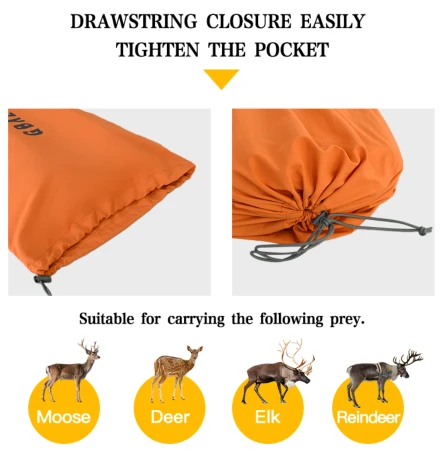

The 905-040 drawstring sack in its two sizes: 34 L at 72 x 43 cm and 70 L at 99 x 56 cm
Technical Part 3: Sourcing, Sampling, and Customization
Buying this category well means buying by construction and capacity together. A range assembled only on capacity - 10, 20, 34, 70 litres - will end up with four bags that overlap functionally and leave at least one real use case uncovered. Assembled by construction, it reads as a coherent system: the 905-041 pair covers the sorted and repeatedly accessed load, the 905-040 pair covers the bulk and single-piece load, and the buyer can present the range to a retail or outfitter account as a pack-out kit rather than as four loose SKUs.
Sampling and inspection should follow the failure modes of each construction, not a generic checklist.
For the 905-040 drawstring sack, the critical zone is the mouth. Inspect the cord channel for a consistent, even run with no tight or pinched sections, since a channel that binds will gather unevenly and leave a gap. Check the stitching at the channel and at the points where the drawstring exits - these take the entire closure load and are the first place a sack fails. Confirm the reflective loops are anchored through reinforced stitching rather than surface-tacked, and that the loop material itself is captured, not just the tab.
For the 905-041, the zipper is the inspection subject. Run the slider the full length in both directions and confirm smooth travel with no catch, no skipped tooth, and no point where the slider requires a second pull. Check both ends of the zipper run specifically: the start box and the top stop must be reinforced so the slider cannot travel past the end or split the track under load. Then check the seam that carries the zipper along its full length - a straight, evenly tensioned seam with no puckering, because a wavy seam is where a zipper track goes out of alignment in use. The webbing loops and handle should be pull-tested at their anchor points, and the handle should be loaded as a handle, not merely inspected as trim.
Two further checks apply across the range. The first is reflective visibility: confirm the reflective loops actually return light in low-angle, low-light conditions rather than merely appearing light-coloured in daylight. The second is specific to the 905-041's white, semi-translucent fabric - it shows field soiling readily, so agree the stain and cleaning judgement criteria with the factory at sample stage, including how the material behaves after the cleaning method you intend to specify, and record the approved sample as the reference. Deciding this after production is how a white bag becomes a dispute.
Customizable logo is available on both families, and placement should follow the construction. On the 905-040, the natural field is the flat body panel away from the gather line, so branding is not distorted when the sack is closed. On the 905-041, the flat side panel between the zipper line and the webbing run keeps the mark legible and clear of abrasion points. On both, keep branding off the reflective loops and off the load-bearing stitch lines.
For range development, the strongest configuration is a paired assortment rather than a single hero SKU: one 905-041 size and one 905-040 size as the core pair, with the second size of each added for accounts that want full coverage. That structure gives a buyer a defensible story - two constructions, four capacities, one pack-out system - and it gives the factory a cleaner sampling and production plan than four unrelated items.
Conclusion
The 905-040 and the 905-041 are not the same bag in two sizes. One is a drawstring sack that opens to its full circumference and loads a large piece in a single motion; the other is a zipped game bag with a full-length YKK zipper, webbing loops, and a handle, built for sorted loads that are opened, worked from, and closed again. Between them they cover 10, 20, 34, and 70 litres, in nylon, with reflective loops and customizable logo across the range. The specification a buyer should carry into a sourcing conversation is not a capacity figure but a construction decision: which loads go into a sack, which go into a zipped bag, and how the two are stocked together so the pack-out is covered from the first cut to the tailgate.
FAQ
Is the 905-041 breathable?
No. The 905-041 has no ventilation openings of any kind. The construction is a closed bag with a full-length YKK zipper, webbing loops, a handle, and reflective loops. It should not be specified or presented as a ventilated or airflow design.
Are these bags waterproof?
No. Neither the 905-040 nor the 905-041 carries a waterproof rating, and no waterproof performance should be claimed for either. The body fabric is nylon.
How do I choose between the two?
Choose by construction, then by capacity. If the load is a large, single, awkward piece - a whole quarter or an unskinned section - use the 905-040 drawstring sack, where the full-circumference mouth accepts the piece in one motion: 34 L for a single substantial piece, 70 L for a whole quarter or a combined load. If the load is cut, sorted, and likely to be opened and reclosed during the carry, use the 905-041 zipped bag, where the full-length YKK zipper allows partial access and reclosure: 10 L for trim and single cuts, 20 L for a quartered load in pieces. Many programs stock both.
What do the numbers correspond to in terms of how much game?
The published figures are capacity and dimensions only: 10 L, 20 L, 34 L, and 70 L, with the external dimensions listed for each size. Volume and dimensions are the specification basis; the appropriate size for a given animal depends on how the carcass is broken down and how the load is carried, so selection should be made against those two factors rather than against a claimed weight figure.


