

Introduction: Why the Belt Rises Above the Vest
Walk any stretch of tailwater during a spring caddis hatch and you will notice a subtle gear shift that has been underway for the better part of a decade. Chest packs and traditional fishing vests - once the default - are steadily giving ground to a leaner, more mobile alternative: the fishing lumbar pack. Also referred to as a waist fishing pack, this piece of equipment sits low on the hips, keeping the angler's torso unencumbered for casting, line management, and the kind of high-frequency movement that wading and scrambling along uneven banks demand.
The appeal is not merely aesthetic. A well-designed lumbar pack solves a genuine ergonomic problem that has plagued chest-mounted storage for years: the trade-off between accessibility and fatigue. When a chest pack is loaded with fly boxes, tippet spools, and terminal tackle, it creates a forward moment that pulls on the trapezius and cervical spine. Four hours into a wading session, the angler's casting stroke shortens. The shoulder on the rod side tightens. The neck stiffens. These are not comfort complaints - they are mechanical failures of load distribution.
A front access fishing bag worn around the waist sidesteps this entirely. By moving the payload to the iliac crest - the strongest load-bearing structure in the human skeleton - the lumbar pack places weight where the body is already engineered to carry it. The result is sustained comfort over 8–10 hour sessions without sacrificing the speed of access that makes or breaks a bite window.
In this article, we dissect the engineering behind the modern fishing lumbar pack from a B2B perspective: load biomechanics, access architecture, rod holder integration, waterproofing tiers, and the material decisions that separate a commodity waist pack from a professional-grade tool.
Part 1: The Biomechanics of Waist-Mounted Load
Understanding why a lumbar pack works requires a brief detour into anatomy. The human pelvis, specifically the iliac crest, forms a natural shelf. Unlike the shoulders - which are suspended by a network of muscles and ligaments designed primarily for articulation, not static load-bearing - the pelvis connects directly to the axial skeleton through the sacroiliac joint. This is a compression-bearing structure. When weight is transferred through a wide waist belt onto the iliac crest, the vertical force vector travels almost straight down through the femoral heads into the ground. There is almost no lever arm to amplify the effective load.
Now contrast this with a chest pack. A 3 kg payload worn across the upper back and chest acts at a distance of roughly 15–20 cm anterior to the spinal column. That creates a bending moment that the erector spinae muscles must continuously counter. The metabolic cost is measurable: EMG studies on load carriage consistently show a 20–30% reduction in paraspinal muscle activation when loads shift from the thoracic region to the pelvic girdle.
Belt Width and Pressure Distribution
The critical design variable here is belt width - and more precisely, the contact patch geometry. A narrow 38 mm webbing belt concentrates force into a thin band. At 5 kg of payload, this can generate localized pressure exceeding 4 psi - well above the threshold where subcutaneous blood flow begins to restrict. Numbness and hot spots follow within 45 minutes.
The solution is a pressure dispersion zone - a padded belt section typically spanning 100–140 mm in height at the lumbar contact area, tapering to 50 mm at the lateral and anterior segments. The padding itself is not just foam; layered construction matters. A competent design sandwiches a closed-cell EVA foam core (density: 60–80 kg/m³) between a 3D spacer mesh against the body and a 210D nylon facing on the exterior. The EVA provides structural resistance to compression under sustained load. The spacer mesh - typically a polyester monofilament knit with 3–4 mm of mechanical loft - creates an air channel that moves moisture away from the lower back, a region that sees heavy perspiration during warm-weather wading.
A less obvious but equally important feature: the belt's vertical angle at the attachment point. When the pack body hangs from a belt that slopes slightly downward at 5–8 degrees from horizontal, gravity naturally pulls the load into the lumbar curve rather than away from it. This "hug" effect is what separates a pack that feels planted from one that bounces with every step. The most refined OEM designs achieve this by engineering the seam angle where the belt wing joins the pack body - a detail invisible to the consumer but immediately felt in the field.
Center of Mass and Stability
A lumbar pack positions the payload's center of mass within 5–8 cm of the body's natural center of mass, roughly at the L4–L5 vertebral level. This proximity minimizes the inertial penalty during rapid movement - think side-stepping across slick river rocks or twisting to land a fish on the opposite side of the body. A chest pack, by contrast, moves the COM anteriorly, increasing rotational inertia around the vertical axis. The angler must "overshoot" torso rotations and then correct. Over hundreds of micro-adjustments per session, this adds up to measurable fatigue.
Moreover, a waist-mounted load is inherently self-stabilizing during the casting stroke. In a standard overhead cast, the torso rotates approximately 60–80 degrees through the back-cast and forward-cast phases. A lumbar pack anchored to the pelvis rotates in near-perfect synchronization with the casting motion. A chest pack lags by a fraction of a second - a phase delay that manifests as a subtle but persistent drag on the cast's tempo.
Part 2: Front-Access Storage Architecture - Rotate, Don't Remove
The ergonomic advantage of waist mounting would be academic if accessing gear required unbuckling and removing the pack every time. This is where the mechanical design of the storage access system becomes the differentiator between a fishing lumbar pack worth stocking and one destined for a clearance bin.
The core innovation in the category is the 180° rotate-to-access architecture. Here is how it works in practice: the angler wears the pack with the main compartment positioned at the rear (lumbar zone). When they need to access a fly box or leader spool, they physically rotate the entire pack around the waist - the belt stays buckled - bringing the main compartment to the front of the body. They open it, extract what they need, and rotate it back. Total time: under 4 seconds. No pack removal. No setting gear on a muddy bank. No missed fish.
This sounds simple, but the mechanical requirements are demanding. The rotation mechanism typically relies on one of two designs:
Sliding Track System: The pack body attaches to the belt via a curved HDPE or polycarbonate track that allows smooth 180° travel with detent stops at the 0°, 90°, and 180° positions. The track must maintain consistent friction across its entire arc - too loose and the pack drifts during walking; too tight and rotation requires both hands. Production tolerances on the track curvature are typically held to ±0.3 mm, which is where precision injection molding or CNC-routed sheet stock becomes non-negotiable.
Webbing Loop + Quick-Release Buckle: A simpler, lower-cost alternative that uses a pair of side-release buckles on webbing loops to anchor the pack. Rotation is still possible but requires more manual guidance. The friction interface here is the webbing against the belt's outer face; durability depends heavily on the webbing's edge finishing - heat-cut versus ultrasonically sealed.
Bilateral Quick-Access Pockets
Beyond the main compartment rotation, a well-architected lumbar pack includes bilateral quick-access pockets positioned on the forward-facing sections of the belt wings. These sit roughly at the 10 o'clock and 2 o'clock positions when the main pack is centered at the rear. They are reachable without rotation - the angler simply reaches down with either hand.
The geometry of these pockets is more specific than it appears. A pocket that is too deep (超过 180 mm) makes it difficult to retrieve small items like split shot or nippers from the bottom without looking down. A pocket that is too shallow risks spilling contents during the torso's forward lean when netting a fish. The sweet spot sits at 140–160 mm depth, with a slight forward cant of 10–12 degrees so that gravity biases contents toward the opening rather than the depths.
Pocket closure is another high-friction decision point. Magnetic Fidlock-style snap closures offer one-handed operation and self-aligning engagement - ideal for cold-water scenarios where the angler is wearing neoprene gloves. However, they add roughly $1.80–$2.50 per unit in BOM cost. Standard YKK #5 reverse coil zippers with Hypalon pulls are more cost-effective and arguably more secure in heavy brush, but they require two-handed operation. The right call depends on the target retail price point.
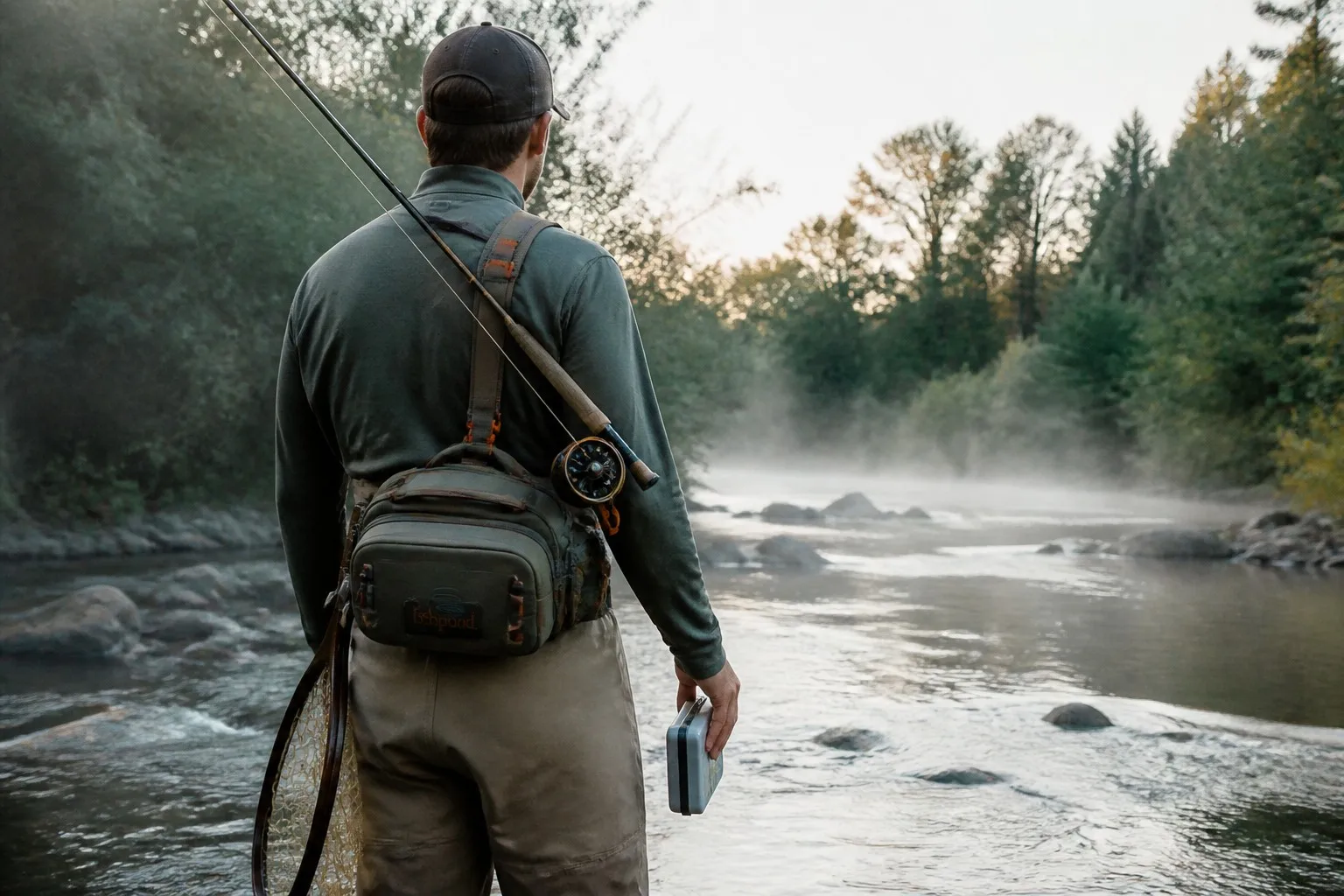
Front-access lumbar pack with integrated rod holder - hands-free access while wading
Part 3: Rod Holder Integration - Structural Synergy, Not Afterthought
A rod holder pack integrates a rod-carrying solution directly into the pack body rather than treating it as a clip-on accessory. This matters more than most buyers realize because the rod holder experiences dynamic loads that are fundamentally different from the static load of stored gear.
When an angler walks with a rod secured in a lumbar-mounted holder, the rod acts as a long lever arm extending 2.7–3.6 meters above the attachment point. Any lateral movement of the hips - and there is plenty during wading - translates into a whip-like oscillation at the rod tip. The peak force at the holder attachment point can spike to 3–4× the static weight of the rod during a stumble or a step into a deeper pocket of water.
Detachable Rod Butt Cradle
The most robust integration uses a detachable rod butt cradle - a molded TPU or reinforced nylon cup that holds the rod handle, paired with an upper retention strap or magnetic clasp positioned 200–250 mm above the cradle. The cradle is typically mounted on a webbing rail sewn into the pack's side panel, allowing vertical adjustment to accommodate different rod lengths and angler heights.
The key engineering detail is load path management. The cradle's mounting point must transfer force into the pack's structural frame - ideally into the internal HDPE stiffener sheet that spans the rear panel - rather than into the fabric alone. Without this load path, repeated dynamic loading fatigues the stitching at the attachment point. The failure mode is progressive: first the bartack stitches elongate, then the fabric around them abrades, and finally the cradle pulls free - usually at the worst possible moment, with a $900 rod heading toward the river bottom.
Magnetic Quick-Attach Systems
A more recent development in the ergonomic fishing gear space is the magnetic quick-attach rod holder. This uses a pair of rare-earth neodymium magnets (N52 grade, typically 12–15 mm diameter) encapsulated in injection-molded housings: one mounted on the pack's shoulder strap or upper belt wing, the other on a ferrous plate affixed to the rod blank.
The advantage is speed - the rod snaps into and out of the holder in a fraction of a second, enabling the kind of rapid rod-switching that Euro nymphing and streamer fishing demand. The trade-off is holding force: a well-designed magnetic system provides 4–6 kg of static pull force, which is adequate for walking but insufficient if the angler trips and the rod experiences a high-acceleration event. Because of this, magnetic systems are typically deployed as a "parking" solution - holding the rod during brief hand-free moments - rather than as a primary transport mechanism. The best OEM designs pair a magnetic quick-attach with a secondary mechanical retention loop for longer walks between pools.
Structural Synergy: The Pack as a Stiffening Element
There is a fascinating secondary benefit to rod holder integration that is rarely discussed in product marketing but well understood by experienced pack designers. When a rod holder is rigidly mounted to a lumbar pack that itself contains a stiffening frame sheet, the assembly acts as a composite structure. The pack body becomes a de facto gusset plate, distributing the rod's lever-arm forces across a wider area of the angler's body. This is the same principle that makes a bridge truss stronger than the sum of its individual members. In practical terms, it means the angler feels less rod "wobble" during hiking and can navigate tighter brush without the rod tip catching on overhead branches.
Part 4: Waterproofing - Grading the Immersion Threat
Water exposure in fishing is not binary - it exists on a spectrum. A fishing lumbar pack designed for a dry-land bank angler faces fundamentally different moisture challenges than one built for a saltwater flats wader who routinely stands chest-deep. B2B buyers evaluating OEM product lines need to understand this grading to match the product specification to the end-user profile.
| Tier | Rating | Closure | Construction | Target User |
|---|---|---|---|---|
| Tier 1 | IPX4 (Splash-Resistant) | AquaGuard zipper | PU-coated 210D/420D nylon, seam-taped | Freshwater bank & thigh-deep wading |
| Tier 2 | IPX6 (Momentary Submersion) | Roll-top main + waterproof zip pockets | TPU-coated nylon, hybrid construction | Deep wading & sustained rain |
| Tier 3 | IPX7/IPX8 (Full Submersible) | Dry-bag roll-top with stiffening bar | HF-welded 500D TPU laminate, zero needle holes | Saltwater flats & surf casting guides |
Tier 1: Splash-Resistant (IPX4 Equivalent)
For the majority of freshwater anglers who wade no deeper than thigh height, splash resistance is adequate. This tier uses PU-coated fabric (typically 210D or 420D nylon with a 1500–2000 mm hydrostatic head rating) paired with YKK AquaGuard or reverse-coil zippers. The zipper itself is not fully waterproof - water can penetrate under sustained pressure - but the PU coating sheds splashes, drizzle, and incidental submersion of less than 2–3 seconds.
The weak point in Tier 1 designs is almost always the seam. Standard lockstitch seams wick water through the needle holes via capillary action. A competent Tier 1 build addresses this with seam taping - applying a 20 mm-wide TPU tape over every exterior seam and heat-pressing it at 170–190°C to bond with the fabric's PU coating. This process adds roughly $0.80–$1.20 per unit but eliminates the most common water-ingress pathway.
Tier 2: Roll-Top Closure (IPX6 Equivalent)
For anglers who routinely wade deep or fish in sustained rain, the roll-top closure becomes the standard. A roll-top main compartment uses a fabric extension at the opening that is folded over 3–4 times and secured with a side-release buckle at each end. When properly closed, this creates a labyrinth seal that is effectively waterproof against full momentary submersion - think a stumble that briefly dips the pack underwater.
The trade-off is access speed. A roll-top takes 6–10 seconds to open and close, versus 2–3 seconds for a zippered lid. This is why high-end designs often employ a hybrid approach: roll-top on the main compartment (where bulk storage lives and access frequency is lower) and waterproof zippers on the quick-access pockets (where speed matters).
Tier 3: Full-Submersible (IPX7/IPX8)
At the top end, fully submersible packs use RF-welded or high-frequency welded construction with 500D TPU-laminated fabric. There are no needle holes - panels are bonded at the molecular level using radio-frequency energy that melts the TPU layers together. The closure is a true dry-bag style roll-top with a stiffening bar at the fold line to ensure a uniform seal.
These packs are overkill for 90% of freshwater fishing scenarios. They are heavier, more expensive (BOM cost roughly 2.5–3× a Tier 1 pack), and slower to access. But for saltwater flats guides and surf casters who operate in waist-deep water for hours at a time, they are non-negotiable. The B2B insight: stock Tier 1 as the volume SKU, Tier 2 as the premium freshwater option, and Tier 3 as a low-volume halo product that signals technical credibility.
Part 5: Material Selection - The TPU-Nylon / Mesh Equation
The material palette for a modern waist fishing pack is defined by a tension between two opposing requirements: abrasion resistance and breathability.
The Shell: Lightweight TPU-Coated Nylon
The dominant shell material across mid-to-high-end lumbar packs is 210D or 420D nylon 6,6 with a 0.15–0.20 mm TPU coating on the face side. Why nylon 6,6 rather than polyester? Two reasons. First, nylon's elongation at break is roughly 25–40% versus polyester's 15–20% - meaning nylon can absorb the repeated stress cycles of pack rotation and rod-holder loading without developing micro-tears at the stitch lines. Second, nylon has a lower coefficient of friction when wet, which reduces abrasion from the constant rubbing of wading belt buckles and net handles against the pack body.
The TPU coating serves a dual purpose. Its primary function is waterproofing (see Part 4), but it also provides significant abrasion protection. Uncoated 210D nylon has a Martindale abrasion rating of roughly 15,000–20,000 cycles before visible wear; a 0.15 mm TPU coating pushes that to 35,000–50,000 cycles. For a product that routinely contacts rocks, branches, and sandy wet-wading boots, this is a meaningful durability multiplier.
A note on denier: there is a persistent assumption that higher denier equals better quality. This is reductive. 1000D Cordura is indestructible - and weighs nearly twice as much as 420D, with a stiffness that interferes with the pack's ability to conform to the lumbar curve. For a product category where weight on the hips is the primary design constraint, material specification is about finding the minimum denier that meets the durability requirement, not the maximum the factory can source.
The Back Panel: Breathable Mesh as a Functional Layer
The back panel - the surface that contacts the angler's lower back - requires a fundamentally different material strategy. Here, the priority shifts from abrasion resistance to moisture management and thermal comfort.
The industry-standard solution is a 3D spacer mesh: a warp-knitted polyester sandwich with a monofilament core layer connecting two fabric faces. The core layer maintains a 3–4 mm air gap between the body and the pack, creating a continuous convection channel. When the angler walks, the natural bellows action of the pack moving against the body pumps air through this channel, carrying away perspiration vapor.
The outer face of the spacer mesh (facing the pack body) typically uses a tighter knit with smaller pores to resist debris ingress, while the inner face (against the body) uses a larger-pore structure for maximum airflow. This asymmetry is one of those details that end users don't consciously notice but that determines whether the pack is wearable for 2 hours or 8 hours in 32°C heat.
The Combination Logic
The seam between the TPU-coated shell and the breathable mesh back panel is the critical interface - and a common failure point. Because the two materials have different stretch characteristics (nylon elongates roughly 3–5% under typical load; spacer mesh compresses rather than stretches), the seam must accommodate differential movement. The standard approach is a floating seam: the shell and mesh are joined with a 2–3 mm rolled edge using a 4-thread overlock stitch that allows independent movement of each panel without transferring tension to the stitch line. Skipping this detail - using a flat lockstitch, for example - produces a pack that looks fine on a retail shelf but develops seam puckering after 20–30 hours of field use.
Factory Profile: GAF Outdoor - Precision Sewing Meets HF Welding
For importers and brand owners evaluating OEM partners for a fishing lumbar pack product line, factory selection determines not just unit cost but the ceiling on achievable design quality. Guangzhou GAF Outdoor, established in 2011, has spent over a decade specializing in compact technical gear - the category of products where small dimensional errors produce large functional failures.
Core Manufacturing Competencies
GAF Outdoor's production floor is organized around two distinct but complementary processes: precision sewing and high-frequency (HF) welding.
On the sewing side, the facility runs a fleet of Juki DDL-9000C series single-needle lockstitch machines for structural seams, complemented by Pegasus W600 series overlock machines for edge finishing and flat-seam construction. These are not specialty machines - they are the standard workhorses of the soft-goods industry. What matters is the production engineering around them: GAF uses laser-cut fabric panels (tolerances of ±0.5 mm versus ±2 mm for manual cutting), which ensures that seam allowances are consistent across production runs. Inconsistent seam allowance is the hidden enemy of waterproofing - a seam that wanders 1 mm outside the taped zone becomes a leak path that may not be caught in final QC.
On the welding side, the facility operates HF welding stations capable of bonding TPU-laminated fabrics without needle penetration. This is the process that produces fully submersible compartments (Tier 3 waterproofing as described in Part 4). HF welding is a specialized competency - it requires precise control of RF power output, dwell time, and electrode pressure, all of which vary by material thickness and TPU formulation. GAF's investment in this capability means the same factory can produce a $18 FOB splash-resistant pack and a $42 FOB full-submersible pack on adjacent production lines, giving brand buyers a single-source solution across product tiers.
Small-Part Precision
What distinguishes GAF in the lumbar pack category specifically is their handling of small precision components: injection-molded belt adjusters, magnetic Fidlock closure hardware, detent-track sliders for rotate-to-access systems, and TPU rod butt cradles. These are components with tolerances in the 0.1–0.3 mm range - errors that are invisible on a production sample but that accumulate into functional failures (binding tracks, misaligned magnetic closures, cracking under dynamic load) over the product's service life.
GAF's QC protocol for incoming small parts includes a 5% AQL 2.5 sampling inspection with go/no-go gauge verification for all mechanical interfaces - belt buckle tongues, track sliders, magnetic housing alignment. This is a level of incoming inspection that is atypical at the $15–25 FOB price point and reflects the factory's strategic focus on reliability over raw output volume.
B2B Strategy: The Lumbar Pack as an Entry-Point, High-Repurchase Category
From a category management perspective, the fishing lumbar pack occupies a strategically valuable position in any fishing accessories product line. It functions as an entry-point product - typically retailing at $35–$79, which is accessible enough to capture first-time buyers and impulse purchasers - while delivering a high repurchase rate driven by two structural factors.
Factor 1: Gear Ecosystem Expansion
A lumbar pack is rarely a standalone purchase. The angler who buys a waist pack this season will, within 12–18 months, need compatible accessories: a waterproof fly box that fits the pack's internal dimensions, a tippet holder that mounts to the belt webbing, a net release that clips to the D-ring. This creates a natural upsell pathway. A brand that designs its lumbar pack with a deliberate accessory ecosystem - standardized MOLLE/PALS webbing spacing, consistent D-ring sizing, documented internal compartment dimensions - captures not just the initial pack sale but a stream of follow-on purchases. For B2B buyers, this means the first-year margin on the pack can be thin if it pulls through higher-margin accessory sales in years two and three.
Factor 2: Wear-Part Replacement Cycle
Unlike a fly rod or a reel - which can serve an angler for a decade - a fabric pack is a wear part. The average field lifespan of a fishing lumbar pack in regular use (40–60 days per year) is 2–4 years. Abrasion from wading belts, UV degradation of nylon fibers, zipper wear from sand and silt ingress, and loss of waterproofing as seam tape delaminates all contribute to a predictable replacement cycle. This makes the lumbar pack one of the few categories in fishing gear with a genuine consumable profile - closer to waders and fly lines than to hard goods.
Positioning for Different Channels
The category supports a clean good-better-best segmentation strategy:
Entry ($35–$49 retail): Tier 1 waterproofing, 210D PU-coated shell, basic webbing-loop rotation system, no rod holder. Target: big-box retail and Amazon, where price-point visibility drives volume.
Mid ($55–$79 retail): Tier 2 hybrid waterproofing (roll-top main + waterproof zip pockets), 420D TPU shell, sliding-track rotation, integrated rod cradle. Target: specialty fishing retail and brand DTC, where margin and differentiation matter.
Premium ($89–$129 retail): Tier 3 HF-welded construction, magnetic quick-attach rod holder, full accessory ecosystem compatibility, limited lifetime warranty. Target: flagship brand positioning - low volume but high perceived value that lifts the entire line.
For importers, the key B2B insight is this: the middle tier delivers the best margin-to-volume ratio because the BOM differential between entry and mid-tier is roughly $4–$7 FOB, while the retail price delta is $20–$30. A factory partner like GAF Outdoor that can span all three tiers from a single production base allows the brand to cover the full market without managing three separate supplier relationships.
Conclusion
The fishing lumbar pack category is undergoing a quiet but significant transformation. What began as a simple fanny-pack adaptation has evolved into a technically sophisticated piece of ergonomic fishing gear - one that demands competence in load biomechanics, precision injection molding, RF welding, and textile engineering. The brands that win share in this category over the next five years will be those that treat the lumbar pack not as a commodity SKU but as a platform product: an engineered system that solves genuine angler problems while creating a sticky accessory ecosystem.
For B2B buyers, the opportunity is clear. Find a manufacturing partner with demonstrated capability in both precision sewing and HF welding. Demand physical proof of tolerance control on mechanical interfaces. And build a product line segmented by waterproofing tier and ergonomic feature set - with the mid-tier as the volume engine.
The factory exists. The technology is mature. The market is growing. What remains is execution.
For inquiries about OEM fishing lumbar pack manufacturing, including custom rotate-to-access systems and integrated rod holder solutions, contact GAF Outdoor's B2B sales team.


