

Introduction: The Three Pillars of Bow Hunting Bag Engineering
In the high-stakes world of archery hunting, the margin for error is measured in centimeters and decibels. Unlike rifle hunters who can engage targets from hundreds of yards away, a bow hunter must often close the distance to within 40 yards-or even 20 yards-to ensure an ethical and effective shot. At this range, the hunter's equipment becomes as much of a liability as an asset if not designed with extreme precision.
Traditional tactical or hiking backpacks, while durable, are fundamentally ill-equipped for the specific demands of the bow hunter. A standard Cordura pack might be rugged, but the "swish-swish" of nylon against a rogue branch sounds like a thunderclap to a whitetail deer. A general-purpose lash system might hold a bow, but it fails to protect the sensitive cams and limbs of a $1,500 compound bow from the jarring impacts of a mountain ascent.
For B2B buyers and outdoor equipment brands, understanding the technical intersection of Silent Fabric Access, Limb Protection Architecture, and Treestand Compatibility is essential. This article deconstructs the engineering requirements that separate a generic "camo bag" from a professional-grade bow hunting backpack, and why manufacturers like GAF Outdoor are leading the shift toward specialized archery carry systems.
Technical Part 1: The Physics of Silence – Brushed Tricot and Acoustic Dampening
The most critical requirement of a bow hunting backpack is acoustic stealth. In the woods, "silent" is not a marketing buzzword; it is a measurable decibel threshold.
The Problem with Standard Synthetics
Standard high-denier nylon (like 500D or 1000D Cordura) is favored in the tactical industry for its abrasion resistance. However, nylon fibers are relatively stiff and smooth. When these fibers rub against each other, or when the pack brushes against dry oak leaves or pine branches, they generate high-frequency friction noise. In laboratory tests, standard nylon friction can spike above 60-70dB-well within the hearing range of a wary buck.
The Brushed Tricot Solution
The industry standard for high-end bow hunting packs is Brushed Tricot fabric. Tricot is a warp-knit fabric that provides a unique blend of stretch and durability. The "brushing" process involves mechanically raising the fibers on the surface of the fabric to create a soft, nap-like texture (similar to fleece but with the structural integrity of a knit).
Acoustic Principle: The raised micro-fibers of brushed tricot act as an acoustic absorber. Instead of two flat surfaces sliding against each other and creating a sharp sound, the soft fibers interlock and deform, absorbing the energy of the friction. When a brushed tricot backpack scrapes against a branch, the sound output is typically less than 40dB, effectively blending into the ambient forest floor noise.
Silent Access Hardware
Silence must extend to the hardware. B2B product developers are increasingly moving away from traditional Velcro (hook-and-loop), which is notoriously loud. In its place, modern designs utilize:
Magnetic Closures: Silent, one-handed operation for lids and pockets.
Toggle and Loop Systems: Utilizing bungee cord and plastic toggles to secure gear without the "zip" of a zipper.
Silent Zipper Pulls: Replacing metal tabs with heat-shrink-wrapped paracord to prevent "clinking" sounds during movement.
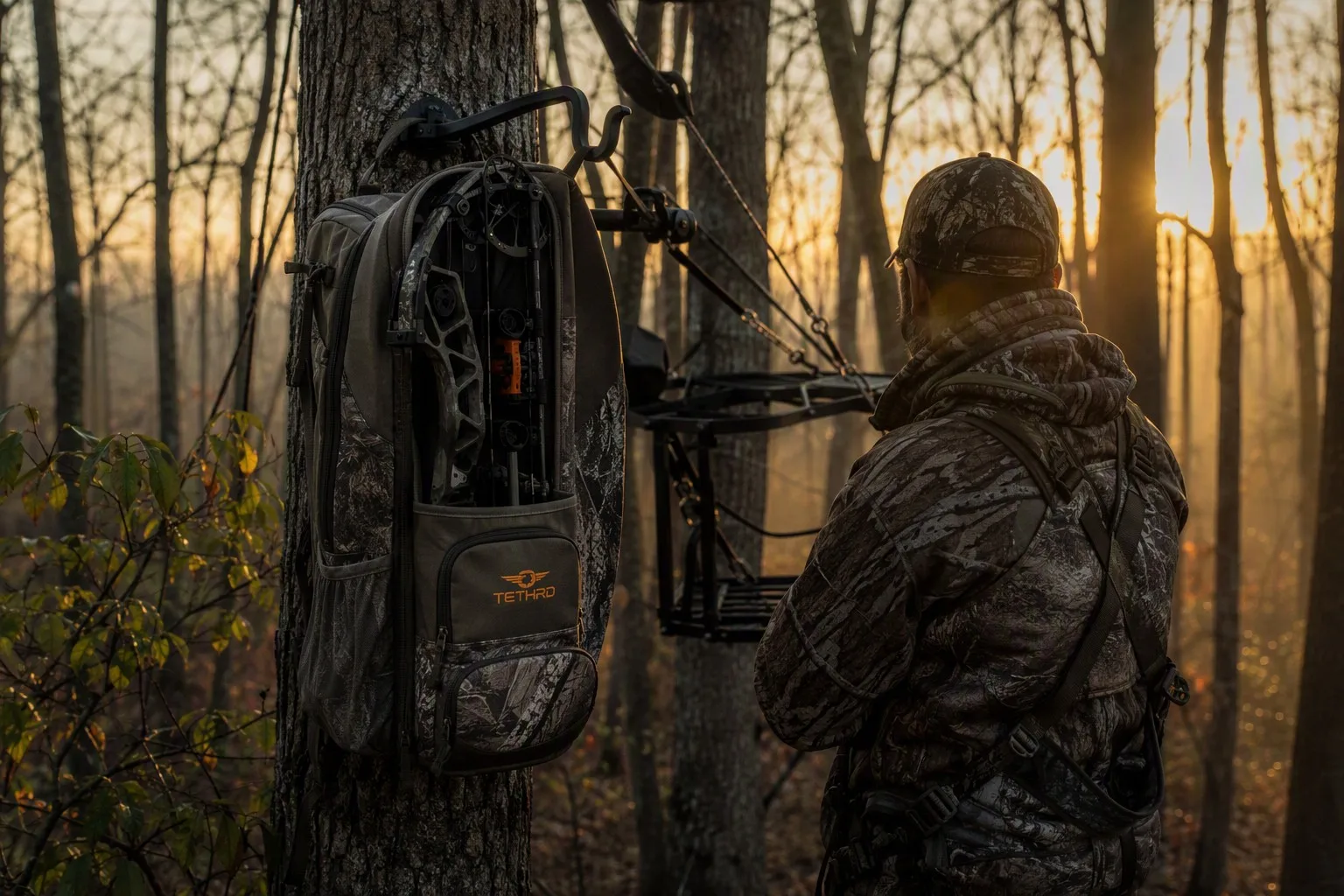
Silent fabric access in action - brushed tricot absorbs friction noise while the bow rides protected
Technical Part 2: Limb Protection Architecture – Safeguarding the Archery Investment
A bow is a precision instrument. The cams, limbs, and strings of a modern compound bow are susceptible to damage from grit, impact, and torque. A bow holder backpack must do more than just "carry"; it must act as a mobile exoskeleton.
The EVA Foam Buffer System
The core of the limb protection system lies in the integration of high-density EVA (Ethylene-Vinyl Acetate) foam. Unlike the soft open-cell foam used in cheap padding, high-density EVA provides structural memory and superior shock absorption.
Limb Pockets: The bottom of the pack should feature reinforced, EVA-lined pockets that cradle the lower limb/cam assembly. This prevents the bow from shifting vertically during a hike.
Grooved Positioning: Advanced designs incorporate molded grooves within the EVA padding. These grooves "lock" the limbs into place, neutralizing the pendulum effect that occurs when a hunter is traversing steep terrain.
Sight and Cam Protection
The most vulnerable parts of a bow are the sight pins and the cams. A professional bow hunting backpack often includes integrated sight shrouds-a dedicated, padded flap or rigid shell that covers the sight housing to prevent pins from being bent by brush. Furthermore, full-wrap cam covers ensure that the "engine" of the bow is kept off the ground when the pack is set down.
Compound vs. Recurve Storage Logic
From a manufacturing perspective, the geometry for a Compound Bow (compact, heavy, high-tension) differs significantly from a Recurve or Traditional Bow (long, awkward limbs). Compound packs focus on center-of-gravity management, keeping the weight tight against the hunter's spine, while Recurve packs often require longer, external scabbard-style attachments to maintain balance.
Technical Part 3: Treestand Compatibility – Ergonomics at 20 Feet Up
Treestand hunting introduces a unique set of constraints: the "vertical workspace." When a hunter is 20 feet in the air on a small platform, they cannot easily reach into the bottom of a backpack.
The "Drop-Zone" Requirement
The pack must be designed as a "bucket" or have a full-face zipper that allows the hunter to access every piece of gear from the top while the pack is hanging. A lightweight internal frame (often HDPE or aluminum) keeps the pack's shape under the tension of being hung from a tree hook, ensuring zippers remain easy to operate.
The Hanging System
B2B buyers should look for heavy-duty integrated hanging loops. Standard haul loops are often not reinforced enough to hold a 20lb pack plus a 5lb bow for 8 hours. Reinforced daisy chains or dedicated Hypalon-reinforced loops allow the hunter to secure the pack to a "tree screw" or "bow hanger" with absolute confidence.
Material & Hardware: The Durability vs. Stealth Matrix
Selecting materials for a bow hunting backpack is a balancing act. You need the silence of a soft fabric but the durability of a tactical bag.
Hypalon Reinforcements: In areas where the bow's sharp edges (like broadheads or stabilizers) touch the pack, GAF Outdoor utilizes Hypalon for its indestructible nature and non-slip surface.
YKK Silent Sliders: Specialized "silent" sliders are preferred, designed with tighter tolerances to prevent the metal-on-metal rattle common in cheaper hardware.
DWR Coatings: Since brushed tricot is a knit, a high-quality C6 DWR treatment is essential to ensure the pack sheds water without compromising the fabric's quiet hand-feel.
Factory Profile: GAF Outdoor – Precision Manufacturing in Guangzhou
Since 2011, Guangzhou GAF Outdoor has established itself as a premier OEM/ODM partner for the world's leading hunting brands. Based in the heart of China's manufacturing hub, GAF Outdoor bridges the gap between technical innovation and scalable production.
What sets GAF apart is their ability to customize fabric at the yarn level. They don't just buy "camo fabric" off the shelf. They work with B2B clients to develop proprietary Brushed Tricot blends that meet specific weight, noise, and infrared (IR) reflectivity requirements. Furthermore, they utilize computerized bar-tacking and reinforced box-stitching at all critical stress points, ensuring long-term durability under heavy archery loads.
B2B Strategy: Navigating the North American Bow Hunting Market
For distributors and retailers, the bow hunting backpack is a high-margin, "sticky" product. The North American archery season typically opens in September, but the B2B procurement cycle begins in Q1/Q2 with design finalization and prototyping.
Successful brands in this space focus on Specialty Archery Retailers. A backpack that demonstrates technical limb protection and treestand-specific features will always outperform a generic camo pack in a pro-shop setting, where serious hunters look for expert gear advice.
Conclusion: The Evolution of the Archery Carry System
As archery technology advances, the backpacks that carry them must evolve in parallel. The modern bow hunting backpack is no longer a simple container; it is a piece of technical equipment designed to facilitate stealth and protect a precision instrument.
By focusing on the science of Brushed Tricot, the structural integrity of EVA limb buffers, and the ergonomic reality of the treestand, brands can offer products that truly solve the hunter's problems. With a manufacturing partner like GAF Outdoor, B2B clients have the technical support needed to bring these sophisticated designs to the global market.


