Introduction
When a distributor opens a supplier catalog and finds two 4-liter waist packs listed side by side, the immediate reaction is rarely excitement. It is suspicion: what is the actual difference, and why should we stock both? If the capacity is identical and the waterproof construction works on the same principle, then "two models" can look like one model with a color change.
This comparison exists to resolve exactly that question before you commit to a sample round or a season of inventory. The 906-024 and the 906-025 are both 4L hip packs built with RF high-frequency welding. Both close their main compartment with an IPX7-rated zipper, both protect a waterproof front pocket with an IPX4-rated zipper, and both build their frame around a MOLLE system and a hip belt. Where they diverge is in everything around those shared elements: the face fabric (420D nylon double TPU on the 906-024; 600D polyester with TPU lamination on the 906-025), the unit weight (0.28 kg versus 0.45 kg), the external profile, the back padding (mesh versus EVA), and a set of structural features that places the two models in clearly different end-user roles.
The stakes are commercial as much as technical. A 4L hip pack is a repeat-purchase category that lives or dies on fit to the end user's lifestyle. The rest of this article breaks the two models down piece by piece, then maps them to selection decisions and to the customization paths available to brand owners and distributors.
Technical Part 1 - What "4L" Actually Carries in the Field
Before touching a single line of the spec sheet, it is worth anchoring what 4 liters means for a hip pack, because the category logic changes once you understand the load envelope.
A 4L waist pack is a mission-carry volume. Realistically, the interior absorbs the small, high-frequency items of a working day: a 0.5L soft squeeze bottle, a phone and a compact power bank, a slim first-aid pouch, energy bars, hand warmers, earplugs, a small range finder, wallet, keys, and a folded micro-towel. What it does not absorb is a day's total kit. Anyone spec'ing a 4L pack for a customer should sell it for what it does, not against what it does not: it is the layer that keeps essentials on the hip while the hands do the work.
The construction logic is the same on both models. The main body is built with RF high-frequency welding, which seals the fabric seams as continuous welded joints rather than stitched lines. In wetland conditions - a marsh blind, a kayak launch, an all-day rain front - that matters, because a welded body has no needle holes to wick water into the interior. The openings are where the protection story gets specific, and this is exactly where the two models share their architecture: an IPX7-rated zipper on the main compartment, and an IPX4-rated zipper on the waterproof front pocket. Those ratings describe the zippers as closure components, and they are the two points you should build your own acceptance testing around.
In hunting use, the 4L hip pack is usually worn through long, static sits. The hip belt carries the load off the shoulders, and the back panel stays in contact with the body for hours. That is where the padding choice between the two models - mesh on the 906-024, EVA on the 906-025 - becomes a felt difference rather than a spec-sheet footnote.
For assortment planning, the key point of this section is simple: two 4L models in one line are only rational if they serve different wearers. Capacity does not differentiate them. Part 2 shows what does.
Technical Part 2 - The Differences, Item by Item
Face fabric
906-024: 420D nylon double TPU.
906-025: 600D polyester with TPU lamination.
Two separate variables are moving here: fiber type and denier. Nylon and polyester are both standard workhorses for outdoor shell fabrics, and industry convention treats them differently - nylon generally offers a softer, more supple hand, while polyester is typically favored for abrasion resistance and dimensional stability. Denier adds a second axis: 600D is a higher denier face than 420D, which conventionally corresponds to a denser, more abrasion-tolerant surface. Keep both variables in mind when you write product descriptions: the 906-024 is the 420D nylon double TPU pack, and the 906-025 is the 600D polyester TPU-laminated pack. Mixing those two fabric call-outs between the models is the most common documentation error from buyers who stock both.
Unit weight
906-024: 0.28 kg
906-025: 0.45 kg
That is a 0.17 kg difference on a pack that is worn, not carried, and it lands in two places for a B2B buyer. First, on the wearer: for users who wear the hip pack all day on top of other gear, unit weight is a real share of the total load budget. Second, on the logistics line: unit weight scales directly into the weight of a full shipment, so the two models will behave differently inside a container even at identical carton counts. We present the difference as a selection input. If the split matters to your end users, the right step is to order both samples and run your own loadout test.
Dimensions and profile
906-024: 10 in / 26 cm wide, 7.9 in high. The third dimension is not published; confirm it on the sample before you finalize hang-tag copy.
906-025: 8.7 in / 22 cm wide × 7.5 in / 19 cm high × 3.9 in / 10 cm deep.
The 906-024 presents a wider front face - 10 inches against 8.7 - and a taller profile at 7.9 inches. The 906-025 is a defined three-dimensional box, and its published 3.9 in / 10 cm thickness is useful for two things: merchandising (a boxier unit photographs and shelves differently from a wide, low one) and accessory planning (the stated depth tells you what fits in the front pocket with a margin).
Back padding
906-024: mesh back padding.
906-025: EVA padding.
Mesh is a breathable, soft contact surface; EVA is a structured foam that holds its shape under compression. Which one a given market prefers is a positioning decision: mesh reads as "ventilation and lightness," EVA reads as "structured support." Neither is objectively better for a 4L hip pack - both are appropriate - but your end users will have opinions, and your product copy should name the material honestly.
Pockets, MOLLE, and webbing work
Both models carry a waterproof front pocket and a MOLLE system, but the layout is not identical.
906-024
Waterproof front pocket
Loop MOLLE panel on the front with four webbing loop positions
MOLLE system
Hip belt
X-stitch reinforcement at the webbing ends
The X-stitching at the webbing terminations is a durability detail worth calling out in your documentation: it reinforces exactly the point where accessory loads concentrate. For buyers who sell the 906-024 to users who clip pouches, holsters, or small bags onto the front panel, this is the kind of detail that supports a stronger position in end-user copy.
906-025
Waterproof front pocket
MOLLE system with front webbing loop positions plus side MOLLE
Back zip pocket
Top carry handle
Hip belt
The side MOLLE extends the attachment surface beyond the front face, and the back zip pocket adds a compartment that sits against the wearer's back - useful for items that should be out of the way but still accessible. The top carry handle gives the pack a second transport mode, which matters for boat and kayak users who move the pack between the launch, the water, and the blind.
Removable fishing rod holder
The single most visible structural difference is the removable fishing rod holder, which the 906-025 carries and the 906-024 does not. For angler-focused markets - kayak fishing, bank fishing, wading - the holder converts the hip pack from a carry pack into a carry pack plus rod stowage without a second product in the line. Because the holder is removable, the same base pack serves users who do not fish: the holder is simply not fitted, and the front and side MOLLE remain available for other accessories.
For a 906-024 buyer targeting the same angler segment, the answer is the front loop MOLLE panel: rod or pole stowage can be addressed with a compatible accessory on the four-loop panel rather than an integrated holder. That is a legitimate route - but it is a route, not a feature, and your marketing copy should reflect the difference.
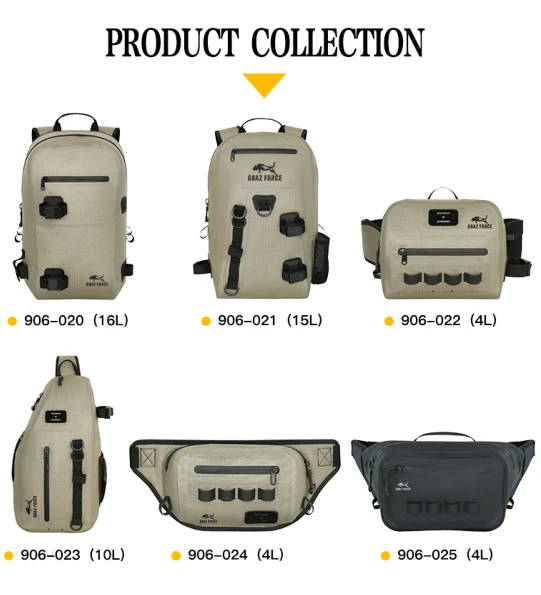
The 906 line at a glance - the two 4L hip packs compared here sit at bottom centre and bottom right
Technical Part 3 - Selection Decisions and the Customization Path
Who the 906-024 is for
Stock the 906-024 when your end-user profile matches most of the following:
The pack will be worn all day, and the total on-body weight budget is tight - 0.28 kg is the lighter anchor in the pair.
The market is general hunting, outdoor, trail, or active-urban rather than fishing-specific.
You want a wider 10 in / 26 cm front face with a clean four-loop MOLLE panel as the accessory interface.
Your product story emphasizes mesh back padding and a lightweight build.
Who the 906-025 is for
Stock the 906-025 when your end-user profile matches most of the following:
Fishing is a core part of the target lifestyle, and the removable rod holder should be a headline feature.
A structured EVA back, a back zip pocket, and a top carry handle should appear in the feature list.
You want MOLLE access on the front and the sides, not only the front.
A 600D polyester TPU-laminated face fits the abrasion-resistance story you want to tell.
A boxier, fully specified 3D profile (8.7 × 7.5 × 3.9 in / 22 × 19 × 10 cm) is useful for your merchandising.
Carrying both
Because both models are 4L and both share the same closure architecture - an IPX7-rated main compartment zipper and an IPX4-rated front pocket zipper - they slot cleanly into the same shelf category and can be merchandised as one family with two roles: the 906-024 as the lightweight all-rounder, the 906-025 as the utility and fishing specialist. The shared zipper ratings also keep spare-parts planning and end-user care instructions simple: one story for the main closure, one story for the front pocket closure, across the whole line.
How customization actually runs
Both models support full-range customization across four dimensions: fabric, webbing, buckles, and style. In practice, a customization round runs in this order:
End-use brief. Describe the market, the typical wearer, and the conditions the pack must handle. This determines which base model is the correct starting point.
Fabric. Start from the base face fabric of the chosen model - 420D nylon double TPU on the 906-024, 600D polyester with TPU lamination on the 906-025 - or select an alternative from your reference materials.
Webbing and buckles. Specify webbing color and buckle types to match your brand system and fit requirements.
Style. Adjust the shape, pocket layout, and accessory configuration to your specification, within the structure of the base model.
Sampling and acceptance. Samples are produced against the locked specification; your acceptance criteria - including your own closure and water tests at the specified IPX levels - are applied before a production commitment.
Two documentation rules that keep this process clean: never swap the fabric call-outs between the models, and never describe the IPX ratings as a whole-pack rating. Your spec sheet should read "main compartment zipper IPX7; front pocket zipper IPX4" - for both models, identically.
Conclusion
The 906-024 and the 906-025 answer the same brief - a 4L, RF-welded, waterproof hip pack with a MOLLE frame, a hip belt, an IPX7-rated main zipper, and an IPX4-rated front pocket zipper - and then they diverge in exactly the places a buyer can act on. The 906-024 is the 0.28 kg, 420D nylon double TPU model: wider, with a four-loop front MOLLE panel, mesh back padding, and X-stitch webbing reinforcement. The 906-025 is the 0.45 kg, 600D polyester TPU-laminated model: a fully specified boxy profile, side MOLLE, a back zip pocket, a top carry handle, EVA padding, and a removable fishing rod holder.
For a B2B buyer, the decision is not "which 4L pack is better." It is "which 4L pack matches the wearer I am selling to." If your market splits into a general outdoor segment and a fishing segment, the answer is both models, positioned by role and customized along the fabric, webbing, buckle, and style dimensions. Order samples, run your own acceptance tests, and keep the closure ratings exactly where they belong - on the zippers, not on the pack.
FAQ
Q1: Both models are 4 liters. Why does one weigh 0.28 kg and the other 0.45 kg?
The published unit weights are 0.28 kg for the 906-024 and 0.45 kg for the 906-025, and we treat that difference as a selection input rather than something to speculate about. It affects two real things: the total weight on the wearer for all-day use, and the weight of a full shipment at identical carton counts. If the difference is decision-critical for your market, order both samples and weigh them with your typical loadout. That measured data will tell you more than any description can.
Q2: The main compartment zipper is rated IPX7. Does that mean I can submerge the whole pack?
No. The IPX7 rating describes the main compartment zipper as a closure component. The front pocket zipper is rated IPX4, and that rating belongs to that zipper only. We do not rate the complete pack as a submersible unit, and we do not quote any submersion time or depth for either model. The bodies are RF-welded - the seams are sealed welded joints rather than stitched lines - but the correct language for your product documentation is: main compartment zipper IPX7; front pocket zipper IPX4. Build your own acceptance tests around those two closure points, and write the pack's water performance claims from the results of your own testing.
Q3: What exactly can we customize on these two models?
Both models support full-range customization across four dimensions: fabric, webbing, buckles, and style. Fabric selection starts from the model's base face fabric - 420D nylon double TPU for the 906-024, 600D polyester with TPU lamination for the 906-025 - or from a reference you provide. Webbing and buckles follow your brand specification. Style covers shape, pocket layout, and accessory configuration within the structure of the base model. Bring your end-use brief and any reference materials, and each requirement gets mapped to a concrete change before anything is sampled.
Q4: Which model should we choose for a fishing or kayak line?
The 906-025 is the natural fit. It carries the removable fishing rod holder, which is the headline feature for an angler line, plus an EVA back panel, a back zip pocket, a top carry handle, and MOLLE on both the front and the sides. The 906-024 points at general hunting and outdoor users: 0.28 kg, a 10 in / 26 cm wide front face, mesh back padding, and a four-loop front MOLLE panel where rod stowage can be handled with a compatible accessory if the market needs it.